Mielke Eckehard W Mielke – författare
Visar alla böcker från författaren . Handla med fri frakt och snabb leverans.
2 produkter
2 produkter
E-bok
Engelska, 2022742 kr
Läs direkt efter köp
Today, Relativity is becoming an integrated aspect of engineering fields. Its application to the Global Positioning System (GPS), extends in usage from smart watches to the navigation of cars, airplanes (drones) and even autonomous tractors. In rather expensive particle accelerators, physicists are everyday ''playing'' with Relativistic Billiards, common to the betatrons of cancer therapy using electrons. Computer programs, such as ''ray tracing'' methods, are enhanced to simulate objects in relativistic motion, which now offer us relativistic visualizations of accretion disks around compact, astrophysical objects like Black Holes.Against the backdrop of the applications explained throughout the chapters, this book takes on a practical and intuitive approach in introducing the Lorentz invariance of light propagation and space-time concepts. The book begins with simple mathematics, like the classical Pythagoras formula for energy-momentum ''triangles''. Later, readers will find the intuitive vector calculus reemerging in the expansion of full relativistic expressions. Prepared with instructive diagrams of recent experiments, even the layperson can grasp the essential study of Relativity and marvel at its applications within this book.
E-bok
PDF, Engelska, 1995683 kr
Läs direkt efter köp
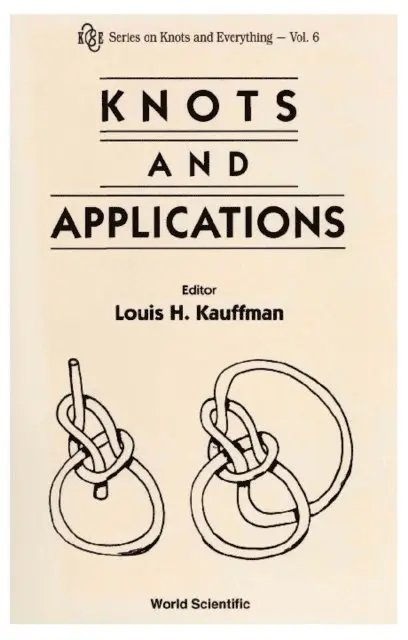
This volume is a collection of research papers devoted to the study of relationships between knot theory and the foundations of mathematics, physics, chemistry, biology and psychology. Included are reprints of the work of Lord Kelvin (Sir William Thomson) on the 19th century theory of vortex atoms, reprints of modern papers on knotted flux in physics and in fluid dynamics and knotted wormholes in general relativity. It also includes papers on Witten''s approach to knots via quantum field theory and applications of this approach to quantum gravity and the Ising model in three dimensions. Other papers discuss the topology of RNA folding in relation to invariants of graphs and Vassiliev invariants, the entanglement structures of polymers, the synthesis of molecular Mobius strips and knotted molecules. The book begins with an article on the applications of knot theory to the foundations of mathematics and ends with an article on topology and visual perception. This volume will be of immense interest to all workers interested in new possibilities in the uses of knots and knot theory.