Nam-Gyu Kang – författare
Visar alla böcker från författaren Nam-Gyu Kang. Handla med fri frakt och snabb leverans.
3 produkter
3 produkter
539 kr
Skickas inom 10-15 vardagar
Young-Hoon Kiem discusses classical enumerative geometry before string theory and improvements after string theory as well as some recent advances in quantum singularity theory, Donaldson–Thomas theory for Calabi–Yau 4-folds, and Vafa–Witten invariants.
539 kr
Skickas inom 10-15 vardagar
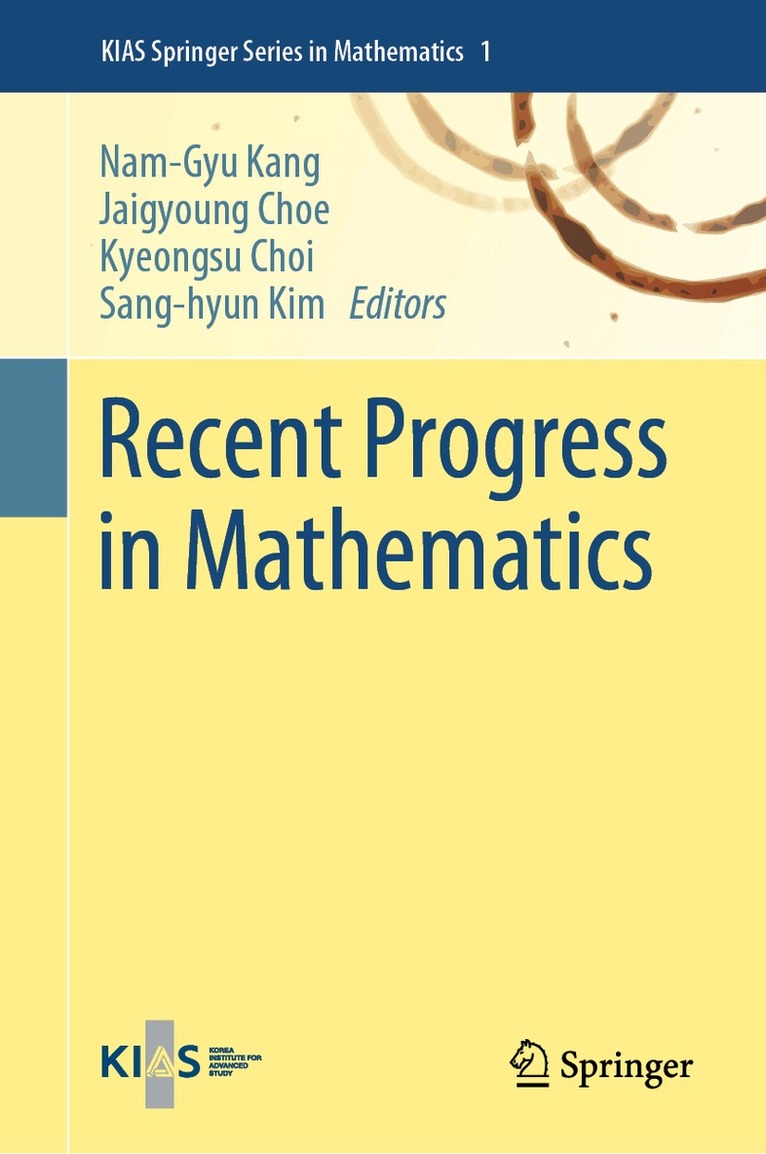
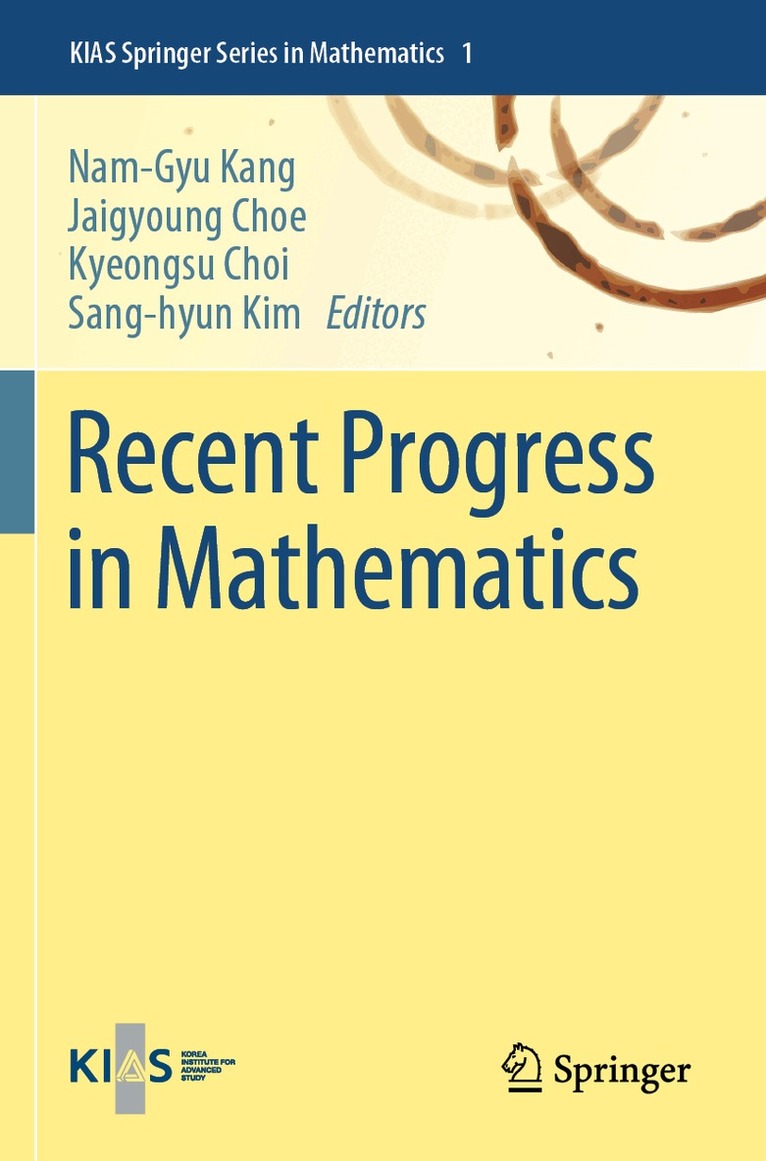
This book consists of five chapters presenting problems of current research in mathematics, with its history and development, current state, and possible future direction. Four of the chapters are expository in nature while one is based more directly on research. All deal with important areas of mathematics, however, such as algebraic geometry, topology, partial differential equations, Riemannian geometry, and harmonic analysis. This book is addressed to researchers who are interested in those subject areas. Young-Hoon Kiem discusses classical enumerative geometry before string theory and improvements after string theory as well as some recent advances in quantum singularity theory, Donaldson–Thomas theory for Calabi–Yau 4-folds, and Vafa–Witten invariants. Dongho Chae discusses the finite-time singularity problem for three-dimensional incompressible Euler equations. He presents Kato's classicallocal well-posedness results, Beale–Kato–Majda's blow-up criterion, and recent studies on the singularity problem for the 2D Boussinesq equations. Simon Brendle discusses recent developments that have led to a complete classification of all the singularity models in a three-dimensional Riemannian manifold. He gives an alternative proof of the classification of noncollapsed steady gradient Ricci solitons in dimension 3. Hyeonbae Kang reviews some of the developments in the Neumann–Poincare operator (NPO). His topics include visibility and invisibility via polarization tensors, the decay rate of eigenvalues and surface localization of plasmon, singular geometry and the essential spectrum, analysis of stress, and the structure of the elastic NPO.Danny Calegari provides an explicit description of the shift locus as a complex of spaces over a contractible building. He describes the pieces in terms of dynamically extended laminations and of certain explicit “discriminant-like” affine algebraic varieties.
Del 5 - KIAS Springer Series in Mathematics
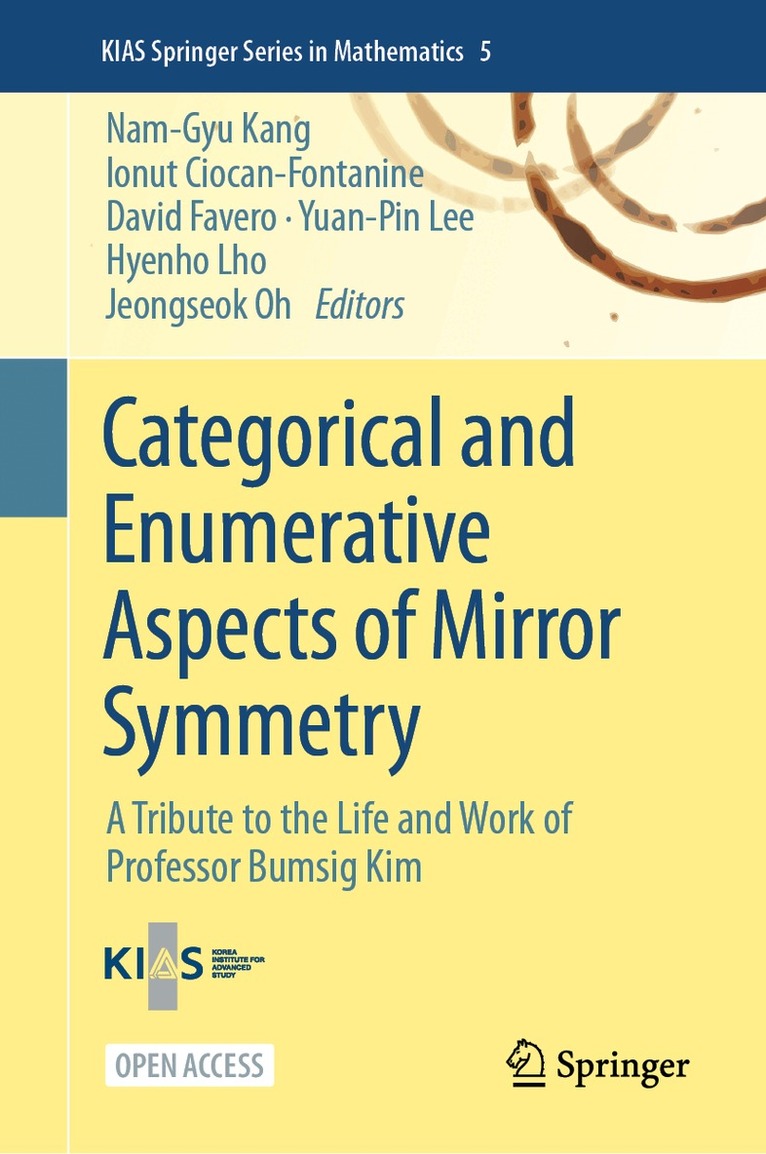
Categorical and Enumerative Aspects of Mirror Symmetry
A Tribute to the Life and Work of Professor Bumsig Kim
Inbunden, Engelska, 2026
539 kr
Skickas inom 10-15 vardagar
This open access book is a tribute to the profound contributions of Professor Bumsig Kim in the field of mathematics, particularly in the realm of mirror symmetry. Mirror symmetry is a fascinating duality between complex/algebraic geometry and symplectic geometry, manifesting in various ways. One of the foundational examples of this duality is the comparison of period integrals on a complex manifold with curve counts (enumerative invariants) on its mirror. This vision was ultimately realized through the Quasimap Wall-Crossing Formula, developed by Bumsig Kim and his collaborators.The book delves into the methods for counting curves, including Gromov–Witten theory and Fan–Jarvis–Ruan–Witten theory. In his final works, Kim and various groups of collaborators achieved methods for counting curves on gauged linear sigma models, effectively unifying Gromov–Witten and Fan–Jarvis–Ruan–Witten theory. This monumental effort involved constructing categorical frameworks and developing a dictionary between categorical and classical homological constructions.As a conference proceedings volume, this book is a collaborative effort by Professor Kim’s network of colleagues. It explores the intricate connections between categorical and enumerative aspects of mirror symmetry, showcasing the depth and breadth of Kim's work. Through detailed discussions and presentations, the book highlights the innovative approaches and groundbreaking results that have shaped the field.Readers will find a comprehensive overview of the latest advancements in mirror symmetry, enriched by the collaborative spirit and intellectual rigor that characterized Professor Kim's career. This volume not only honors his legacy but also serves as a valuable resource for researchers and students seeking to understand and build upon his pioneering work. Whether you are new to the field or an experienced mathematician, this book offers a wealth of knowledge and insights into the complex and beautiful world of mirror symmetry.