Natalie Robins – författare
Visar alla böcker från författaren Natalie Robins. Handla med fri frakt och snabb leverans.
4 produkter
4 produkter
Inbunden, Engelska, 2017
374 kr
Skickas inom 3-6 vardagar
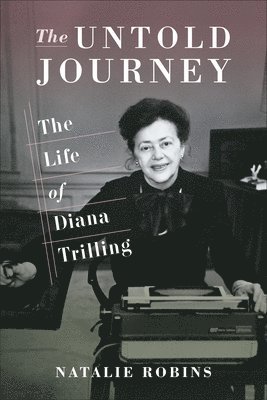
Throughout her life, Diana Trilling (1905-1996) wrote about profound social changes with candor and wisdom, first for The Nation and later for Partisan Review, Harpers, and such popular magazines as Vogue and McCalls. She went on to publish five books, including the best-selling Mrs. Harris: The Death of the Scarsdale Diet Doctor, written when she was in her late seventies. She was also one half of one of the most famous intellectual couples in the United States. Diana Trilling's life with Columbia University professor and literary critic Lionel Trilling was filled with secrets, struggles, and betrayals, and she endured what she called her "own private hell" as she fought to reconcile competing duties and impulses at home and at work. She was a feminist, yet she insisted that women's liberation created unnecessary friction with men, asserting that her career ambitions should be on equal footing with caring for her child and supporting her husband. She fearlessly expressed sensitive, controversial, and moral views, and fought publicly with Lillian Hellman, among other celebrated writers and intellectuals, over politics.Diana Trilling was an anticommunist liberal, a position often misunderstood, especially by her literary and university friends. And finally, she was among the "New Journalists" who transformed writing and reporting in the 1960s, making her nonfiction as imaginative in style and scope as a novel. The first biographer to mine Diana Trilling's extensive archives, Natalie Robins tells a previously undisclosed history of an essential member of New York City culture at a time of dynamic change and intellectual relevance.
E-bok
Engelska, 2009216 kr
Läs direkt efter köp
Today, one out of every three Americans uses some form of alternative medicine, either along with their conventional (“standard,” “traditional”) medications or in place of them. One of the most controversial–as well as one of the most popular–alternatives is homeopathy, a wholly Western invention brought to America from Germany in 1827, nearly forty years before the discovery that germs cause disease. Homeopathy is a therapy that uses minute doses of natural substances–minerals, such as mercury or phosphorus; various plants, mushrooms, or bark; and insect, shellfish, and other animal products, such as Oscillococcinum. These remedies mimic the symptoms of the sick person and are said to bring about relief by “entering” the body’s “vital force.” Many homeopaths believe that the greater the dilution, the greater the medical benefit, even though often not a single molecule of the original substance remains in the solution.In Copeland’s Cure, Natalie Robins tells the fascinating story of homeopathy in this country; how it came to be accepted because of the gentleness of its approach–Nathaniel Hawthorne and Henry Wadsworth Longfellow were outspoken advocates, as were Louisa May Alcott, Harriet Beecher Stowe, and Daniel Webster. We find out about the unusual war between alternative and conventional medicine that began in 1847, after the AMA banned homeopaths from membership even though their medical training was identical to that of doctors practicing traditional medicine. We learn how homeopaths were increasingly considered not to be “real” doctors, and how “real” doctors risked expulsion from the AMA if they even consulted with a homeopath.At the center of Copeland''s Cure is Royal Samuel Copeland, the now-forgotten maverick senator from New York who served from 1923 to 1938. Copeland was a student of both conventional and homeopathic medicine, an eye surgeon who became president of the American Institute of Homeopathy, dean of the New York Homeopathic Medical College, and health commissioner of New York City from 1918 to 1923 (he instituted unique approaches to the deadly flu pandemic). We see how Copeland straddled the worlds of politics (he befriended Calvin Coolidge, Herbert Hoover, and Franklin and Eleanor Roosevelt, among others) and medicine (as senator, he helped get rid of medical “diploma mills”). His crowning achievement was to give homeopathy lasting legitimacy by including all its remedies in the Federal Food, Drug, and Cosmetic Act of 1938.Finally, the author brings the story of clashing medical beliefs into the present, and describes the role of homeopathy today and how some of its practitioners are now adhering to the strictest standards of scientific research–controlled, randomized, double-blind clinical studies.From the Hardcover edition.
E-bok
Engelska, 2007202 kr
Läs direkt efter köp
A spellbinding tale of money and madness, incest and matricide, Savage Grace is the saga of Brooks and Barbara Baekeland -- beautiful, rich, worldly -- and their handsome, gentle son, Tony. Alternately neglected and smothered by his parents, he was finally driven to destroy the whole family in a violent chain of events. Savage Grace unfolds against a glamorous international background (New York, London, Paris, Italy, Spain); features a nonpareil cast of characters (including Salvador Dalí, James Jones, the Astors, the Vanderbilts, and European nobility); and tells the doomed Baekelands'' story through remarkably candid interviews, private letters, and diaries, not to mention confidential hospital, State Department, and prison documents. A true-crime classic, it exposes the envied lives of the rich and beautiful, and brilliantly illuminates the darkest corners of the American Dream.
Häftad, Engelska, 2007
375 kr
Skickas inom 3-6 vardagar