Niels da Vitoria Lobo – författare
Visar alla böcker från författaren Niels da Vitoria Lobo. Handla med fri frakt och snabb leverans.
5 produkter
5 produkter
Inbunden, Engelska, 2001
1 667 kr
Skickas inom 10-15 vardagar
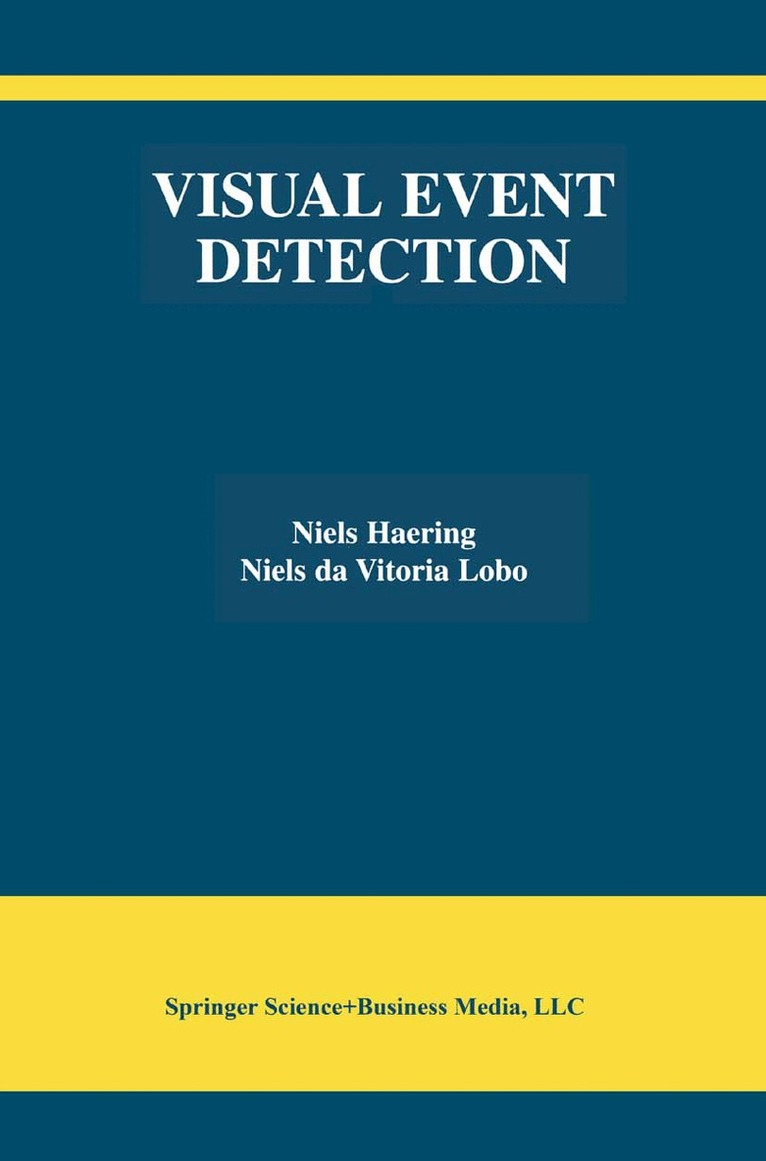
This text focuses on visual event detection. It demonstrates that computer vision research has matured to a point where meaningful visual event detection can be achieved. The authors propose that the exact object and motion information is not necessary to achieve video event detection. They show that some visual events are sufficiently described by little more than the broad categories of the constituent objects and their qualitative motions. The Video Computing book series provides a forum for the dissemination of innovative research results for computer vision, image processing, database and computer graphics researchers.
Häftad, Engelska, 2010
1 667 kr
Skickas inom 10-15 vardagar
This book is one of the first books to focus on visual event detection. It demonstrates that computer vision research has matured to a point where meaningful visual event detection can be achieved. The authors propose that the exact object and motion information is not necessary to achieve video event detection. They show that some visual events are sufficiently described by little more than the broad categories of the constituent objects and their qualitative motions. The Video Computing book series provides a forum for the dissemination of innovative research results for computer vision, image processing, database and computer graphics researchers. Visual Event Detection will be of interest to those working in video analysis, video understanding, video compression, image understanding, and artificial intelligence.
E-bok
PDF, Engelska, 20131 995 kr
Läs direkt efter köp
Traditionally, scientific fields have defined boundaries, and scientists work on research problems within those boundaries. However, from time to time those boundaries get shifted or blurred to evolve new fields. For instance, the original goal of computer vision was to understand a single image of a scene, by identifying objects, their structure, and spatial arrangements. This has been referred to as image understanding. Recently, computer vision has gradually been making the transition away from understanding single images to analyzing image sequences, or video understanding. Video understanding deals with understanding of video sequences, e. g. , recognition of gestures, activities, facial expressions, etc. The main shift in the classic paradigm has been from the recognition of static objects in the scene to motion-based recognition of actions and events. Video understanding has overlapping research problems with other fields, therefore blurring the fixed boundaries. Computer graphics, image processing, and video databases have obvious overlap with computer vision. The main goal of computer graphics is to gener ate and animate realistic looking images, and videos. Researchers in computer graphics are increasingly employing techniques from computer vision to gen erate the synthetic imagery. A good example of this is image-based rendering and modeling techniques, in which geometry, appearance, and lighting is de rived from real images using computer vision techniques. Here the shift is from synthesis to analysis followed by synthesis.
Häftad, Engelska, 2008
1 114 kr
Skickas inom 10-15 vardagar
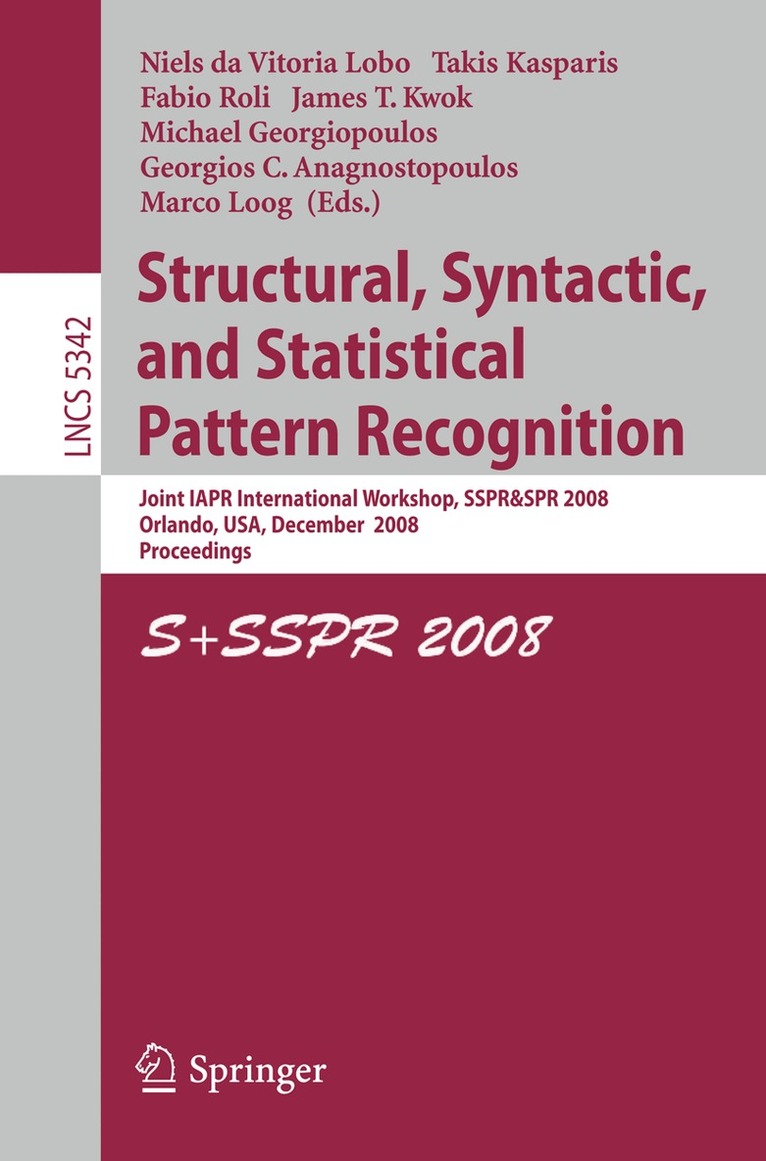
This volume in the Springer Lecture Notes in Computer Science (LNCS) series contains 98 papers presented at the S+SSPR 2008 workshops. S+SSPR 2008 was the sixth time that the SPR and SSPR workshops organized by Technical Committees, TC1 and TC2, of the International Association for Pattern Rec- nition (IAPR) wereheld as joint workshops. S+SSPR 2008was held in Orlando, Florida, the family entertainment capital of the world, on the beautiful campus of the University of Central Florida, one of the up and coming metropolitan universities in the USA. S+SSPR 2008 was held during December 4–6, 2008 only a few days before the 19th International Conference on Pattern Recog- tion(ICPR2008),whichwasheldin Tampa,onlytwo hoursawayfromOrlando, thus giving the opportunity of both conferences to attendees to enjoy the many attractions o?ered by two neighboring cities in the state of Florida. SPR 2008 and SSPR 2008 received a total of 175 paper submissions from many di?erent countries around the world,thus giving the workshop an int- national clout, as was the case for past workshops. This volume contains 98 accepted papers: 56 for oral presentations and 42 for poster presentations. In addition to parallel oral sessions for SPR and SSPR, there was also one joint oral session with papers of interest to both the SPR and SSPR communities. A recent trend that has emerged in the pattern recognition and machine lea- ing research communities is the study of graph-based methods that integrate statistical andstructural approaches.
E-bok
PDF, Engelska, 20081 379 kr
Läs direkt efter köp
This volume in the Springer Lecture Notes in Computer Science (LNCS) series contains 98 papers presented at the S+SSPR 2008 workshops. S+SSPR 2008 was the sixth time that the SPR and SSPR workshops organized by Technical Committees, TC1 and TC2, of the International Association for Pattern Rec- nition (IAPR) wereheld as joint workshops. S+SSPR 2008was held in Orlando, Florida, the family entertainment capital of the world, on the beautiful campus of the University of Central Florida, one of the up and coming metropolitan universities in the USA. S+SSPR 2008 was held during December 4–6, 2008 only a few days before the 19th International Conference on Pattern Recog- tion(ICPR2008),whichwasheldin Tampa,onlytwo hoursawayfromOrlando, thus giving the opportunity of both conferences to attendees to enjoy the many attractions o?ered by two neighboring cities in the state of Florida. SPR 2008 and SSPR 2008 received a total of 175 paper submissions from many di?erent countries around the world,thus giving the workshop an int- national clout, as was the case for past workshops. This volume contains 98 accepted papers: 56 for oral presentations and 42 for poster presentations. In addition to parallel oral sessions for SPR and SSPR, there was also one joint oral session with papers of interest to both the SPR and SSPR communities. A recent trend that has emerged in the pattern recognition and machine lea- ing research communities is the study of graph-based methods that integrate statistical andstructural approaches.