Octavian Iordache - Böcker
Visar alla böcker från författaren Octavian Iordache. Handla med fri frakt och snabb leverans.
17 produkter
17 produkter
2 307 kr
Skickas inom 10-15 vardagar
How do you know what works and what doesn't? This book contains case studies highlighting the power of polytope projects for complex problem solving. Any sort of combinational problem characterized by a large variety of possibly complex constructions and deconstructions based on simple building blocks can be studied in a similar way. Although the majority of case studies are related to chemistry, the method is general and equally applicable to other fields for engineering or science.
1 062 kr
Skickas inom 10-15 vardagar
This book focuses on new developments in polytopic projects, particularly on implementation domains and case studies, as well as high-dimensional methodology.
1 062 kr
Skickas inom 10-15 vardagar
This book focuses on new developments in polytopic projects, particularly on implementation domains and case studies, as well as high-dimensional methodology.
1 062 kr
Skickas inom 10-15 vardagar
Polytopic flow sheets, online analytical processing, polytopic engineering designs, and reality-inspired engineering are presented. Innovative concepts such as Industry 5.0, polytopic industry, Society 5.0, polytopic society, cyber physical social systems, industrial Internet, and digital twins have been discussed.
1 062 kr
Skickas inom 10-15 vardagar
Polytopic flow sheets, online analytical processing, polytopic engineering designs, and reality-inspired engineering are presented. Innovative concepts such as Industry 5.0, polytopic industry, Society 5.0, polytopic society, cyber physical social systems, industrial Internet, and digital twins have been discussed.
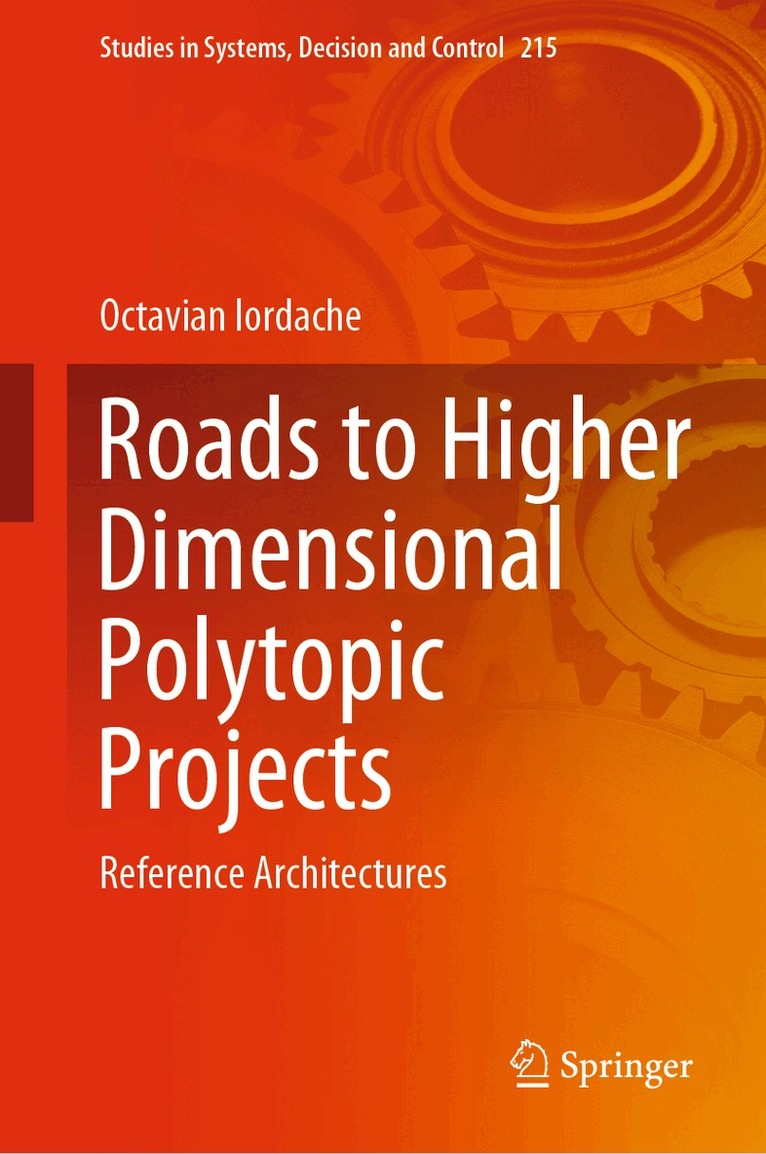
Del 215 - Studies in Systems, Decision and Control
Roads to Higher Dimensional Polytopic Projects
Reference Architectures
Inbunden, Engelska, 2022
1 062 kr
Skickas inom 10-15 vardagar
High dimensional reference architectures presented here allows confronting and prevailing over the growing complexity of polytopic projects implementations.Such projects should be envisaged giving that conventional systems operations, equipments, methodologies or organizations will reach their limits for self-evolvability in high complexity conditions. Self-evolvable high complexity systems are based on high dimensional polytopic reference architectures.Polytope is the general term of the sequence: point, line, polygon, polyhedron and so on.The polytopic projects are targeting the artificiality, not only for materials where it is well known and applied, but also for biological, cognitive, intelligent and mathematical systems. The book highlights the polytopic projects basic similarity despite the noticeable difference as domains of application. The roads to follow and the algebra of changing roads are emphasized.The book is divided in 9 chapters. Chapter 1 introduces the Polytopic Roadmap to 4D and beyond. The role for the dialogue of processes in duality of the non-Aristotelian Logic of Contradiction and of Included Middle is emphasized for different domains. Chapter 2 refers to chemical systems. Supramolecular chemistry, metal organic frameworks, MOF, and reaction networks, are the examples considered in the frame of polytopic chemistry. Chapter 3 refers to biological systems. Biological dynamical hierarchies and quasi-species are the considered case studies. Technological and scientific projects targeting artificiality for cells and viruses are considered. Chapter 4 refers to cognitive systems. Developmental stages, formal and relational concepts analysis, and neural coding are considered here. The roles of the 4D systems of systems of systems and of conceptual 4D-cube are emphasized. Artificiality for cognitive systems is the object of study.Chapter 5 refers to mathematical systems. Modeling levels and the 4D digital twins are discussed. Hopf monoids as tools for the study of combinations and separations, dual graded graphs and V-models are informally presented. Chapter 6 refers to application of formal concept analysis, FCA, for high dimensional separations, nesting and drug delivery. Chapter 7 refers to polytopic engineering systems as multiscale transfer, distributors-collectors, cyclic operations, middle vessel columns, mixing, assembly and designs. Equipments have been characterized using Polytopic Roadmaps and classified by Periodic Tables. Chapter 8 introduces polytopic industry, economy, society and sustainability. Chapter 9 outlines new domains of interest as arts and architecture, transdisciplinarity, complex systems and unity of sciences and engineering.Polytopic Roadmaps are proposed as Method for experts from various fields to synthesize their thinking and capabilities into new projects implementation to face and surpass high complexity. A repetitive finding of this book is that self-evolvability observed in physical systems is based on the same directed sequence of reference architectures as the self-evolvability of concepts in our mind. Continuing to develop the field of self-evolvable systems and presenting the polytopic roadmaps for 4D and beyond advances in ever growing complexity domains, the book will be useful to engineers, researchers, entrepreneurs and students in different branches of production, complex systems sciences and engineering, ecology and applied mathematics.
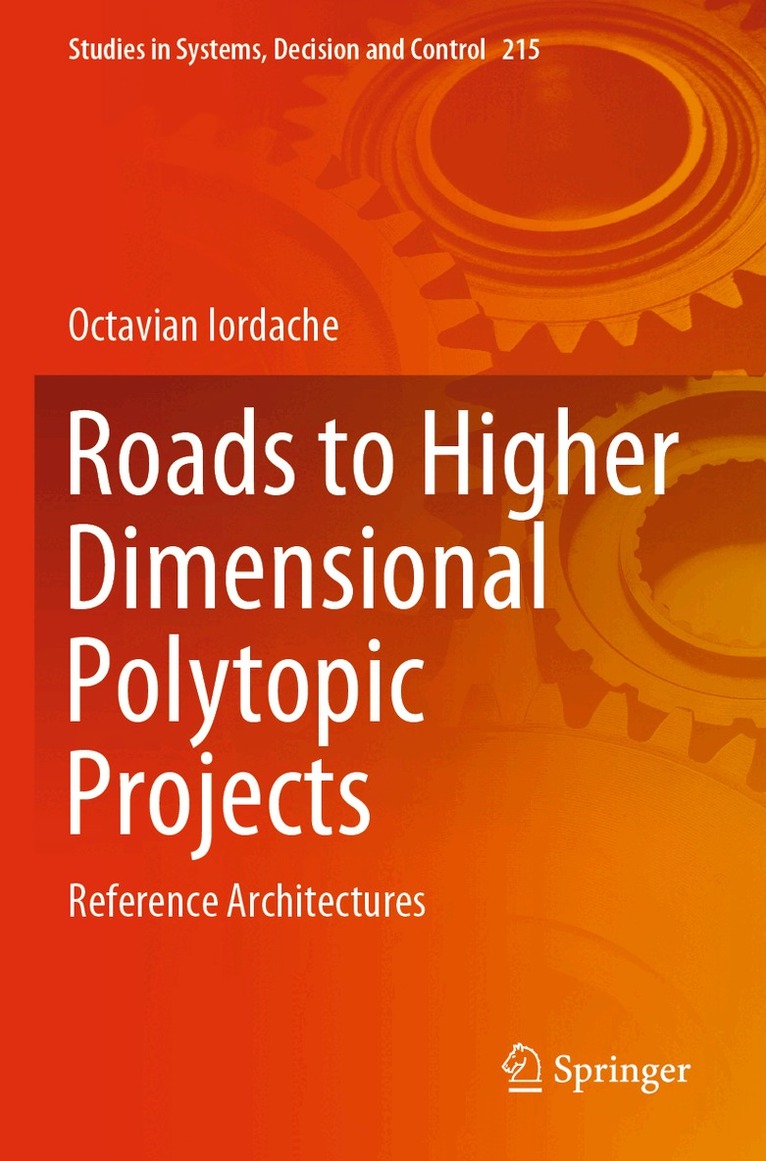
Del 215 - Studies in Systems, Decision and Control
Roads to Higher Dimensional Polytopic Projects
Reference Architectures
Häftad, Engelska, 2023
1 062 kr
Skickas inom 10-15 vardagar
High dimensional reference architectures presented here allows confronting and prevailing over the growing complexity of polytopic projects implementations.Such projects should be envisaged giving that conventional systems operations, equipments, methodologies or organizations will reach their limits for self-evolvability in high complexity conditions. Self-evolvable high complexity systems are based on high dimensional polytopic reference architectures.Polytope is the general term of the sequence: point, line, polygon, polyhedron and so on.The polytopic projects are targeting the artificiality, not only for materials where it is well known and applied, but also for biological, cognitive, intelligent and mathematical systems. The book highlights the polytopic projects basic similarity despite the noticeable difference as domains of application. The roads to follow and the algebra of changing roads are emphasized.The book is divided in 9 chapters. Chapter 1 introduces the Polytopic Roadmap to 4D and beyond. The role for the dialogue of processes in duality of the non-Aristotelian Logic of Contradiction and of Included Middle is emphasized for different domains. Chapter 2 refers to chemical systems. Supramolecular chemistry, metal organic frameworks, MOF, and reaction networks, are the examples considered in the frame of polytopic chemistry. Chapter 3 refers to biological systems. Biological dynamical hierarchies and quasi-species are the considered case studies. Technological and scientific projects targeting artificiality for cells and viruses are considered. Chapter 4 refers to cognitive systems. Developmental stages, formal and relational concepts analysis, and neural coding are considered here. The roles of the 4D systems of systems of systems and of conceptual 4D-cube are emphasized. Artificiality for cognitive systems is the object of study.Chapter 5 refers to mathematical systems. Modeling levels and the 4D digital twins are discussed. Hopf monoids as tools for the study of combinations and separations, dual graded graphs and V-models are informally presented. Chapter 6 refers to application of formal concept analysis, FCA, for high dimensional separations, nesting and drug delivery. Chapter 7 refers to polytopic engineering systems as multiscale transfer, distributors-collectors, cyclic operations, middle vessel columns, mixing, assembly and designs. Equipments have been characterized using Polytopic Roadmaps and classified by Periodic Tables. Chapter 8 introduces polytopic industry, economy, society and sustainability. Chapter 9 outlines new domains of interest as arts and architecture, transdisciplinarity, complex systems and unity of sciences and engineering.Polytopic Roadmaps are proposed as Method for experts from various fields to synthesize their thinking and capabilities into new projects implementation to face and surpass high complexity. A repetitive finding of this book is that self-evolvability observed in physical systems is based on the same directed sequence of reference architectures as the self-evolvability of concepts in our mind. Continuing to develop the field of self-evolvable systems and presenting the polytopic roadmaps for 4D and beyond advances in ever growing complexity domains, the book will be useful to engineers, researchers, entrepreneurs and students in different branches of production, complex systems sciences and engineering, ecology and applied mathematics.
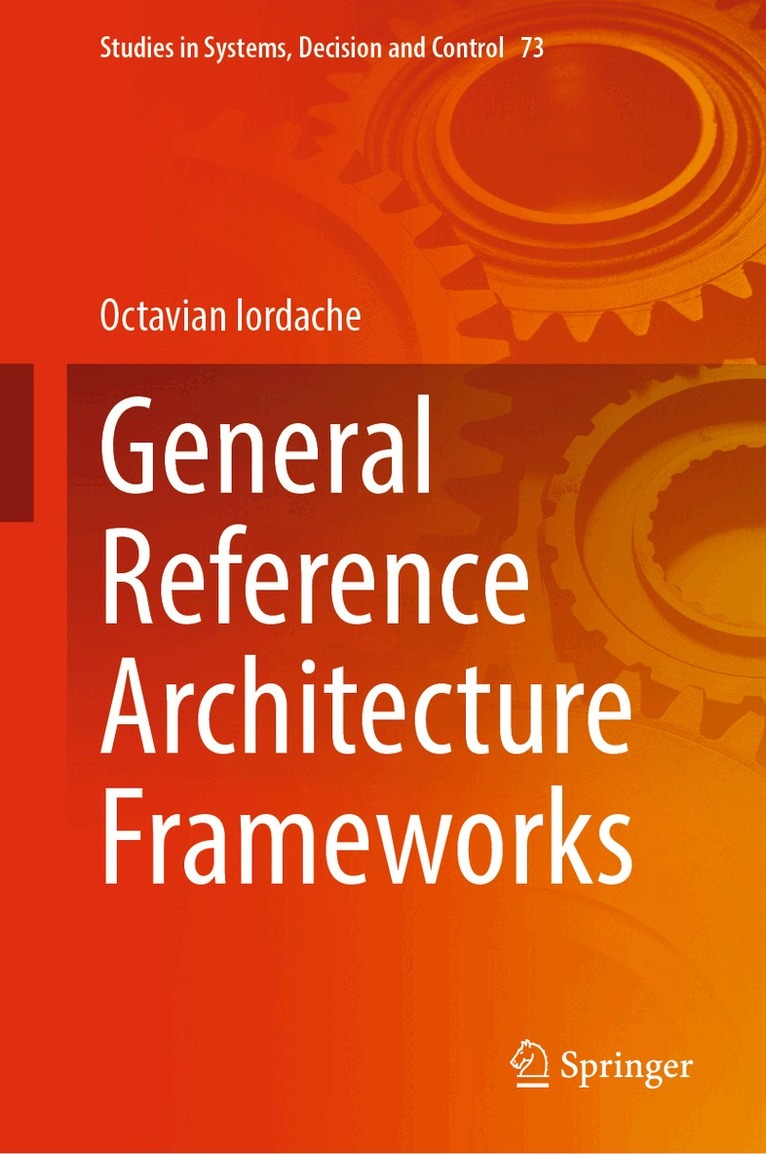
Del 73 - Studies in Systems, Decision and Control
General Reference Architecture Frameworks
Inbunden, Engelska, 2024
1 753 kr
Skickas inom 10-15 vardagar
Chapter 7 focuses on complex systems as production systems of systems architecture frameworks, decision models, operations processes, and cyber-physical social systems.
1 062 kr
Skickas inom 10-15 vardagar
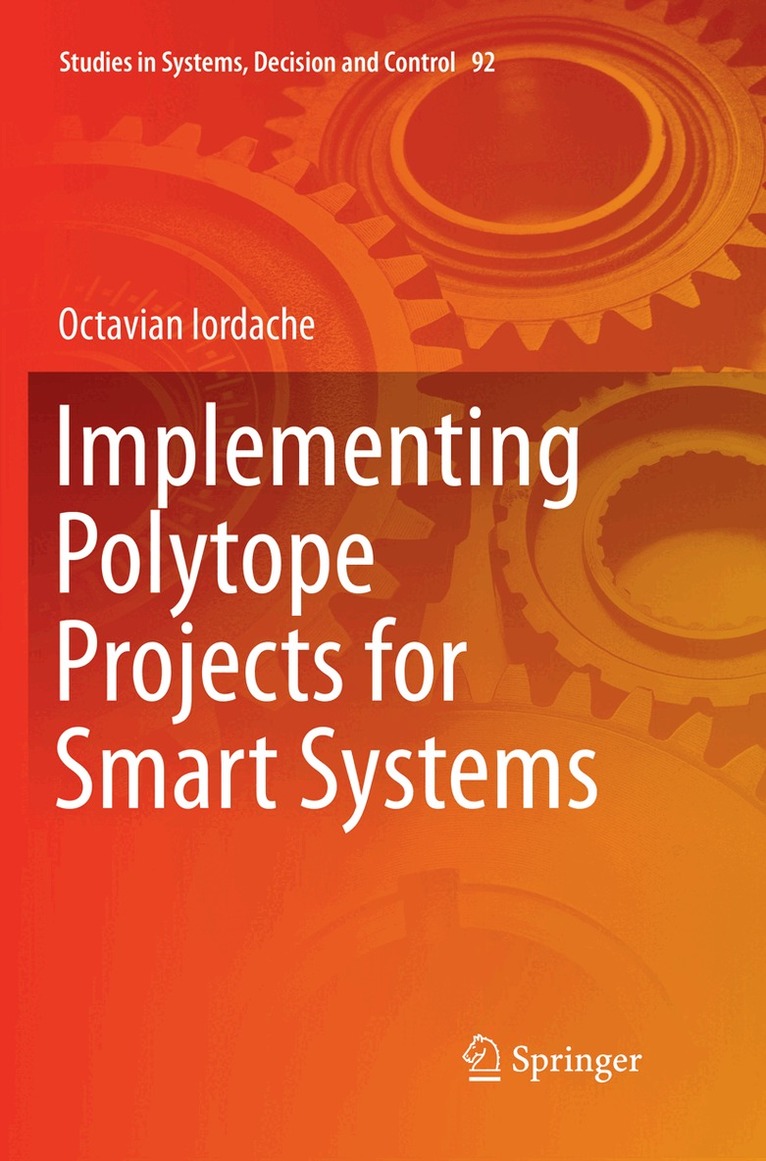
This book presents a domain of extreme industrial and scientific interest: the study of smart systems and structures. It presents polytope projects as comprehensive physical and cognitive architectures that support the investigation, fabrication and implementation of smart systems and structures. These systems feature multifunctional components that can perform sensing, control, and actuation. In light of the fact that devices, tools, methodologies and organizations based on electronics and information technology for automation, specific to the third industrial revolution, are increasingly reaching their limits, it is essential that smart systems be implemented in industry. Polytope projects facilitate the utilization of smart systems and structures as key elements of the fourth industrial revolution.The book begins by presenting polytope projects as a reference architecture for cyber-physical systems and smart systems, before addressing industrial process synthesis inChapter 2. Flow-sheet trees, cyclic separations and smart configurations for multi-component separations are discussed here. In turn, Chapter 3 highlights periodic features for drug delivery systems and networks of chemical reactions, while Chapter 4 applies conditioned random walks to polymers and smart materials structures. Chapter 5 examines self-assembly and self-reconfiguration at different scales from molecular to micro systems. Smart devices and technologies are the focus of chapter 6. Modular micro reactor systems and timed automata are examined in selected case studies. Chapter 7 focuses on inferential engineering designs, concept-knowledge, relational concept analysis and model driven architecture, while Chapter 8 puts the spotlight on smart manufacturing, industry 4.0, reference architectures and models for new product development and testing. Lastly, Chapter 9 highlights the polytope projects methodology and the prospects for smart systems and structures.Focusing onprocess engineering and mathematical modeling for the fourth industrial revolution, the book offers a unique resource for engineers, scientists and entrepreneurs working in chemical, biochemical, pharmaceutical, materials science or systems chemistry, students in various domains of production and engineering, and applied mathematicians.
1 409 kr
Skickas inom 5-8 vardagar
Polytope projects facilitate the utilization of smart systems and structures as key elements of the fourth industrial revolution.The book begins by presenting polytope projects as a reference architecture for cyber-physical systems and smart systems, before addressing industrial process synthesis inChapter 2.
1 151 kr
Tillfälligt slut
1 589 kr
Skickas inom 10-15 vardagar
This book is devoted to a domain of highest industrial and scienti?c interest, the complexity. The complexity understanding and management will be a main source of e?ciency and prosperity for the next decades. Complex systems areassembliesof multiple subsystemsand arecharact- ized by emergent behavior that results by nonlinear interactions among the subsystems at multiple levels of organization. Evolvability that is the ability to evolve is the method to confront and surpass the successive boundaries of complexity. Evolvability is not biological but should be considered here in the sense that the corresponding systems have, at di?erent levels, charact- istics that are naturally associated to the living systems. The signi?cance of the complexity and the phenomena of emergence are highlighted in the ?rst chapterofthe book.Theimplicationofconcepts aslevelofreality,circularity and closure for evolvable systems is evaluated. The second chapter of the book exposes the methodology to analyze and manage complex systems. The polystochastic models, PSMs, are the cons- ered mathematical tools. PSMs characterize systems emerging when several stochastic processes occurring at di?erent conditioning levels, are capable to interact with each other, resulting in qualitatively new processes and s- tems.Innovative are the higher categories approach and the introduction of apartialdi?erentialmodelfor multiple levelsmodeling.This imposes making use of appropriate notions of time, space, probabilities and entropy. Categorytheoryistheformalismcapabletooutlinethegeneralframework, shared by the functional organization of biological organisms, of cognitive systems, by the operational structure of evolvable technologies and devices and after all by the scienti?c and engineering methods.
1 800 kr
Skickas inom 10-15 vardagar
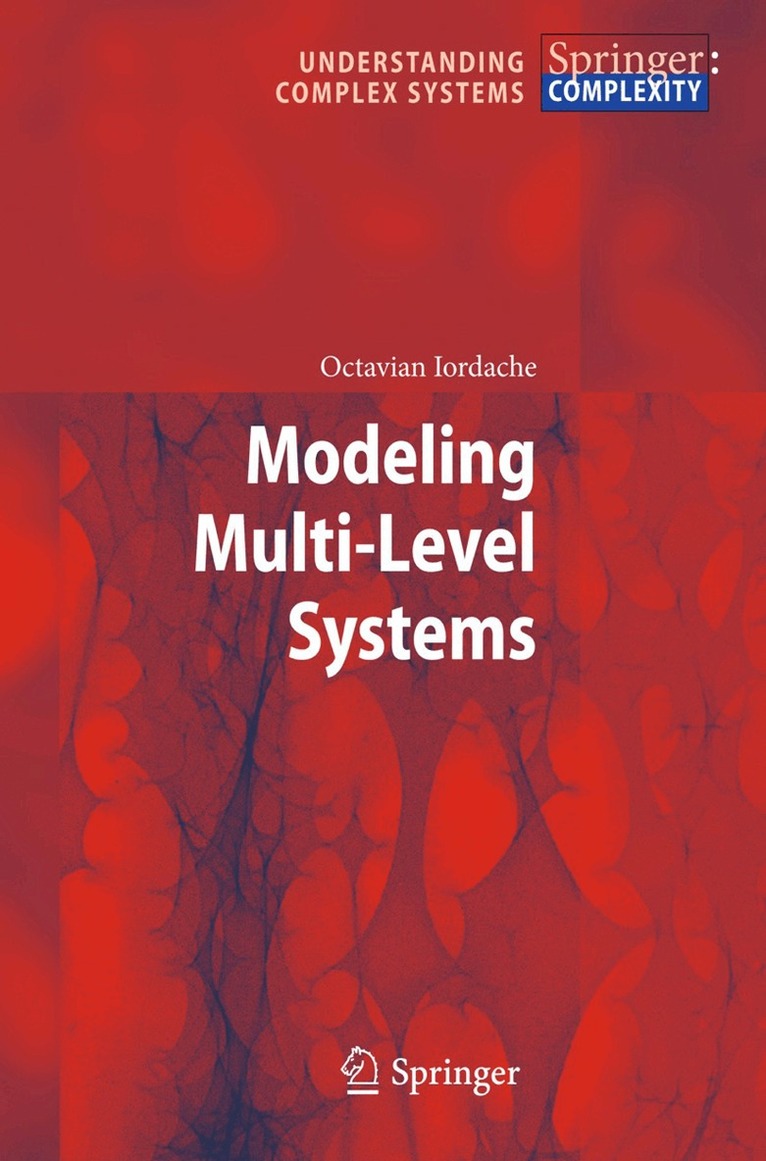
This book is devoted to modeling of multi-level complex systems, a challenging domain for engineers, researchers and entrepreneurs, confronted with the transition from learning and adaptability to evolvability and autonomy for technologies, devices and problem solving methods. Chapter 1 introduces the multi-scale and multi-level systems and highlights their presence in different domains of science and technology. Methodologies as, random systems, non-Archimedean analysis, category theory and specific techniques as model categorification and integrative closure, are presented in chapter 2. Chapters 3 and 4 describe polystochastic models, PSM, and their developments. Categorical formulation of integrative closure offers the general PSM framework which serves as a flexible guideline for a large variety of multi-level modeling problems.Focusing on chemical engineering, pharmaceutical and environmental case studies, the chapters 5 to 8 analyze mixing, turbulent dispersion and entropy production for multi-scale systems. Taking inspiration from systems sciences, chapters 9 to 11 highlight multi-level modeling potentialities in formal concept analysis, existential graphs and evolvable designs of experiments. Case studies refer to separation flow-sheets, pharmaceutical pipeline, drug design and development, reliability management systems, security and failure analysis. Perspectives and integrative points of view are discussed in chapter 12. Autonomous and viable systems, multi-agents, organic and autonomic computing, multi-level informational systems, are revealed as promising domains for future applications.Written for: engineers, researchers, entrepreneurs and students in chemical, pharmaceutical, environmental and systems sciences engineering, and for applied mathematicians.
1 589 kr
Skickas inom 10-15 vardagar
This book is devoted to a domain of highest industrial and scienti?c interest, the complexity. The complexity understanding and management will be a main source of e?ciency and prosperity for the next decades. Complex systems areassembliesof multiple subsystemsand arecharact- ized by emergent behavior that results by nonlinear interactions among the subsystems at multiple levels of organization. Evolvability that is the ability to evolve is the method to confront and surpass the successive boundaries of complexity. Evolvability is not biological but should be considered here in the sense that the corresponding systems have, at di?erent levels, charact- istics that are naturally associated to the living systems. The signi?cance of the complexity and the phenomena of emergence are highlighted in the ?rst chapterofthe book.Theimplicationofconcepts aslevelofreality,circularity and closure for evolvable systems is evaluated. The second chapter of the book exposes the methodology to analyze and manage complex systems. The polystochastic models, PSMs, are the cons- ered mathematical tools. PSMs characterize systems emerging when several stochastic processes occurring at di?erent conditioning levels, are capable to interact with each other, resulting in qualitatively new processes and s- tems.Innovative are the higher categories approach and the introduction of apartialdi?erentialmodelfor multiple levelsmodeling.This imposes making use of appropriate notions of time, space, probabilities and entropy. Categorytheoryistheformalismcapabletooutlinethegeneralframework, shared by the functional organization of biological organisms, of cognitive systems, by the operational structure of evolvable technologies and devices and after all by the scienti?c and engineering methods.
1 589 kr
Skickas inom 10-15 vardagar
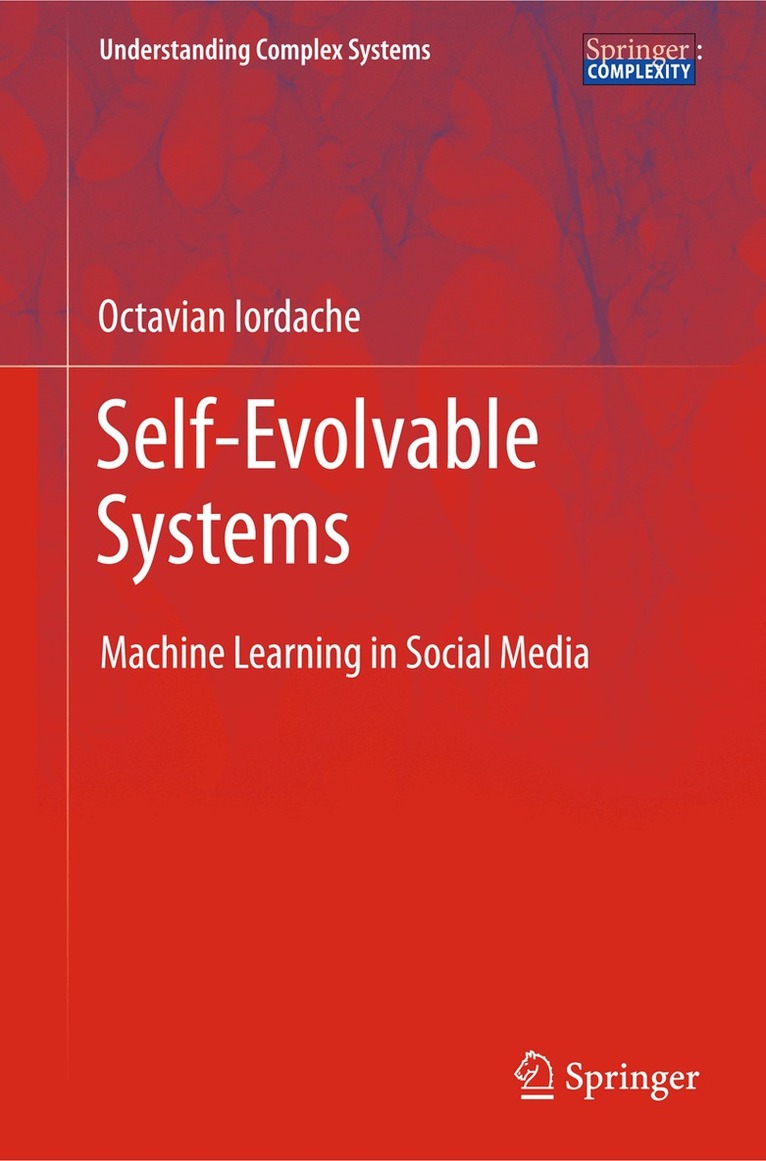
This monograph presents key method to successfully manage the growing complexity of systems where conventional engineering and scientific methodologies and technologies based on learning and adaptability come to their limits and new ways are nowadays required. The transition from adaptable to evolvable and finally to self-evolvable systems is highlighted, self-properties such as self-organization, self-configuration, and self-repairing are introduced and challenges and limitations of the self-evolvable engineering systems are evaluated.
1 800 kr
Skickas inom 10-15 vardagar
This book is devoted to modeling of multi-level complex systems, a challenging domain for engineers, researchers and entrepreneurs, confronted with the transition from learning and adaptability to evolvability and autonomy for technologies, devices and problem solving methods. Chapter 1 introduces the multi-scale and multi-level systems and highlights their presence in different domains of science and technology. Methodologies as, random systems, non-Archimedean analysis, category theory and specific techniques as model categorification and integrative closure, are presented in chapter 2. Chapters 3 and 4 describe polystochastic models, PSM, and their developments. Categorical formulation of integrative closure offers the general PSM framework which serves as a flexible guideline for a large variety of multi-level modeling problems.Focusing on chemical engineering, pharmaceutical and environmental case studies, the chapters 5 to 8 analyze mixing, turbulent dispersion and entropy production for multi-scale systems. Taking inspiration from systems sciences, chapters 9 to 11 highlight multi-level modeling potentialities in formal concept analysis, existential graphs and evolvable designs of experiments. Case studies refer to separation flow-sheets, pharmaceutical pipeline, drug design and development, reliability management systems, security and failure analysis. Perspectives and integrative points of view are discussed in chapter 12. Autonomous and viable systems, multi-agents, organic and autonomic computing, multi-level informational systems, are revealed as promising domains for future applications.Written for: engineers, researchers, entrepreneurs and students in chemical, pharmaceutical, environmental and systems sciences engineering, and for applied mathematicians.
1 589 kr
Skickas inom 10-15 vardagar
This monograph presents key method to successfully manage the growing complexity of systems where conventional engineering and scientific methodologies and technologies based on learning and adaptability come to their limits and new ways are nowadays required. The transition from adaptable to evolvable and finally to self-evolvable systems is highlighted, self-properties such as self-organization, self-configuration, and self-repairing are introduced and challenges and limitations of the self-evolvable engineering systems are evaluated.