Otfried Spreen – författare
Visar alla böcker från författaren Otfried Spreen. Handla med fri frakt och snabb leverans.
5 produkter
5 produkter
E-bok
Engelska, 2002743 kr
Läs direkt efter köp
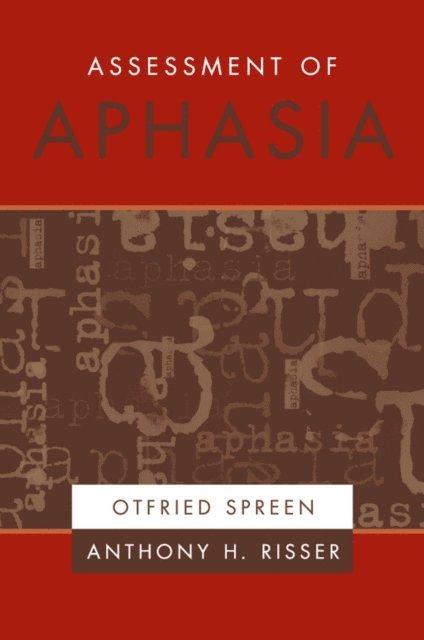
Spreen and Risser present a comprehensive, critical review of available methods for the assessment of aphasia and related disorders in adults and children. The authors explore test instruments and approaches that have been used traditionally for the diagnosis of aphasia, ranging from bedside screening and ratings, to tests of specific aspects of language, and to comprehensive and psychometrically standardized aphasia batteries. Coverage of other methods reflects newer trends, including the areas of functional communication, testing of bilingual patients, psycholinguistic approaches, and pragmatic and discourse-related aspects of language in everyday life. The authors also examine the expansion of language assessment to individuals with non-aphasic neurological disorders, such as patients with traumatic brain injury, lesions of the right hemisphere, the healthy elderly, and invidulas with dimentia. Taking a flexible and empirical approach to the assessment process in their own clinical practice, Spreen and Risser review numerous test instruments and their source for professionals and students-in-training to choose from in their own use. The introductory chapters cover the history of aphasia assessment, a basic outline of subtypes of aphasia- both neuro-anatomically and psycholinguistically-, and the basic psychometric requirements for assessment instruments. The final part discusses issues in general clinical practice, specifically questions of test selection and interpretation. The book is a thorough and practical resource for speech and language pathologists, neuropsychologists, and their students and trainees.
Häftad, Engelska, 1995
573 kr
Skickas inom 5-8 vardagar
In the ten years since the first edition of this book appeared, many new findings have been generated in a variety of clinical and research contexts. The new edition of this successful text summarizes this research and adds normative data on new populations including children and the elderly. It therefore offers an updated coverage of the clinical tests developed at the Benton Laboratory of Neuropsychology.
Inbunden, Engelska, 2003
988 kr
Skickas inom 5-8 vardagar
In this book, Spreen and Risser present a comprehensive, critical review of available methods for the assessment of aphasia and related disorders in adults and children. The authors explore test instruments and approaches that have been used traditionally for the diagnosis of aphasia, ranging from bedside screening and ratings, to tests of specific aspects of language, and to comprehensive and psychometrically standardised aphasia batteries. Coverage of other methods reflects newer trends, including the areas of functional communication, testing of bilingual patients, psycholinguistic approaches, and pragmatic and discourse-related aspects of language in everyday life. The authors also examine the expansion of language assessment to individuals with non-aphasic neurological disorders, such as patients with traumatic brain injury, lesions of the right hemisphere, the healthy elderly, and individuals with dementia. Taking a flexible and empirical approach to the assessment process in their own clinical practice, Spreen and Risser review numerous test instruments and their source for professionals and students-in-training to choose from in their own use. The introductory chapters cover the history of aphasia assessment, a basic outline of subtypes of aphasia, both neuro-anatomically and psycholinguistically, and the basic psychometric requirements for assessment instruments. The final part discusses issues in general clinical practice, specifically questions of test selection and interpretation. The book is a thorough and practical resource for speech and language pathologists, neuropsychologists, and their students and trainees.
E-bok
PDF, Engelska, 2002743 kr
Läs direkt efter köp
Spreen and Risser present a comprehensive, critical review of available methods for the assessment of aphasia and related disorders in adults and children. The authors explore test instruments and approaches that have been used traditionally for the diagnosis of aphasia, ranging from bedside screening and ratings, to tests of specific aspects of language, and to comprehensive and psychometrically standardized aphasia batteries. Coverage of other methods reflects newer trends, including the areas of functional communication, testing of bilingual patients, psycholinguistic approaches, and pragmatic and discourse-related aspects of language in everyday life. The authors also examine the expansion of language assessment to individuals with non-aphasic neurological disorders, such as patients with traumatic brain injury, lesions of the right hemisphere, the healthy elderly, and invidulas with dimentia. Taking a flexible and empirical approach to the assessment process in their own clinical practice, Spreen and Risser review numerous test instruments and their source for professionals and students-in-training to choose from in their own use. The introductory chapters cover the history of aphasia assessment, a basic outline of subtypes of aphasia- both neuro-anatomically and psycholinguistically-, and the basic psychometric requirements for assessment instruments. The final part discusses issues in general clinical practice, specifically questions of test selection and interpretation. The book is a thorough and practical resource for speech and language pathologists, neuropsychologists, and their students and trainees.
E-bok
PDF, Engelska, 1998502 kr
Läs direkt efter köp
The Second Edition of this well-known Compendium has been considerably expanded and updated. It contains new chapters on test selection administration and preparation of the client; report writing and the informing interview; executive functions; occupational interest and aptitude; and malingering and symptom validity testing. The first four chapters focus on history taking, test selection, profiling of test results, report writing, and informing the client. The remaining thirteen chapters contain nearly all the tests covered in the first edition plus almost the same number of new ones. Some of the new tests are: Kaufman-Brief Intelligence Test, Mini-Mental State Examination, Wechsler Individual Achievement Test, Design Fluency Test, California Verbal Learning Test, and Boston Diagnostic Aphasia Test. For each test, the authors provide a thorough description, source and price, instructions for administration, duration, scoring procedures, normative data, and validity information. They also discuss special tests and clinical techniques in examining the functional integrity of brain regions. The volume does not limit itself to the adult age range, but includes all the norms available for pediatric and gerontological populations, as well as neuropsychological tests developed specifically for children.