Pienemann Manfred Pienemann – författare
Visar alla böcker från författaren . Handla med fri frakt och snabb leverans.
2 produkter
2 produkter
E-bok
PDF, Engelska, 20111 304 kr
Läs direkt efter köp
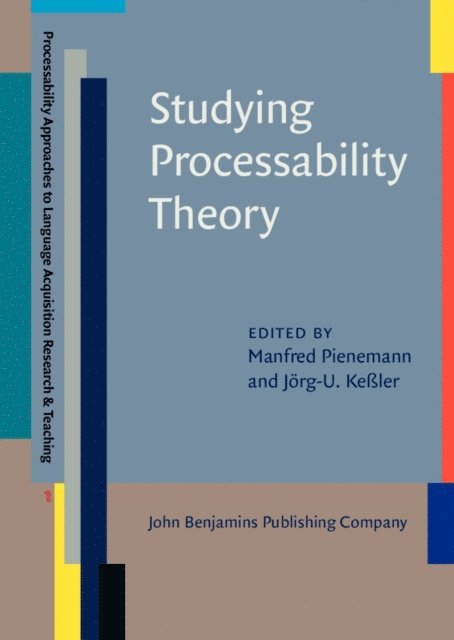
Processability Theory (PT) as developed by Manfred Pienemann is a prominent theory of second language acquisition. PT serves as a framework for a wide range of research covering issues, including L2 processing, interlanguage variation, typological effects on SLA, L1 transfer, pidgins and creoles, linguistic profiling, stabilisation/fossilisation and teachability. This textbook provides a reader-friendly introduction to PT. It is designed for students with a basic knowledge of (applied) linguistics. The components of PT are set out in four parts. The first part focuses on observed facts, in particular on paths of L2 development and learner variation. The second part gives an overview of the theoretical basis of PT. Part three details the application of PT to contexts other than ESL (i.e. Japanese, creoles and bilingual acquisition), and the fourth part focuses on practical applications. Each chapter contains exercises (including data analysis and interpretation) which may be used for individual study or in class. The textbook can be used as a concise introduction to PT. However, it may also serve as a point of reference for particular PT-related topics. The individual chapters were written by specialists in each of the research areas.
E-bok
PDF, Engelska, 20051 581 kr
Läs direkt efter köp
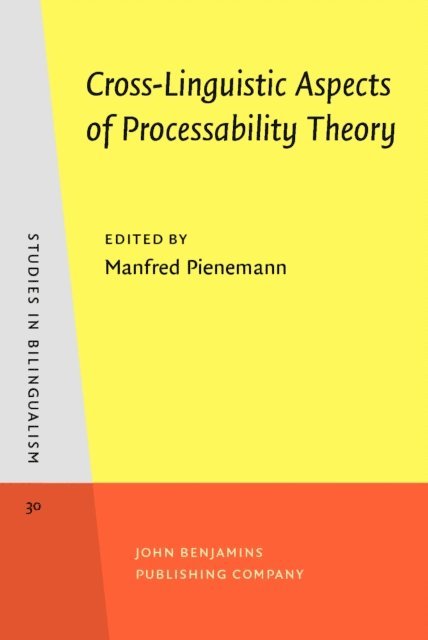
Seven years ago Manfred Pienemann proposed a novel psycholinguistic theory of language development, Processability Theory (PT). This volume examines the typological plausibility of PT. Focusing on the acquisition of Arabic, Chinese and Japanese the authors demonstrate the capacity of PT to make detailed and verifiable predictions about the developmental schedule for each language. This cross-linguistic perspective is also applied to the study of L1 transfer by comparing the impact of processability and typological proximity. The typological perspective is extended by including a comparison of different types of language acquisition. The architecture of PT is expanded by the addition of a second set of principles that contributes to the formal modeling of levels of processability, namely the mapping of argument-structure onto functional structure in lexical mapping theory. This step yields the inclusion of a range of additional phenomena in the processability hierarchy thus widening the scope of PT.