Plamondon Rejean Plamondon – författare
Visar alla böcker från författaren Plamondon Rejean Plamondon. Handla med fri frakt och snabb leverans.
5 produkter
Lognormality Principle And Its Applications In E-security, E-learning And E-health, The
Av Ferrer-ballester Miguel Angel Ferrer-ballester, Marcelli Angelo Marcelli m. fl.
E-bok, 2020
1676 kr
Lägg i varukorg
This compendium provides a detailed account of the lognormality principle characterizing the human motor behavior by summarizing a sound theoretical framework for modeling such a behavior, introducing the most recent algorithms for extracting the lognormal components of complex movements in 2, 2.5 …
Progress In Automatic Signature Verification
E-bok, 1994
630 kr
Lägg i varukorg
This volume highlights some of the multidisciplinary aspects of automatic signature verification. The first two chapters serve as an introduction. The first constitutes a review of the literature of the past five years. The second addresses the problem of parallel strategies to construct and …
Pattern Recognition: Architectures, Algorithms And Applications
Av Cheng Heng-da Cheng, Plamondon Rejean Plamondon
E-bok, 1991
881 kr
Lägg i varukorg
This book contains 15 reviewed papers selected from among those presented at the 4th Vision Interface Conference in Halifax, Canada 14 - 18 May 1990. The papers are grouped into three sections which deal with parallel architectures and neural networks, algorithms for analysis and processing, and …
Computer Processing Of Handwriting
Av Plamondon Rejean Plamondon, Leedham Graham Leedham
E-bok, 1990
887 kr
Lägg i varukorg
This book presents 17 selected papers from the 4th International Graphonomics Society Conference, held at the University of Trondheim (Norway) in July 1989. It focusses on different aspects of automatic processing of handwriting by computer. The book is divided into three sections. The first one …
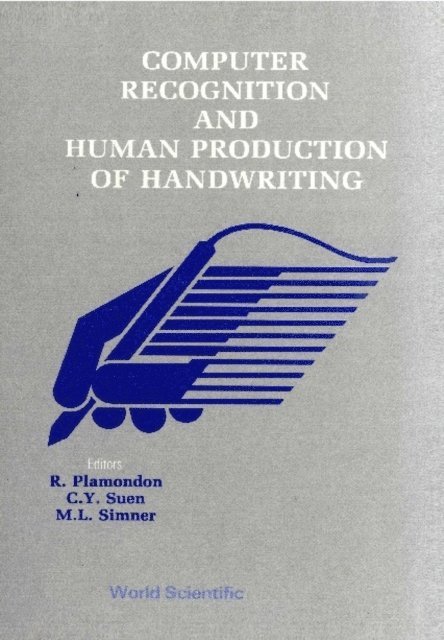
Computer Recognition And Human Production Of Handwriting
Av Simner Marvin L Simner, Plamondon Rejean Plamondon m. fl.
E-bok, 1989
657 kr
Lägg i varukorg
This book contains a representative cross section of critically reviewed papers from the Third International Symposium on Handwriting and Computer Applications (Montreal, 1987). The first section focuses on different aspects of computer recognition of handwriting such as signature analysis and …