Ramón Soneira Martínez – författare
Visar alla böcker från författaren . Handla med fri frakt och snabb leverans.
4 produkter
4 produkter
Inbunden, Engelska, 2024
1 444 kr
Skickas inom 3-6 vardagar
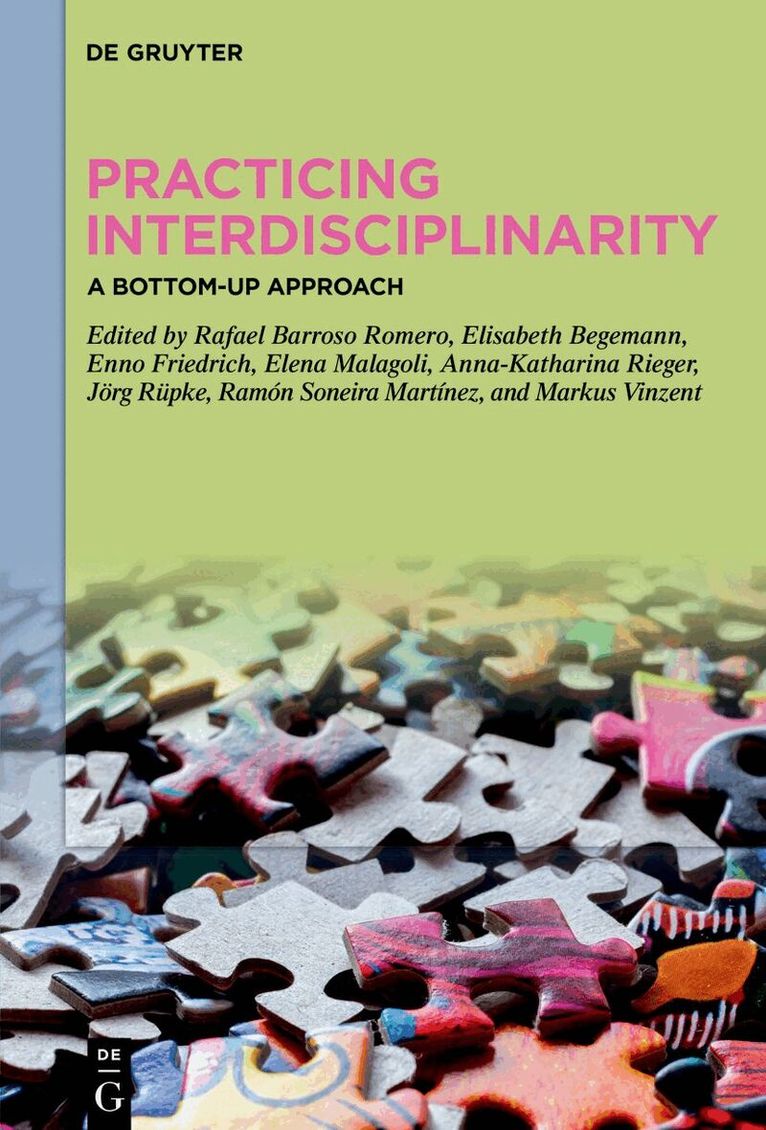
In interdisciplinary projects and research collaborations, participants face multiple demands. However, these expectations encounter a reality that is characterized by time pressure, high demands in one's own discipline, and often increasingly administrative tasks. What can meaningful interdisciplinary work look like in an academic environment? What tasks and constraints do researchers face? And, considering the range of disciplines involved, how can interdisciplinary research projects be designed in a successful way? How does one meaningfully bring different disciplines, their methods, and theories into conversation with each other across the spatial and temporal distance of their subjects? And all that in a way in which the yield is effective and visible in all subprojects? This publication sheds light on this issue by way of example. It reflects on and formulates the experiences and outcomes of interdisciplinary work of a humanities and social science research training group with disciplinary breadth as well as historical depth. The disciplines involved are ancient history, archaeology, art history, music didactics, North American history, patristics, philology (Latin/Greek studies), religious studies, sociology, and theology with the subjects Old and New Testament. In pairs of advanced and young scholars, individual experiences and identifiable results of interdisciplinary work in the respective contributions or research projects are recorded; on a next level, discipline-specific outcomes, but also problems are pinpointed; on a third level, collective experiences with interdisciplinary research displayed. The contributions take a variety of forms: reflections, dialogues, experience reports as well as perspective observations. Rafael Barroso Romero, Complutense University of Madrid, Spain, Elisabeth Begemann, Max-Weber-Kolleg Erfurt, Germany, Enno Friedrich, University of Rostock, Germany, Elena Malagoli, Max-Weber-Kolleg Erfurt, Germany, Anna-Katharina Rieger, University of Graz, Austria, Jörg Rüpke, Max-Weber-Kolleg Erfurt, Germany, Ramón Soneira Martínez, Austrian Archaeological Institute Vienna, Austria, Markus Vinzent, Max-Weber-Kolleg Erfurt, Germany.
Del 17 - Religionswissenschaft heute
Relational Atheism
Häftad, Engelska, 2026
667 kr
Skickas inom 3-6 vardagar
E-bok
PDF, Engelska, 2026643 kr
Läs direkt efter köp
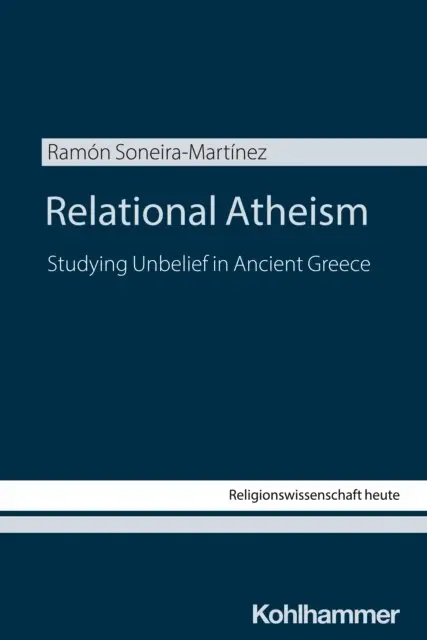
This book reorients the study of 'unbelief' in Ancient Greece by dismantling two persistent scholarly misconceptions: the portrayal of Greek atheism as a form of proto-modern secularity and the dismissal of the subject as merely a lexical dispute over definitions. By integrating a diverse range of philosophical, medical and epigraphical sources, the author contextualises irreligious stances within the discursive and social ecology that shaped Greek religiosity. Rather than representing an external negation of the divine, unbelief emerges as a historically specific modification of self-world relations. Leveraging relational sociology and contemporary Religious Studies, this analysis demonstrates how doubt, critique and denial took root within the fabric of lived ancient religion - from theatre and intellectual circles to civic conflict and the politics of impiety. The result is a transformative account of Greek unbelief and a transferable analytical model for future comparative and historical research.
E-bok
Engelska, 2026643 kr
Läs direkt efter köp
This book reorients the study of 'unbelief' in Ancient Greece by dismantling two persistent scholarly misconceptions: the portrayal of Greek atheism as a form of proto-modern secularity and the dismissal of the subject as merely a lexical dispute over definitions. By integrating a diverse range of philosophical, medical and epigraphical sources, the author contextualises irreligious stances within the discursive and social ecology that shaped Greek religiosity. Rather than representing an external negation of the divine, unbelief emerges as a historically specific modification of self-world relations. Leveraging relational sociology and contemporary Religious Studies, this analysis demonstrates how doubt, critique and denial took root within the fabric of lived ancient religion - from theatre and intellectual circles to civic conflict and the politics of impiety. The result is a transformative account of Greek unbelief and a transferable analytical model for future comparative and historical research.