Ravi A. Rao – författare
Visar alla böcker från författaren . Handla med fri frakt och snabb leverans.
4 produkter
4 produkter
Inbunden, Engelska, 2004
1 083 kr
Skickas inom 10-15 vardagar
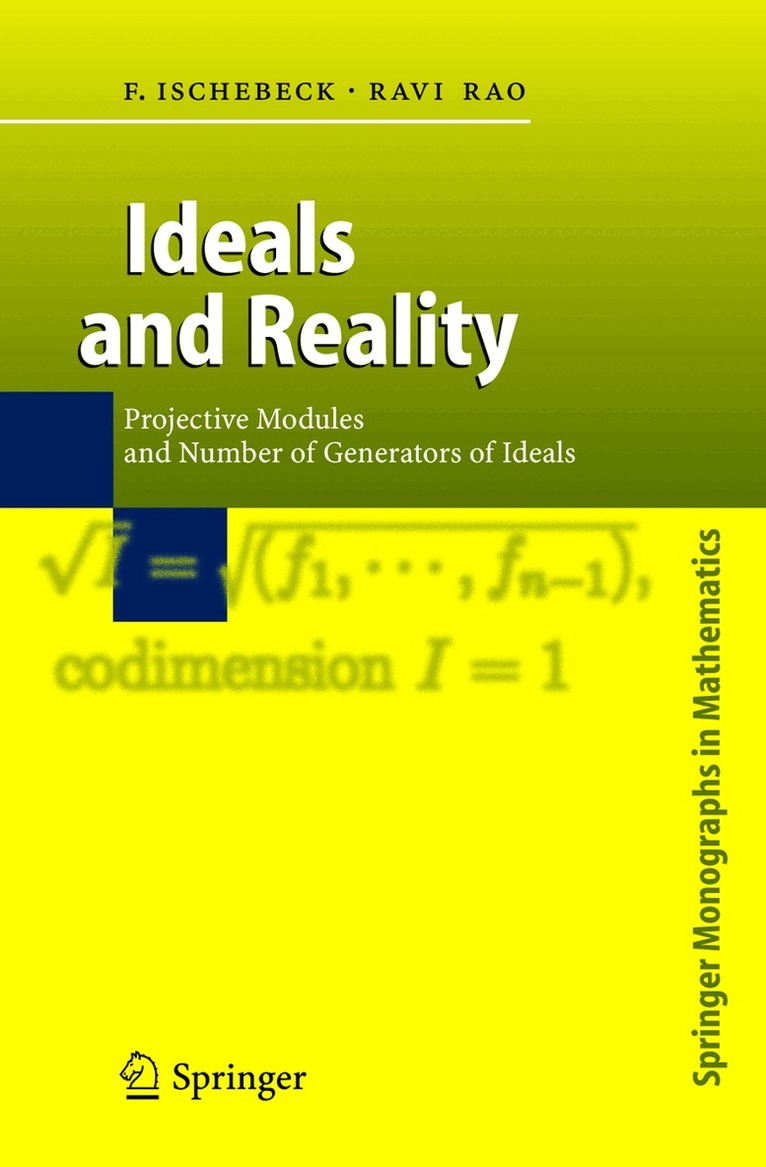
Besides giving an introduction to Commutative Algebra - the theory of c- mutative rings - this book is devoted to the study of projective modules and the minimal number of generators of modules and ideals. The notion of a module over a ring R is a generalization of that of a vector space over a field k. The axioms are identical. But whereas every vector space possesses a basis, a module need not always have one. Modules possessing a basis are called free. So a finitely generated free R-module is of the form Rn for some n E IN, equipped with the usual operations. A module is called p- jective, iff it is a direct summand of a free one. Especially a finitely generated R-module P is projective iff there is an R-module Q with P @ Q S Rn for some n. Remarkably enough there do exist nonfree projective modules. Even there are nonfree P such that P @ Rm S Rn for some m and n. Modules P having the latter property are called stably free. On the other hand there are many rings, all of whose projective modules are free, e. g. local rings and principal ideal domains. (A commutative ring is called local iff it has exactly one maximal ideal. ) For two decades it was a challenging problem whether every projective module over the polynomial ring k[X1,. . .
E-bok
PDF, Engelska, 20051 416 kr
Läs direkt efter köp
Besides giving an introduction to Commutative Algebra - the theory of c- mutative rings - this book is devoted to the study of projective modules and the minimal number of generators of modules and ideals. The notion of a module over a ring R is a generalization of that of a vector space over a field k. The axioms are identical. But whereas every vector space possesses a basis, a module need not always have one. Modules possessing a basis are called free. So a finitely generated free R-module is of the form Rn for some n E IN, equipped with the usual operations. A module is called p- jective, iff it is a direct summand of a free one. Especially a finitely generated R-module P is projective iff there is an R-module Q with P @ Q S Rn for some n. Remarkably enough there do exist nonfree projective modules. Even there are nonfree P such that P @ Rm S Rn for some m and n. Modules P having the latter property are called stably free. On the other hand there are many rings, all of whose projective modules are free, e. g. local rings and principal ideal domains. (A commutative ring is called local iff it has exactly one maximal ideal. ) For two decades it was a challenging problem whether every projective module over the polynomial ring k[X1,. . .
Häftad, Engelska, 2010
1 083 kr
Skickas inom 10-15 vardagar
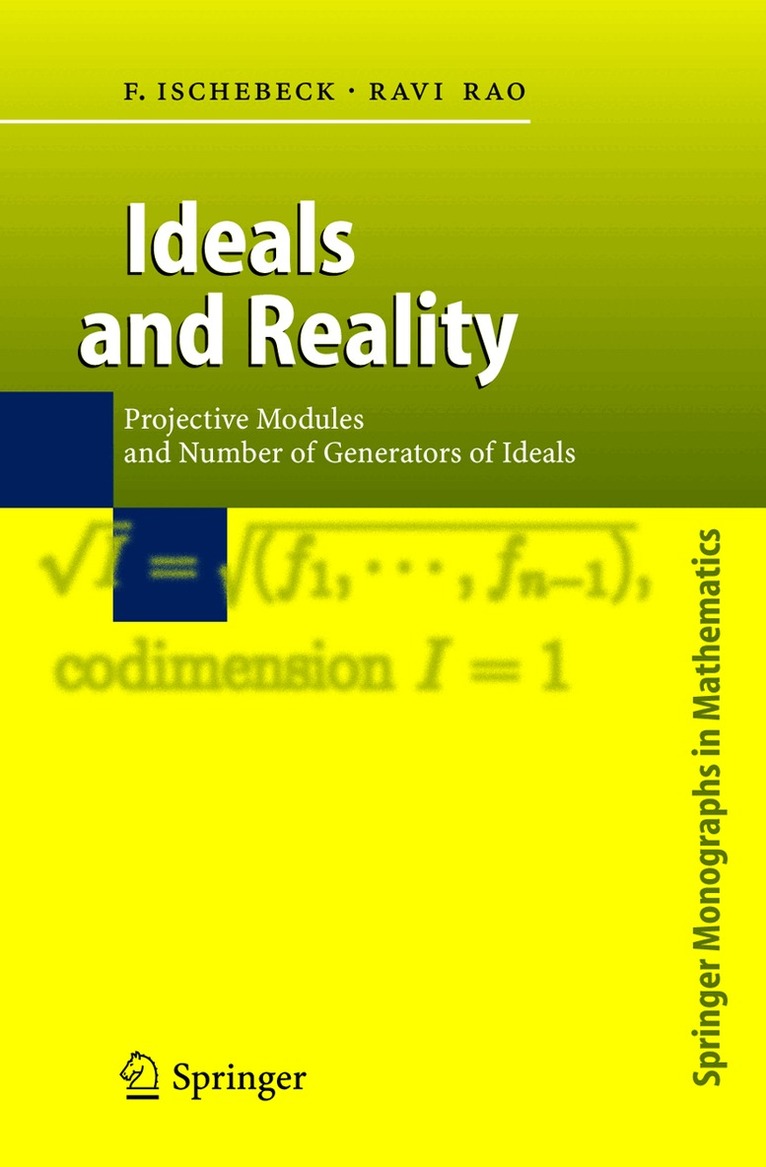
Besides giving an introduction to Commutative Algebra - the theory of c- mutative rings - this book is devoted to the study of projective modules and the minimal number of generators of modules and ideals. The notion of a module over a ring R is a generalization of that of a vector space over a field k. The axioms are identical. But whereas every vector space possesses a basis, a module need not always have one. Modules possessing a basis are called free. So a finitely generated free R-module is of the form Rn for some n E IN, equipped with the usual operations. A module is called p- jective, iff it is a direct summand of a free one. Especially a finitely generated R-module P is projective iff there is an R-module Q with P @ Q S Rn for some n. Remarkably enough there do exist nonfree projective modules. Even there are nonfree P such that P @ Rm S Rn for some m and n. Modules P having the latter property are called stably free. On the other hand there are many rings, all of whose projective modules are free, e. g. local rings and principal ideal domains. (A commutative ring is called local iff it has exactly one maximal ideal. ) For two decades it was a challenging problem whether every projective module over the polynomial ring k[X1,. . .
Inbunden, Engelska, 2019
2 192 kr
Skickas inom 5-8 vardagar
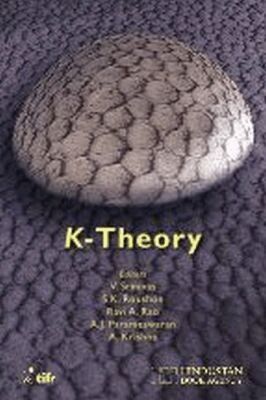
This volume contains the proceedings of the international colloquium organized by the Tata Institute of Fundamental Research in January 2016, one of a series of colloquia going back to 1956.The talks at the colloquium covered a wide spectrum of mathematics, ranging over algebraic geometry, topology, algebraic $K$-theory and number theory. Algebraic theory, $\mathbb{A}^1$-homotopy theory and topological $K$-theory formed important sub-streams in this colloquium. Several branches of $K$-theory, like algebraic cycles, triangulated categories of motives, motivic cohomology, motivic homotopy theory, Chow groups of varieties, Euler class theory, equivariant $K$-theory as well as classical $K$-theory have developed considerably in recent years, giving rise to newer directions to the subject as well as proving results of ``classical'' interest. The colloquium brought together experts in these various branches and their talks covered this wide spectrum, highlighting the interconnections and giving a better perspective of the whole subject area.This volume contains refereed articles by leading experts in these fields and includes original results as well as expository materials in these areas.