Richard L. Anderson – författare
Visar alla böcker från författaren Richard L. Anderson. Handla med fri frakt och snabb leverans.
6 produkter
6 produkter
Del 9 - American Academy of Ophthalmology Monograph Series
Surgical Anatomy of the Ocular Adnexa
A Clinical Approach
Inbunden, Engelska, 2012
4 162 kr
Skickas inom 7-10 vardagar
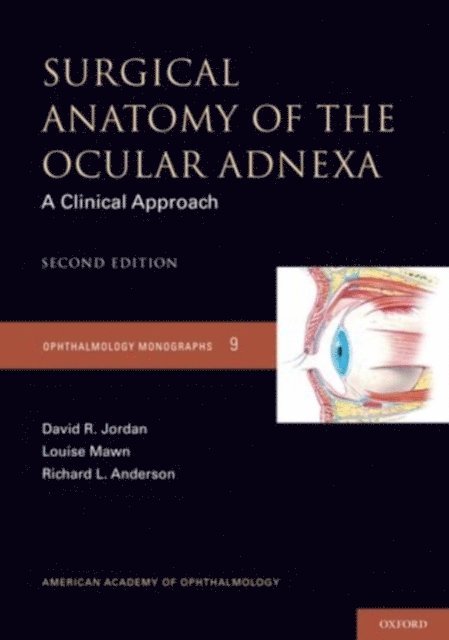
Surgical Anatomy of the Ocular Adnexa is a beautifully and thoughtfully illustrated anatomical text that provides the ophthalmic surgeon or any surgeon working in the eyelid/orbital region with detailed yet concise, easy to read and understand descriptions of the anatomy in any particular region of the eyelid, orbit or nasolacrimal system. Throughout the text are clinical pearls and vignettes to help the reader appreciate why certain anatomical features are important to understand. Key anatomical concepts are highlighted and easy to visualize with real cadaver photos as well as the artists rendition of the same region.This book:- Develops a thorough understanding of the anatomy in the eyelid, orbit, nasolacriaml and periocular regions.- Fosters an appreciation of how knowledge of the anatomy leads to a better understanding of the pathophysiology of various disease processes involving the eyelid, orbit, nasolacrimal and periocular region.- Conveys the importance of anatomy in the surgical approach to various disease processes in the eyelid, orbit, nasolacrimal and periocular regions.This second edition will be an invaluable guidel to all those working in the eyelid, orbital, and nasolacrimal areas including residents, fellows and staff in ophthalmology, otolaryngology/head and neck surgery, plastic surgery and neurosurgeons working in and around the orbit.
E-bok
PDF, Engelska, 20122 353 kr
Läs direkt efter köp
Surgical Anatomy of the Ocular Adnexa is a beautifully and thoughtfully illustrated anatomical text that provides the ophthalmic surgeon or any surgeon working in the eyelid/orbital region with detailed yet concise, easy to read and understand descriptions of the anatomy in any particular region of the eyelid, orbit or nasolacrimal system. Throughout the text are clinical pearls and vignettes to help the reader appreciate why certain anatomical features are important to understand. Key anatomical concepts are highlighted and easy to visualize with real cadaver photos as well as the artists rendition of the same region.This book:- Develops a thorough understanding of the anatomy in the eyelid, orbit, nasolacriaml and periocular regions.- Fosters an appreciation of how knowledge of the anatomy leads to a better understanding of the pathophysiology of various disease processes involving the eyelid, orbit, nasolacrimal and periocular region.- Conveys the importance of anatomy in the surgical approach to various disease processes in the eyelid, orbit, nasolacrimal and periocular regions.This second edition will be an invaluable guidel to all those working in the eyelid, orbital, and nasolacrimal areas including residents, fellows and staff in ophthalmology, otolaryngology/head and neck surgery, plastic surgery and neurosurgeons working in and around the orbit.
Häftad, Engelska, 2015
228 kr
Skickas inom 5-8 vardagar
Häftad, Engelska, 2008
756 kr
Skickas inom 10-15 vardagar
The relationship between a person with a question and a source of information is complex. Indexing and abstracting often fail because too much emphasis is put on the mechanics of description and too little on what ought to be represented. Research literature suggests that inappropriate representation results in failed searches a significant number of times, perhaps even in a majority of cases. Doing Things with Information seeks to rectify this unfortunate situation by emphasizing methods of modeling and constructing appropriate representations of such questions and documents. Students in programs of information studies will find focal points for discussion about system design and refinement of existing systems. Librarians, scholars, and those who work within large document collections, whether paper or electronic, will find insights into the strengths and weaknesses of the access systems they use.
Häftad, Engelska, 2019
372 kr
Skickas inom 10-15 vardagar
For over a century, motion pictures have entertained us, occasionally educated us, and even served a few specialized fields of study. Now, however, with the precipitous drop in prices and increase in image quality, motion pictures are as widespread as paperback books and postcards once were. Yet, theories and practices of analysis for particular genres and analytical stances, definitions, concepts, and tools that span platforms have been wanting. Therefore, we developed a suite of tools to enable close structural analysis of the time-varying signal set of a movie. We take an information-theoretic approach (message is a signal set) generated (coded) under various antecedents (sent over some channel) decoded under some other set of antecedents. Cultural, technical, and personal antecedents might favor certain message-making systems over others. The same holds true at the recipient end-yet, the signal set remains the signal set. In order to discover how movies work-their structure and meaning-we honed ways to provide pixel level analysis, forms of clustering, and precise descriptions of what parts of a signal influence viewer behavior. We assert that analysis of the signal set across the evolution of film—from Edison to Hollywood to Brakhage to cats on social media—yields a common ontology with instantiations (responses to changes in coding and decoding antecedents).
E-bok
PDF, Engelska, 2022444 kr
Läs direkt efter köp
For over a century, motion pictures have entertained us, occasionally educated us, and even served a few specialized fields of study. Now, however, with the precipitous drop in prices and increase in image quality, motion pictures are as widespread as paperback books and postcards once were. Yet, theories and practices of analysis for particular genres and analytical stances, definitions, concepts, and tools that span platforms have been wanting. Therefore, we developed a suite of tools to enable close structural analysis of the time-varying signal set of a movie. We take an information-theoretic approach (message is a signal set) generated (coded) under various antecedents (sent over some channel) decoded under some other set of antecedents. Cultural, technical, and personal antecedents might favor certain message-making systems over others. The same holds true at the recipient end-yet, the signal set remains the signal set. In order to discover how movies work-their structure and meaning-we honed ways to provide pixel level analysis, forms of clustering, and precise descriptions of what parts of a signal influence viewer behavior. We assert that analysis of the signal set across the evolution of film—from Edison to Hollywood to Brakhage to cats on social media—yields a common ontology with instantiations (responses to changes in coding and decoding antecedents).