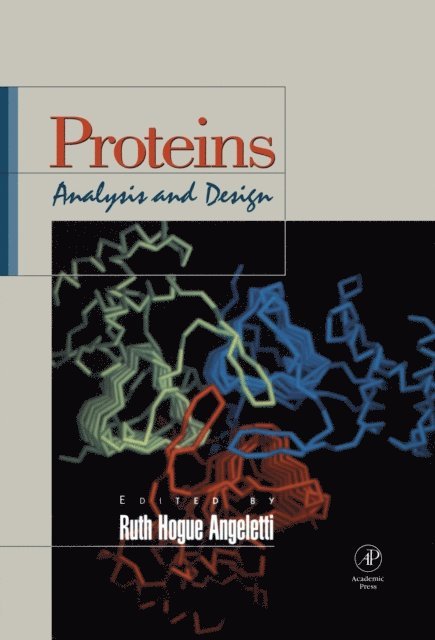
Proteins: Analysis and Design focuses solely on individual experimental approaches, rather than on specific classes of proteins. The book provides insight into the important issues in protein science and how one can cope with them. These include all issues which explore the detailed relationship of protein structure to function.- Provides problems and technical solutions- Includes posttranslational modifications- Uses synthetic peptides as biological models- Details mutagenesis and protein engineering- Covers design of protein structure and function
Techniques in Protein Chemistry III compiles papers presented at the Fifth Protein Society Symposium in Baltimore on June 22-26, 1991. This book discusses the protein and peptide recovery from PVDF membranes; high-sensitivity peptide mapping utilizing reversed-phase microbore and microcolumn liquid chromatography; and capillary electrophoresis for preparation of peptides and direct determination of amino acids. The TFMSA/TFA cleavage in t-Boc peptide synthesis; applications of automatic PTC amino acid analysis; and identification of O-glycosylation sites with a gas phase sequencer are also elaborated. This text likewise covers the conformational stability of the molten globule of cytochrome c and role of aqueous solvation in protein folding. This publication is useful to students and researchers interested in methods and research approaches on protein chemistry.
Techniques in Protein Chemistry IV compiles papers presented at the Sixth Protein Society Symposium held in San Diego, California in 1992. This book discusses the mass spectrometry in protein sequence and structural investigations; site specific heterogeneity of N-linked oligosaccharides on recombinant human erythropoietin; and modification of thiophosphorylated proteins with extrinsic probes. The cysteine and tryptophan amino acid analysis of ABRF92-AAA; development of separation strategies for proteins by capillary electrophoresis; and peptide mapping of 2-D gel proteins by capillary HPLC are also elaborated. This text likewise covers the single syringe-pump solid-phase protein sequencer; hydrophobic contact density distribution functions; and application of chemical shift calculation to protein structure determination by NMR. This publication is valuable to biologists and students concerned with the developments in mass spectrometry of proteins.
Proteins: Analysis and Design focuses solely on individual experimental approaches, rather than on specific classes of proteins. The book provides insight into the important issues in protein science and how one can cope with them. These include all issues which explore the detailed relationship of protein structure to function.- Provides problems and technical solutions- Includes posttranslational modifications- Uses synthetic peptides as biological models- Details mutagenesis and protein engineering- Covers design of protein structure and function
Techniques in Protein Chemistry III compiles papers presented at the Fifth Protein Society Symposium in Baltimore on June 22-26, 1991. This book discusses the protein and peptide recovery from PVDF membranes; high-sensitivity peptide mapping utilizing reversed-phase microbore and microcolumn liquid chromatography; and capillary electrophoresis for preparation of peptides and direct determination of amino acids. The TFMSA/TFA cleavage in t-Boc peptide synthesis; applications of automatic PTC amino acid analysis; and identification of O-glycosylation sites with a gas phase sequencer are also elaborated. This text likewise covers the conformational stability of the molten globule of cytochrome c and role of aqueous solvation in protein folding. This publication is useful to students and researchers interested in methods and research approaches on protein chemistry.
Techniques in Protein Chemistry IV compiles papers presented at the Sixth Protein Society Symposium held in San Diego, California in 1992. This book discusses the mass spectrometry in protein sequence and structural investigations; site specific heterogeneity of N-linked oligosaccharides on recombinant human erythropoietin; and modification of thiophosphorylated proteins with extrinsic probes. The cysteine and tryptophan amino acid analysis of ABRF92-AAA; development of separation strategies for proteins by capillary electrophoresis; and peptide mapping of 2-D gel proteins by capillary HPLC are also elaborated. This text likewise covers the single syringe-pump solid-phase protein sequencer; hydrophobic contact density distribution functions; and application of chemical shift calculation to protein structure determination by NMR. This publication is valuable to biologists and students concerned with the developments in mass spectrometry of proteins.