R.W. Carlson – författare
Visar alla böcker från författaren R.W. Carlson. Handla med fri frakt och snabb leverans.
3 produkter
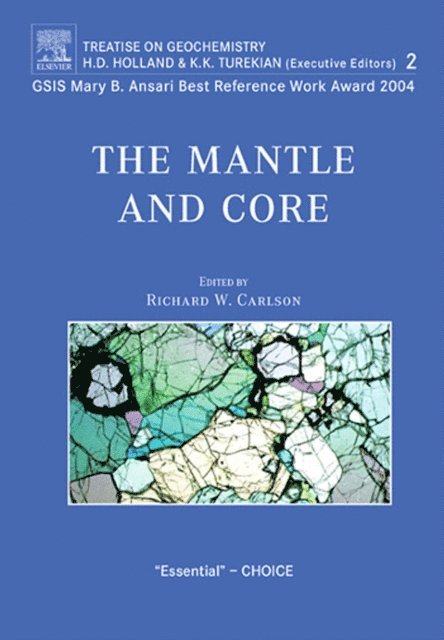
The Mantle and Core
Treatise on Geochemistry,Volume 2
Av R.W. Carlson
Häftad, 2005
1098 kr
Lägg i varukorg
Though largely inaccessible, the geochemistry of Earth's mantle and core can be examined through a wide variety of approaches. Volume 2 focuses first on "remote" sensing using evidence from cosmochemical, seismic, petrologic and geochemical approaches. Mantle composition is then examined in detail …
Mantle and Core
Treatise on Geochemistry,Volume 2
Av R.W. Carlson
E-bok, 2005
1174 kr
Lägg i varukorg
Though largely inaccessible, the geochemistry of Earth''s mantle and core can be examined through a wide variety of approaches. Volume 2 focuses first on "remote" sensing using evidence from cosmochemical, seismic, petrologic and geochemical approaches. Mantle composition is then examined in detail …
A Tale of Two Cratons
The Slave Kaapvaal Workshop
Av H.S. Gr�tter, A. G. Jones m. fl.
Inbunden, 2004
1870 kr
Tillfälligt slut
Given the established nature of geoscientific knowledge of the Kaapvaal craton compared to the Slave craton, and given the exciting new interdisciplinary results coming from the Kaapvaal Project and from Slave craton studies, scientists working on both cratons were brought together in a workshop to …