S Balasivanandha Prabu – författare
Visar alla böcker från författaren S Balasivanandha Prabu. Handla med fri frakt och snabb leverans.
4 produkter
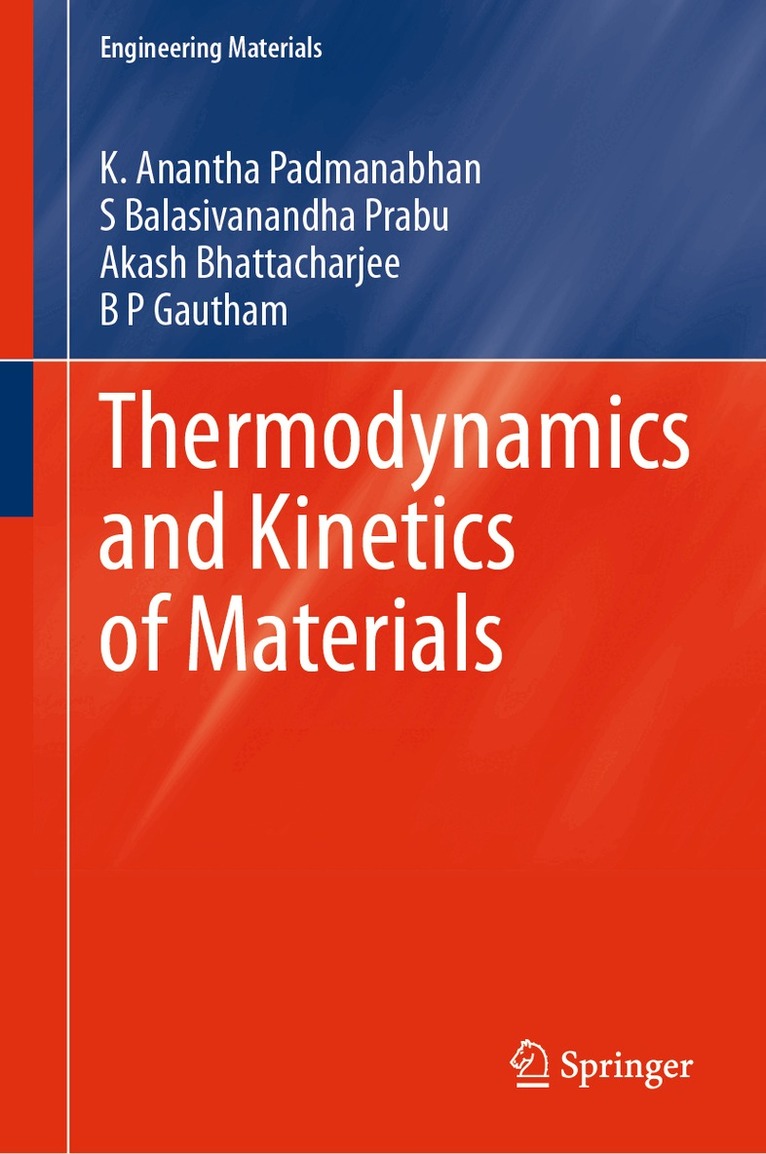
Thermodynamics and Kinetics of Materials
Av K. Anantha Padmanabhan, S Balasivanandha Prabu m. fl.
Inbunden, 2026
764 kr
Lägg i varukorg
This book provides a comprehensive exploration of the fundamental principles of thermodynamics and kinetics in materials science, offering a balanced integration of theoretical frameworks, computational methodologies, and real-world applications. Covering both equilibrium and non-equilibrium …
Thermodynamics and Kinetics of Materials
Av B P Gautham, Akash Bhattacharjee m. fl.
E-bok, 2026
957 kr
Lägg i varukorg
This book provides a comprehensive exploration of the fundamental principles of thermodynamics and kinetics in materials science, offering a balanced integration of theoretical frameworks, computational methodologies, and real-world applications. Covering both equilibrium and non-equilibrium …
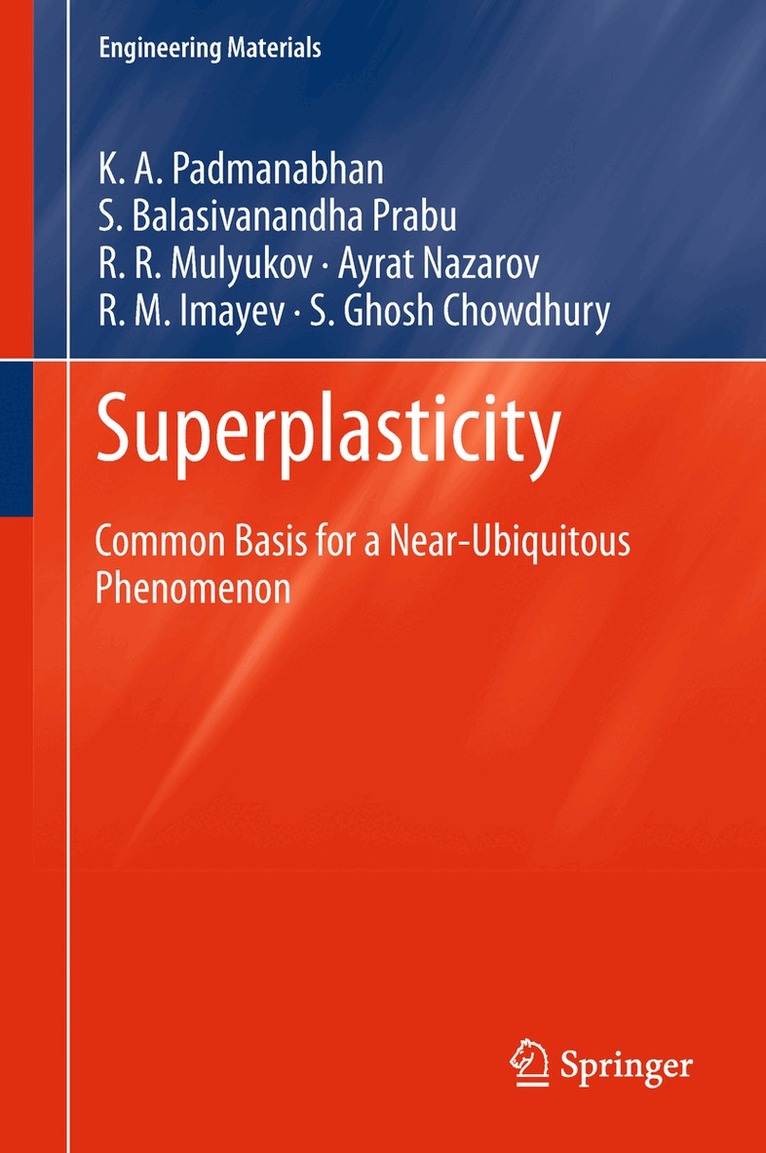
Superplasticity
Common Basis for a Near-Ubiquitous Phenomenon
Av K. A. Padmanabhan, S. Balasivanandha Prabu m. fl.
Inbunden, 2018
1955 kr
Lägg i varukorg
This book combines the perspectives of materials science of Superplasticity, on the one hand, and those of design and mechanics, on the other, in order to provide a holistic view of materials, design, mechanics and performance which will lead to useful solutions of societal benefits, in addition to …
Superplasticity
Common Basis for a Near-Ubiquitous Phenomenon
Av S. Ghosh Chowdhury, R. M. Imayev m. fl.
E-bok, 2018
2599 kr
Lägg i varukorg
This book combines the perspectives of materials science of Superplasticity, on the one hand, and those of design and mechanics, on the other, in order to provide a holistic view of materials, design, mechanics and performance which will lead to useful solutions of societal benefits, in addition to …