Serge-Christophe Kolm - Böcker
Visar alla böcker från författaren Serge-Christophe Kolm. Handla med fri frakt och snabb leverans.
7 produkter
7 produkter
70 kr
Tillfälligt slut
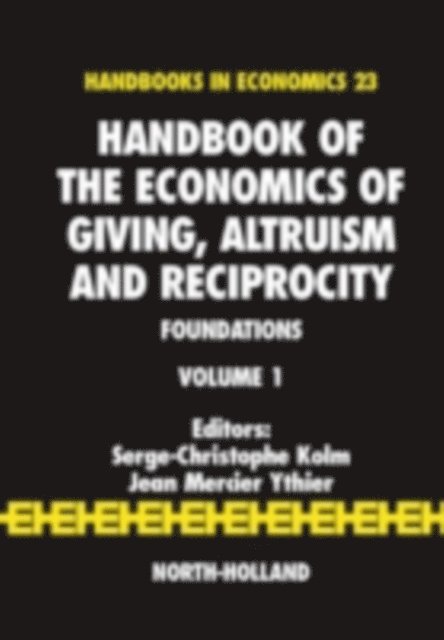
Del 1 - Handbook of the Economics of Giving, Reciprocity and Altruism
Handbook of the Economics of Giving, Altruism and Reciprocity
Foundations
Inbunden, Engelska, 2006
1 532 kr
Skickas inom 7-10 vardagar
The Handbook on the Economics of Giving, Reciprocity and Altruism provides a comprehensive set of reviews of literature on the economics of nonmarket voluntary transfers. The foundations of the field are reviewed first, with a sequence of chapters that present the hard core of the theoretical and empirical analyses of giving, reciprocity and altruism in economics, examining their relations with the viewpoints of moral philosophy, psychology, sociobiology, sociology and economic anthropology. Secondly, a comprehensive set of applications are considered of all the aspects of society where nonmarket voluntary transfers are significant: family and intergenerational transfers; charity and charitable institutions; the nonprofit economy; interpersonal relations in the workplace; the Welfare State; and international aid.*Every volume contains contributions from leading researchers*Each Handbook presents an accurate, self-contained survey of a particular topic *The series provides comprehensive and accessible surveys
Del 2 - Handbook of the Economics of Giving, Reciprocity and Altruism
Handbook of the Economics of Giving, Altruism and Reciprocity
Applications
Inbunden, Engelska, 2006
1 389 kr
Skickas inom 7-10 vardagar
The Handbook on the Economics of Giving, Reciprocity and Altruism provides a comprehensive set of reviews of literature on the economics of nonmarket voluntary transfers. The foundations of the field are reviewed first, with a sequence of chapters that present the hard core of the theoretical and empirical analyses of giving, reciprocity and altruism in economics, examining their relations with the viewpoints of moral philosophy, psychology, sociobiology, sociology and economic anthropology. Secondly, a comprehensive set of applications are considered of all the aspects of society where nonmarket voluntary transfers are significant: family and intergenerational transfers; charity and charitable institutions; the nonprofit economy; interpersonal relations in the workplace; the Welfare State; and international aid.*Every volume contains contributions from leading researchers*Each Handbook presents an accurate, self-contained survey of a particular topic *The series provides comprehensive and accessible surveys
577 kr
Skickas inom 7-10 vardagar
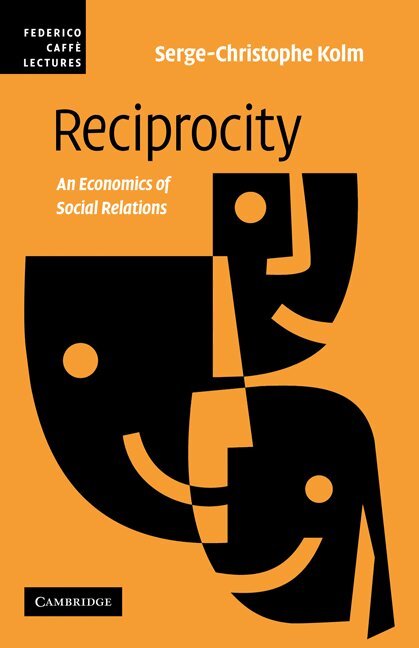
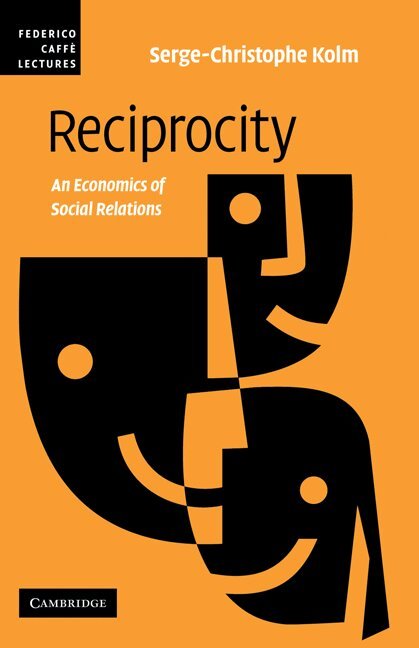
Reciprocity is the basis of social relations. It permits a peaceful and free society in which people and rights are respected. The essence of families and communities, it also enables the working of markets and organisations, while correcting their main failures. Reciprocity is also a basis of politics, and it justifies social policies. Although the importance of reciprocity has been widely recognised in other social sciences, it has, until recently, been somewhat ignored in economic analysis. Over the past three decades, economic theorist and moral philosopher Serge-Christophe Kolm has been at the forefront of research into the economics of the deepest aspects of societies. In Reciprocity, he provides a unique in-depth analysis of the motives, conducts, and effects of reciprocal relationships. In doing this, he explains crucial functionings of society and its economy, and the ways in which they can be improved. This book should be read by economists, sociologists, philosophers, and anyone concerned with understanding the economy of social relationships and its far-reaching consequences.
586 kr
Skickas inom 7-10 vardagar
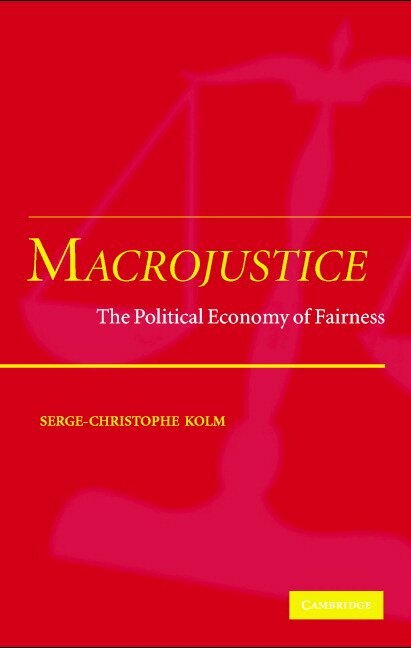
The main features of the just society, as they would be chosen by the unanimous, impartial, and fully informed judgment of its members, present a remarkable and simple meaningful structure. In this society, individuals' freedom is fully respected, and overall redistribution amounts to an equal sharing of individuals' different earnings obtained by the same limited 'equalization labour'. The concept of equalization labour is a measure of the degree of community, solidarity, reciprocity, redistribution, and equalization of the society under consideration. It is determined by a number of methods presented in this study, which also emphasizes the rationality, meanings, properties, and ways of practical implementation of this optimum distribution. This result is compared with the various distributive principles found in practice and in political, philosophical, and economic thinking, with the conclusion that most have their proper specific scope of application. The analytical presentation of the social ethics of economics is particularly enlightening.
1 126 kr
Skickas inom 7-10 vardagar
The main features of the just society, as they would be chosen by the unanimous, impartial, and fully informed judgment of its members, present a remarkable and simple meaningful structure. In this society, individuals' freedom is fully respected, and overall redistribution amounts to an equal sharing of individuals' different earnings obtained by the same limited 'equalization labour'. The concept of equalization labour is a measure of the degree of community, solidarity, reciprocity, redistribution, and equalization of the society under consideration. It is determined by a number of methods presented in this study, which also emphasizes the rationality, meanings, properties, and ways of practical implementation of this optimum distribution. This result is compared with the various distributive principles found in practice and in political, philosophical, and economic thinking, with the conclusion that most have their proper specific scope of application. The analytical presentation of the social ethics of economics is particularly enlightening.
1 499 kr
Skickas inom 7-10 vardagar
Reciprocity is the basis of social relations. It permits a peaceful and free society in which people and rights are respected. The essence of families and communities, it also enables the working of markets and organisations, while correcting their main failures. Reciprocity is also a basis of politics, and it justifies social policies. Although the importance of reciprocity has been widely recognised in other social sciences, it has, until recently, been somewhat ignored in economic analysis. Over the past three decades, economic theorist and moral philosopher Serge-Christophe Kolm has been at the forefront of research into the economics of the deepest aspects of societies. In Reciprocity, he provides a unique in-depth analysis of the motives, conducts, and effects of reciprocal relationships. In doing this, he explains crucial functionings of society and its economy, and the ways in which they can be improved. This book should be read by economists, sociologists, philosophers, and anyone concerned with understanding the economy of social relationships and its far-reaching consequences.