Shantanu Kumar – författare
Visar alla böcker från författaren . Handla med fri frakt och snabb leverans.
5 produkter
5 produkter
E-bok
PDF, Engelska, 20261 844 kr
Läs direkt efter köp
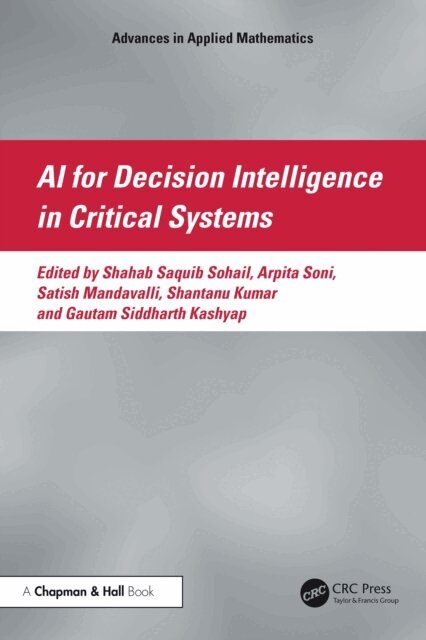
This book is a multi-disciplinary reference on how domain-aware artificial intelligence (AI) models can outperform generic approaches by addressing sector-specific complexities. It offers comparative frameworks, reproducible case studies, and real-world applications of emerging AI methods.Collectively, AI for Decision Intelligence in Critical Systems emphasizes a unifying theme: the effective deployment of AI to strengthen decision-making, enhance system reliability, and mitigate risks in domains where precision, trust, and efficiency are critical.This edited volume brings together twenty-one chapters of original research, each exploring how AI, machine learning (ML), and deep learning (DL) are shaping innovation across critical domains. The book highlights the application of advanced architectures-including Convolutional Neural Networks (CNNs), Quaternion Neural Networks (QCNNs), Large Language Models (LLMs), and Gradient-Boosted Decision Trees (GBDTs)-to solve complex, domain-specific challenges.Concerning computer vision and infrastructure safety, chapters discuss the use of CNNs and QCNNs for automated road crack detection, offering scalable approaches to improving transportation safety while reducing dependence on manual inspections. With regard to software engineering, contributions focus on leveraging ML, DL, and LLMs to enhance software quality assurance, minimize defects, and improve resilience in high-stakes industries. Additional chapters examine ML-driven methods, particularly GBDT, to uncover non-linear drivers of equity valuation across sectors, supporting more accurate forecasts and risk-sensitive decision-making.Academics and researchers in computer science, AI, and data science, industry professionals in transportation, software engineering, finance, and policymakers seeking to apply AI systems effectively will find this book useful.
E-bok
Engelska, 20261 844 kr
Läs direkt efter köp
This book is a multi-disciplinary reference on how domain-aware artificial intelligence (AI) models can outperform generic approaches by addressing sector-specific complexities. It offers comparative frameworks, reproducible case studies, and real-world applications of emerging AI methods.Collectively, AI for Decision Intelligence in Critical Systems emphasizes a unifying theme: the effective deployment of AI to strengthen decision-making, enhance system reliability, and mitigate risks in domains where precision, trust, and efficiency are critical.This edited volume brings together twenty-one chapters of original research, each exploring how AI, machine learning (ML), and deep learning (DL) are shaping innovation across critical domains. The book highlights the application of advanced architectures-including Convolutional Neural Networks (CNNs), Quaternion Neural Networks (QCNNs), Large Language Models (LLMs), and Gradient-Boosted Decision Trees (GBDTs)-to solve complex, domain-specific challenges.Concerning computer vision and infrastructure safety, chapters discuss the use of CNNs and QCNNs for automated road crack detection, offering scalable approaches to improving transportation safety while reducing dependence on manual inspections. With regard to software engineering, contributions focus on leveraging ML, DL, and LLMs to enhance software quality assurance, minimize defects, and improve resilience in high-stakes industries. Additional chapters examine ML-driven methods, particularly GBDT, to uncover non-linear drivers of equity valuation across sectors, supporting more accurate forecasts and risk-sensitive decision-making.Academics and researchers in computer science, AI, and data science, industry professionals in transportation, software engineering, finance, and policymakers seeking to apply AI systems effectively will find this book useful.
Häftad, Engelska, 2015
519 kr
Skickas inom 5-8 vardagar
E-bok
Engelska, 2015381 kr
Läs direkt efter köp
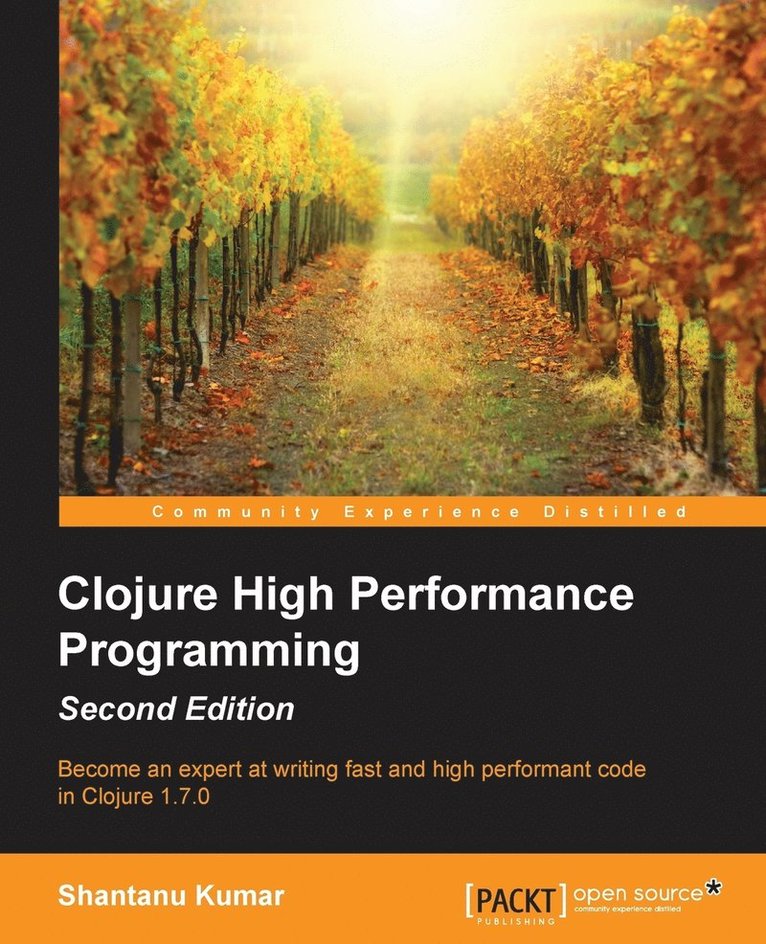
Become an expert at writing fast and high performant code in Clojure 1.7.0About This Book• Enhance code performance by using appropriate Clojure features• Improve the efficiency of applications and plan their deployment• A hands-on guide to designing Clojure programs to get the best performanceWho This Book Is ForThis book is intended for intermediate Clojure developers who are looking to get a good grip on achieving optimum performance. Having a basic knowledge of Java would be helpful.What You Will Learn• Identify performance issues in Clojure programs using different profiling tools• Master techniques to achieve numerical performance in Clojure• Use Criterium library to measure latency of Clojure expressions• Exploit Java features in Clojure code to enhance performance• Avoid reflection and boxing with type hints• Understand Clojure''s concurrency and state-management primitives in depth• Measure and monitor performance, and understand optimization techniquesIn DetailClojure treats code as data and has a macro system. It focuses on programming with immutable values and explicit progression-of-time constructs, which are intended to facilitate the development of more robust programs, particularly multithreaded ones. It is built with performance, pragmatism, and simplicity in mind. Like most general purpose languages, various Clojure features have different performance characteristics that one should know in order to write high performance code.This book shows you how to evaluate the performance implications of various Clojure abstractions, discover their underpinnings, and apply the right approach for optimum performance in real-world programs.It starts by helping you classify various use cases and the need for them with respect to performance and analysis of various performance aspects. You will also learn the performance vocabulary that experts use throughout the world and discover various Clojure data structures, abstractions, and their performance characteristics. Further, the book will guide you through enhancing performance by using Java interoperability and JVM-specific features from Clojure. It also highlights the importance of using the right concurrent data structure and Java concurrency abstractions.This book also sheds light on performance metrics for measuring, how to measure, and how to visualize and monitor the collected data. At the end of the book, you will learn to run a performance profiler, identify bottlenecks, tune performance, and refactor code to get a better performance.Style and approachAn easy-to-follow guide full of real-world examples and self-sufficient code snippets that will help you get your hands dirty with high performance programming with Clojure.
Häftad, Engelska, 2025
342 kr
Skickas inom 5-8 vardagar