
Silja HA¤usermann – författare
Visar alla böcker från författaren Silja HA¤usermann. Handla med fri frakt och snabb leverans.
2 produkter
2 produkter
E-bok
Engelska, 2022928 kr
Läs direkt efter köp
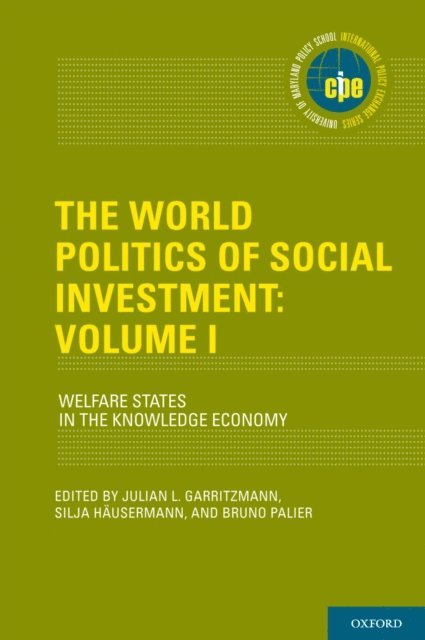
Welfare states around the globe are changing, challenged by the development of knowledge economies. In many countries, policy-makers'' main response has been to modernize welfare states by focusing on future-oriented social investment policies that focus on creating, mobilizing, and preserving human skills and capabilities. Yet, there is massive variance in the development of social investment strategies. The World Politics of Social Investment: Welfare States in the 21st Century is the first of two volumes of the World Politics of Social Investment (WOPSI) project, which systematically maps and explains different welfare reform strategies in democratic countries around the world. This volume develops a theory on the political and socio-economic conditions for the development of social investment policies around the globe, and studies the impact of the main explanatory factors on the empirical variety of social investment reforms (and non-social investment reforms). It also proposes a new typology of different welfare reform strategies, distinguishing nine types of social investment strategies depending on their functions (creating, mobilizing and preserving human skill and capabilities) and their distributive profiles (inclusive, stratified or targeted), and three types of non-social investment welfare strategies (market liberalism, social protectionism and basic income). The chapters of this volume are written by leading social policy scholars from different disciplines and countries, who apply the WOPSI global theoretical framework in a range of contexts and policy fields, shedding light on the scope conditions of social investment, as well as political demand- and supply-side drivers of social investment reforms. This volume on its own or in conjunction with the second volume is an invaluable resource on the state of modern welfare and social investment policies from around the globe.

E-bok
Engelska, 2022739 kr
Läs direkt efter köp
Welfare states around the globe are changing, challenged by the development of knowledge economies. In many countries, policy-makers'' main response has been to modernize welfare states by focusing on future-oriented social investment policies that focus on creating, mobilizing, and preserving human skills and capabilities. Yet, there is massive variance in the development of social investment strategies. The World Politics of Social Investment: Political Dynamics of Reform is the second of two volumes of the World Politics of Social Investment (WOPSI) project, which systematically maps and explains different welfare reform strategies in democratic countries around the world. This volume traces the development of social investment reforms across the regions of Nordic, Continental, and Southern Europe, as well as Central and Eastern Europe, North and Latin America, and North East Asia. The chapters in this volume study the impact of different structural drivers for social investment (e.g., demographic, poverty, demand for skill, or lack of an available workforce), the salience of social investment in the public debates, and the different political coalitions that led to or prevented the adoption of social investment strategies. The chapters are written by leading social policy scholars from different world regions. They all apply a joint theoretical framework (developed in the first of the two volumes) to explain the politics of social investment in a range of contexts and policy fields. Jointly with the first volume, the WOPSI project offers the first worldwide analysis of social investment reforms around the globe.