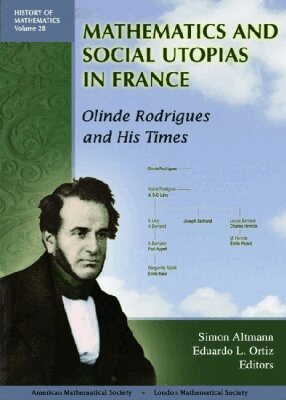
Social reformer, banker, and mathematician, Olinde Rodrigues is a fascinating figure of nineteenth-century Paris. Information about him is obscure--scattered in publications on history, mathematics, and the social sciences--and often inaccurate. Rodrigues left no papers or archives. Here, for the first time, is an authoritative account of his family history, education, and important mathematical works. Written by a team of prominent mathematicians and historians, the book comprises the interests and associations that make Rodrigues such a remarkable character in the history of mathematics. This is a superb panorama of nineteenth-century France, portrayed through the life and work of Olinde Rodrigues.The beginning chapters attempt to recreate the scientific and social background of nineteenth-century Paris and Rodrigues's place in it. The following chapters discuss his contributions to a variety of mathematical fields (e.g., orthogonal polynomials, combinatorics, and rotations). The final chapters discuss contemporary reactions to his mathematical work. Sufficient background is given to make it accessible to readers familiar with basic college mathematics. The book is suitable for specialists in the history of mathematics and/or science, graduate students, and mathematicians. Co-published with the London Mathematical Society beginning with Volume 4.
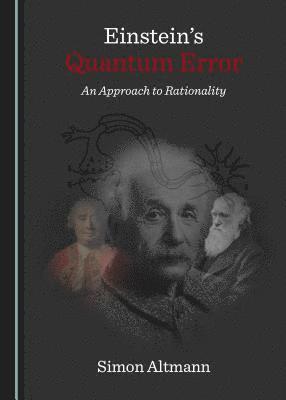
What is it to be rational? This is the fundamental subject of this book as long as we concern ourselves to thinking about the physical world. It used to be thought by philosophers that rational thinking required the use of principles that are absolutes, that have universal application and require no justification. This book argues that this is not so, that such principles as are used in discussing the physical world must in some way be empirically justified. The principle of causality, for instance, as this book shows, reflects the structure of the brain's neural network – as created by the process of evolution – which is such that repeated inputs reinforce their relation to their effects. Therefore, it parallels in some way the structure of the physical world, at least insofar as the interactions of the latter with our cognitive system have guided the brain's evolution. This book also discusses the various attacks on science and rationality that emerged during the twentieth century, and discusses very carefully the implications on the philosophy of science of the Theory of Evolution. A very unusual feature of this book is that it contains a number of poems attached at the end of certain chapters. These poems are not the usual "science poems" that are no more than the lyrical thoughts of some poets about science. They are designed to illustrate definite events in the history of science and some of the important philosophical or theological problems associated with them.
Social reformer, banker, and mathematician, Olinde Rodrigues is a fascinating figure of nineteenth-century Paris. Information about him is obscure--scattered in publications on history, mathematics, and the social sciences--and often inaccurate. Rodrigues left no papers or archives. Here, for the first time, is an authoritative account of his family history, education, and important mathematical works. Written by a team of prominent mathematicians and historians, the book comprises the interests and associations that make Rodrigues such a remarkable character in the history of mathematics. This is a superb panorama of nineteenth-century France, portrayed through the life and work of Olinde Rodrigues.The beginning chapters attempt to recreate the scientific and social background of nineteenth-century Paris and Rodrigues's place in it. The following chapters discuss his contributions to a variety of mathematical fields (e.g., orthogonal polynomials, combinatorics, and rotations). The final chapters discuss contemporary reactions to his mathematical work. Sufficient background is given to make it accessible to readers familiar with basic college mathematics. The book is suitable for specialists in the history of mathematics and/or science, graduate students, and mathematicians. Co-published with the London Mathematical Society beginning with Volume 4.
What is it to be rational? This is the fundamental subject of this book as long as we concern ourselves to thinking about the physical world. It used to be thought by philosophers that rational thinking required the use of principles that are absolutes, that have universal application and require no justification. This book argues that this is not so, that such principles as are used in discussing the physical world must in some way be empirically justified. The principle of causality, for instance, as this book shows, reflects the structure of the brain's neural network – as created by the process of evolution – which is such that repeated inputs reinforce their relation to their effects. Therefore, it parallels in some way the structure of the physical world, at least insofar as the interactions of the latter with our cognitive system have guided the brain's evolution. This book also discusses the various attacks on science and rationality that emerged during the twentieth century, and discusses very carefully the implications on the philosophy of science of the Theory of Evolution. A very unusual feature of this book is that it contains a number of poems attached at the end of certain chapters. These poems are not the usual "science poems" that are no more than the lyrical thoughts of some poets about science. They are designed to illustrate definite events in the history of science and some of the important philosophical or theological problems associated with them.