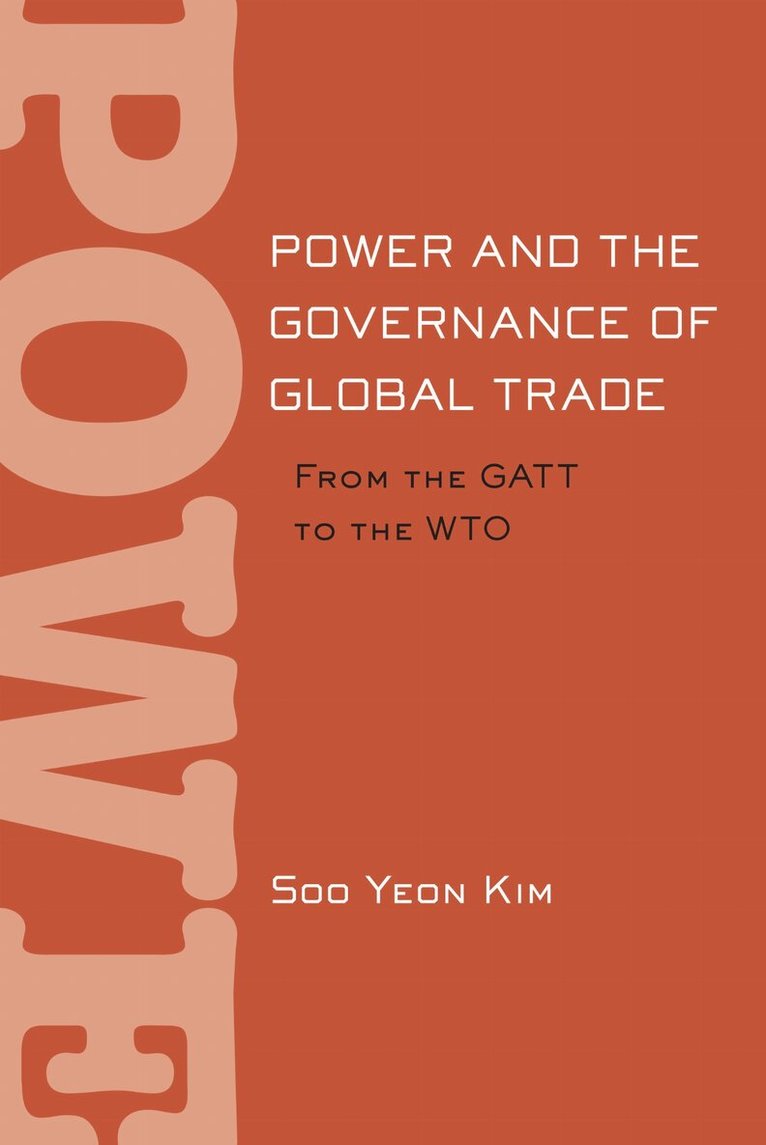
In Power and the Governance of Global Trade, Soo Yeon Kim analyzes the design, evolution, and economic impact of the global trade regime, focusing on the power politics that prevailed in the regime and shaped its distributive impact on global trade. Using documents now available from the archives of the General Agreement on Tariffs and Trade (GATT), Kim examines the institutional origins and critical turning points in the evolution of the GATT, as well as preferences of the lesser powers of the developing world that were the subject of heated debate over the International Trade Organization (ITO), which failed to materialize. Using quantitative analysis, Kim assesses the impact of the global trade regime on international trade and finds that the rules of trade forged by the great powers resulted in a developmental divide, in which industrialized countries benefited from trade expansion but developing countries reaped far fewer gains. The findings indicate that a successful conclusion to the Doha Round of the World Trade Organization (WTO) is urgently needed to mitigate the developmental divide by increasing trade between the industrialized and developing worlds.Kim offers a timely reading of the GATT/WTO system as a way to think about how trade and globalization more broadly may be governed in this post-Cold War century, as the global economy contends with a new geopolitical configuration featuring rising powers from the developing world. Important trading nations such as China, India, and other emergent actors in the G-20 countries, Kim argues, reflect the new power politics that will shape the course of global trade governance in the years to come.
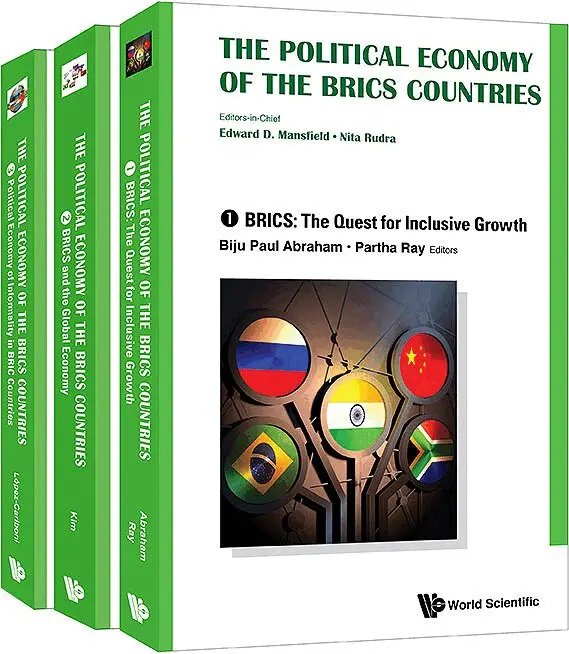
Over the past 20 years, social scientists, government officials, and investors have expressed mounting interest in the BRICS countries, which include Brazil, Russia, India, China and South Africa. These countries are widely viewed as both key actors in the global economy and important regional powers. The Political Economy of the BRICS Countries is a three-volume set that aims to address various crucial issues regarding these countries.Volume 1 analyzes whether economic growth in the BRICS countries has been broad-based and promoted equitable economic and social outcomes. The authors examine specific dimensions of growth in these five economies that constrain their ability to act effectively and cohesively in international affairs.Volume 2 considers how the BRICS have affected global economic governance and the international political economy.Volume 3 provides various approaches to economic informality in the BRICS. Moreover, the chapters deal with several connections between informality and important political, economic, and institutional phenomena such as economic globalization and international aid, economic development, political regimes, social capital, political networks and political participation, labor market rules, and social policy preferences.The BRICS countries have attracted rising attention over the past two decades. The volumes provide an in-depth analysis of various key issues regarding these countries and chart a course for future research.
In Power and the Governance of Global Trade, Soo Yeon Kim analyzes the design, evolution, and economic impact of the global trade regime, focusing on the power politics that prevailed in the regime and shaped its distributive impact on global trade. Using documents now available from the archives of the General Agreement on Tariffs and Trade (GATT), Kim examines the institutional origins and critical turning points in the evolution of the GATT, as well as preferences of the lesser powers of the developing world that were the subject of heated debate over the International Trade Organization (ITO), which failed to materialize. Using quantitative analysis, Kim assesses the impact of the global trade regime on international trade and finds that the rules of trade forged by the great powers resulted in a developmental divide, in which industrialized countries benefited from trade expansion but developing countries reaped far fewer gains. The findings indicate that a successful conclusion to the Doha Round of the World Trade Organization (WTO) is urgently needed to mitigate the developmental divide by increasing trade between the industrialized and developing worlds.Kim offers a timely reading of the GATT/WTO system as a way to think about how trade and globalization more broadly may be governed in this post-Cold War century, as the global economy contends with a new geopolitical configuration featuring rising powers from the developing world. Important trading nations such as China, India, and other emergent actors in the G-20 countries, Kim argues, reflect the new power politics that will shape the course of global trade governance in the years to come.
Over the past 20 years, social scientists, government officials, and investors have expressed mounting interest in the BRICS countries, which include Brazil, Russia, India, China and South Africa. These countries are widely viewed as both key actors in the global economy and important regional powers. The Political Economy of the BRICS Countries is a three-volume set that aims to address various crucial issues regarding these countries.Volume 1 analyzes whether economic growth in the BRICS countries has been broad-based and promoted equitable economic and social outcomes. The authors examine specific dimensions of growth in these five economies that constrain their ability to act effectively and cohesively in international affairs.Volume 2 considers how the BRICS have affected global economic governance and the international political economy.Volume 3 provides various approaches to economic informality in the BRICS. Moreover, the chapters deal with several connections between informality and important political, economic, and institutional phenomena such as economic globalization and international aid, economic development, political regimes, social capital, political networks and political participation, labor market rules, and social policy preferences.The BRICS countries have attracted rising attention over the past two decades. The volumes provide an in-depth analysis of various key issues regarding these countries and chart a course for future research.