
TorbjA¶rn Bergman – författare
Visar alla böcker från författaren TorbjA¶rn Bergman. Handla med fri frakt och snabb leverans.
4 produkter
4 produkter
E-bok
PDF, Engelska, 20191 369 kr
Läs direkt efter köp
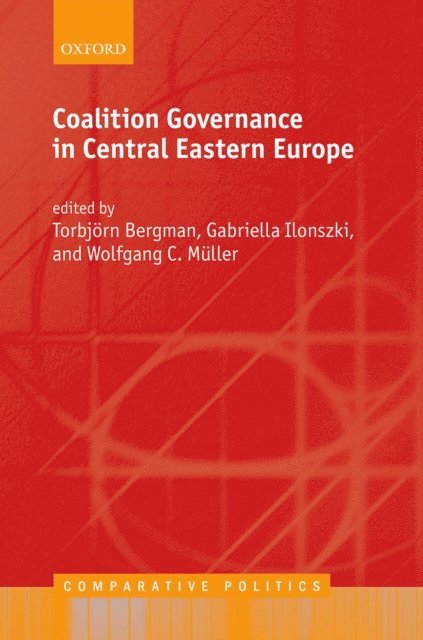
Coalition government among different political parties is the way most European democracies are governed. Traditionally, the study of coalition politics has been focused on Western Europe. Coalition governance in Central Eastern Europe brings the study of the full coalition life-cycle to a region that has undergone tremendous political transformation, but which has not been studied from this perspective. The volume covers Bulgaria, Estonia, the Czech Republic,Latvia, Lithuania, Hungary, Poland, Romania, Slovakia, and Slovenia. It provides information and analyses of the coalition life-cycle, from pre-electoral alliances to coalition formation and portfolio distribution, governing in coalitions, the stages that eventually lead to government termination, and theelectoral performance of coalition parties. In Central Eastern Europe, few single-party cabinets form and there have been only a few early elections. The evidence provided shows that coalition partners in the region write formal agreements (coalition agreements) to an extent that is similar to the patterns that we find in Western Europe, but also that they adhere less closely to these contracts. While the research on Western Europe tends to stress that coalition partners emphasize coalitioncompromise and mutual supervision, there is more evidence of ''ministerial government'' by individual ministers and their parties. There are also some systems where coalition governance is heavily dominated by the prime minister. No previous study has covered the full coalition life-cycle in all of theten countries with as much detail. Systematic information is presented in 10 figures and in more than one hundred tables.Comparative Politics is a series for researchers, teachers, and students of political science that deals with contemporary government and politics. Global in scope, books in the series are characterised by a stress on comparative analysis and strong methodological rigour. The series is published in association with the European Consortium for Political Research. For more information visit: www.ecprnet.eu.The series is edited by Emilie van Haute, Professor of Political Science, Université libre de Bruxelles; Ferdinand Müller-Rommel, Director of the Center for the Study of Democracy, Leuphana University; and Susan Scarrow, John and Rebecca Moores Professor of Political Science, University of Houston.
E-bok
Engelska, 20191 406 kr
Läs direkt efter köp
Coalition government among different political parties is the way most European democracies are governed. Traditionally, the study of coalition politics has been focused on Western Europe. Coalition governance in Central Eastern Europe brings the study of the full coalition life-cycle to a region that has undergone tremendous political transformation, but which has not been studied from this perspective. The volume covers Bulgaria, Estonia, the Czech Republic,Latvia, Lithuania, Hungary, Poland, Romania, Slovakia, and Slovenia. It provides information and analyses of the coalition life-cycle, from pre-electoral alliances to coalition formation and portfolio distribution, governing in coalitions, the stages that eventually lead to government termination, and theelectoral performance of coalition parties. In Central Eastern Europe, few single-party cabinets form and there have been only a few early elections. The evidence provided shows that coalition partners in the region write formal agreements (coalition agreements) to an extent that is similar to the patterns that we find in Western Europe, but also that they adhere less closely to these contracts. While the research on Western Europe tends to stress that coalition partners emphasize coalitioncompromise and mutual supervision, there is more evidence of ''ministerial government'' by individual ministers and their parties. There are also some systems where coalition governance is heavily dominated by the prime minister. No previous study has covered the full coalition life-cycle in all of theten countries with as much detail. Systematic information is presented in 10 figures and in more than one hundred tables.Comparative Politics is a series for researchers, teachers, and students of political science that deals with contemporary government and politics. Global in scope, books in the series are characterised by a stress on comparative analysis and strong methodological rigour. The series is published in association with the European Consortium for Political Research. For more information visit: www.ecprnet.eu.The series is edited by Emilie van Haute, Professor of Political Science, Université libre de Bruxelles; Ferdinand Müller-Rommel, Director of the Center for the Study of Democracy, Leuphana University; and Susan Scarrow, John and Rebecca Moores Professor of Political Science, University of Houston.
E-bok
PDF, Engelska, 20211 958 kr
Läs direkt efter köp
Coalition government is the most frequent form of government in Western Europe, but we have relatively little systematic knowledge about how that form of government has developed in recent decades. This book studies such governments, covering the full life-cycle of coalitions from the formation of party alliances before elections to coalition formation after elections (or in the sitting parliament), portfolio distribution among the coalition parties, governing and policy-making when parties work together in office, and the stages that eventually lead to government termination. A particular emphasis is on the study of how coalitions govern together even when they have different agendas. Do individual ministers decide, or the Prime minister or is the outcome a result of a process of coalition compromise? The volume covers 16 West European countries and introduces the case of Croatia, focusing mainly on governments formed during the past two decades.Comparative Politics is a series for researchers, teachers, and students of political science that deals with contemporary government and politics. Global in scope, books in the series are characterised by a stress on comparative analysis and strong methodological rigour. The series is published in association with the European Consortium for Political Research. For more information visit: www.ecprnet.eu.The series is edited by Susan Scarrow, Chair of the Department of Political Science, University of Houston, and Jonathan Slapin, Professor of Political Institutions and European Politics, Department of Political Science, University of Zurich.
Inbunden, Engelska, 2019
1 561 kr
Skickas inom 5-8 vardagar
Coalition government among different political parties is the way most European democracies are governed. Traditionally, the study of coalition politics has been focused on Western Europe. Coalition governance in Central Eastern Europe brings the study of the full coalition life-cycle to a region that has undergone tremendous political transformation, but which has not been studied from this perspective. The volume covers Bulgaria, Estonia, the Czech Republic, Latvia, Lithuania, Hungary, Poland, Romania, Slovakia, and Slovenia. It provides information and analyses of the coalition life-cycle, from pre-electoral alliances to coalition formation and portfolio distribution, governing in coalitions, the stages that eventually lead to government termination, and the electoral performance of coalition parties. In Central Eastern Europe, few single-party cabinets form and there have been only a few early elections. The evidence provided shows that coalition partners in the region write formal agreements (coalition agreements) to an extent that is similar to the patterns that we find in Western Europe, but also that they adhere less closely to these contracts. While the research on Western Europe tends to stress that coalition partners emphasize coalition compromise and mutual supervision, there is more evidence of 'ministerial government' by individual ministers and their parties. There are also some systems where coalition governance is heavily dominated by the prime minister. No previous study has covered the full coalition life-cycle in all of the ten countries with as much detail. Systematic information is presented in 10 figures and in more than one hundred tables.Comparative Politics is a series for researchers, teachers, and students of political science that deals with contemporary government and politics. Global in scope, books in the series are characterised by a stress on comparative analysis and strong methodological rigour. The series is published in association with the European Consortium for Political Research. For more information visit: www.ecprnet.eu. The series is edited by Emilie van Haute, Professor of Political Science, Université libre de Bruxelles; Ferdinand Müller-Rommel, Director of the Center for the Study of Democracy, Leuphana University; and Susan Scarrow, John and Rebecca Moores Professor of Political Science, University of Houston.