Vera V. Myasoedova – författare
2 412 kr
Kommande
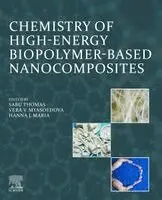
Chemistry of High-Energy Biopolymer-Based Nanocomposites brings together the latest research in energy-rich and high-energy nanocomposites based on polysaccharide- and other biopolymer-based fillers with synthetic polymers, examining chemistry, properties, preparation and advanced applications. The book begins by explaining the fundamentals of bionanocomposites, the use of cellulose, cellulose derivatives, and lignocellulose as fillers, the chemistry of energy-rich polymer bionanocomposites, and the design of composite architectures. Innovative methods in chemical modification, characterization, and analysis, are then presented in detail, including scattering studies, Fourier infra-red spectroscopy, thermogravimetric analysis, differential scanning calorimetry, mechanical properties, microscopy studies, and rheological studies.This is followed by chapters focusing on specific properties and cutting-edge areas of application, including fire retardancy, electro properties, capacitors for energy storage, and cellulose and synthetic polymer blends as nanocomposites for auxiliary solid fuel. Finally, the book reviews recycling of biopolymer-based nanocomposites, the energy rich concept driving the bionanocomposites approach, and future perspectives and outlook.
Provides detailed information on the preparation of biopolymer-based nanocomposites for innovative applicationsFocuses on chemical structure, modifications and characterization methods of biopolymer-based nanocompositesExplores multifunctional properties, such as high conductivity, thermostability and flame-retardancy or high heat of combustion4 262 kr
Skickas inom 5-8 vardagar
4 827 kr
Skickas inom 3-6 vardagar
5 348 kr
Läs direkt efter köp
Comprehensive knowledge on the preparation, characterization, and applications of polymer nanocomposites
Chemical Physics of Polymer Nanocomposites examines the state of the art in preparation, processing, characterizing, and applying a wide range of polymer nanocomposites, elucidating nanofiller/polymer interactions, nanofiller dispersion, distribution, filler-filler interactions, and interface properties, with a particular focus on the rheology of this important class of materials. The dependence of the rheological properties on the preparation techniques is discussed in detail, complemented by an overview of the processing approaches using conventional and micro injection molding, extrusion, compression molding, film blowing, pultrusion, and resin transfer molding.
The book covers the latest understanding and accomplishments on polymer composites and presents the huge variety of this materials class. Practice-oriented with industry relevance, it also reviews preparation, characterization, morphology, properties, applications, sustainability, and recyclability.
The topics covered in Chemical Physics of Polymer Nanocomposites include:
Classification of nano fillers, nano-objects, nanomaterials, and polymer nanocomposites based on chemical nature and identity, and synthesis and characterization of nanoparticlesGeneral manufacturing methods and processes, including melt and shear mixing manufacturing of polymer nanocomposites1D nano fillers and polymer nanocomposites, including polymer nanocomposites based on graphite nanoplatelets (GNP) and amphiphilic graphene plateletsPolymer nanocomposites based on nano chitin, starch, and lignin, gold nanowires, titanium dioxide, and graphene and graphene oxideChemical Physics of Polymer Nanocomposites is an essential resource for materials scientists, polymer chemists, chemical engineers, and engineering scientists in industry.
5 160 kr
Läs direkt efter köp
Comprehensive knowledge on the preparation, characterization, and applications of polymer nanocomposites
Chemical Physics of Polymer Nanocomposites examines the state of the art in preparation, processing, characterizing, and applying a wide range of polymer nanocomposites, elucidating nanofiller/polymer interactions, nanofiller dispersion, distribution, filler-filler interactions, and interface properties, with a particular focus on the rheology of this important class of materials. The dependence of the rheological properties on the preparation techniques is discussed in detail, complemented by an overview of the processing approaches using conventional and micro injection molding, extrusion, compression molding, film blowing, pultrusion, and resin transfer molding.
The book covers the latest understanding and accomplishments on polymer composites and presents the huge variety of this materials class. Practice-oriented with industry relevance, it also reviews preparation, characterization, morphology, properties, applications, sustainability, and recyclability.
The topics covered in Chemical Physics of Polymer Nanocomposites include:
Classification of nano fillers, nano-objects, nanomaterials, and polymer nanocomposites based on chemical nature and identity, and synthesis and characterization of nanoparticlesGeneral manufacturing methods and processes, including melt and shear mixing manufacturing of polymer nanocomposites1D nano fillers and polymer nanocomposites, including polymer nanocomposites based on graphite nanoplatelets (GNP) and amphiphilic graphene plateletsPolymer nanocomposites based on nano chitin, starch, and lignin, gold nanowires, titanium dioxide, and graphene and graphene oxideChemical Physics of Polymer Nanocomposites is an essential resource for materials scientists, polymer chemists, chemical engineers, and engineering scientists in industry.