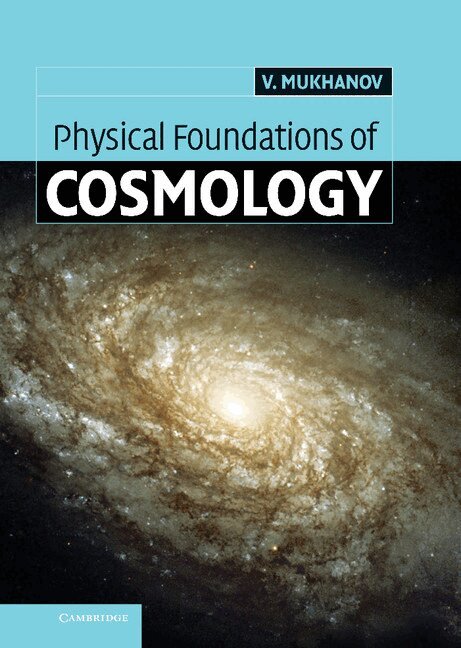
Inflationary cosmology has been developed over the last twenty years to remedy serious shortcomings in the standard hot big bang model of the universe. This textbook, first published in 2005, explains the basis of modern cosmology and shows where the theoretical results come from. The book is divided into two parts; the first deals with the homogeneous and isotropic model of the Universe, the second part discusses how inhomogeneities can explain its structure. Established material such as the inflation and quantum cosmological perturbation are presented in great detail, however the reader is brought to the frontiers of current cosmological research by the discussion of more speculative ideas. An ideal textbook for both advanced students of physics and astrophysics, all of the necessary background material is included in every chapter and no prior knowledge of general relativity and quantum field theory is assumed.
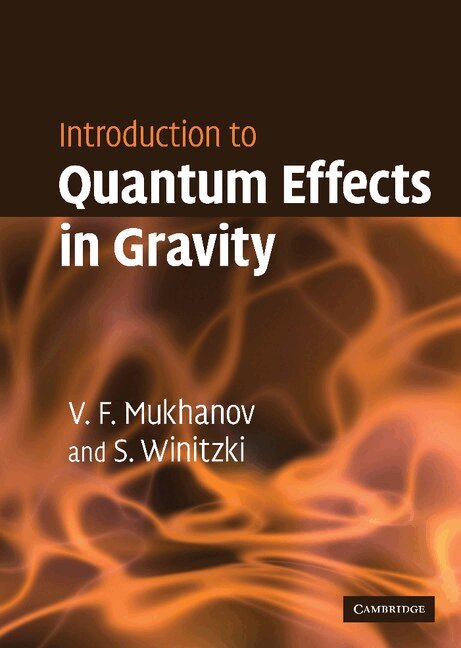
This book, first published in 2007, is an introductory textbook on quantum field theory in gravitational backgrounds intended for undergraduate and beginning graduate students in the fields of theoretical astrophysics, cosmology, particle physics, and string theory. The book covers the basic (but essential) material of quantization of fields in an expanding universe and quantum fluctuations in inflationary spacetime. It also contains a detailed explanation of the Casimir, Unruh, and Hawking effects, and introduces the method of effective action used for calculating the back-reaction of quantum systems on a classical external gravitational field. The broad scope of the material covered will provide the reader with a thorough perspective of the subject. Every major result is derived from first principles and thoroughly explained. The book is self-contained and assumes only a basic knowledge of general relativity. Exercises with detailed solutions are provided throughout the book.
Jacob Bekenstein, an Israeli physicist of the Hebrew University, Jerusalem, planted the seeds of a revolution of our understanding of space-time. Using conservative intuitive methods including time-old gedanken experiments, he discovered that black holes have thermodynamical properties such as entropy.Moreover, he found that their entropy was not extensive, unlike that of any other thermodynamical system considered before, but rather is proportional to the surface of their horizon. Furthermore, Bekenstein pioneered the study of black holes by focusing on their information content aspects. This led him to obtain bounds of a holographic nature on the amount of information that can be stored in a given region of space-time.This book contains a series of scientific and personal contributions by his contemporaries who recall the struggle against his ideas and then with them: the fate accompanying many revolutionary ideas. This is followed by original scientific contributions by many of the leaders of current research on black hole physics and holography. They have trodden his path and expanded it. The impact of Jacob Bekenstein's visionary ideas is just starting to be understood.
Inflationary cosmology has been developed over the last twenty years to remedy serious shortcomings in the standard hot big bang model of the universe. This textbook, first published in 2005, explains the basis of modern cosmology and shows where the theoretical results come from. The book is divided into two parts; the first deals with the homogeneous and isotropic model of the Universe, the second part discusses how inhomogeneities can explain its structure. Established material such as the inflation and quantum cosmological perturbation are presented in great detail, however the reader is brought to the frontiers of current cosmological research by the discussion of more speculative ideas. An ideal textbook for both advanced students of physics and astrophysics, all of the necessary background material is included in every chapter and no prior knowledge of general relativity and quantum field theory is assumed.
This book, first published in 2007, is an introductory textbook on quantum field theory in gravitational backgrounds intended for undergraduate and beginning graduate students in the fields of theoretical astrophysics, cosmology, particle physics, and string theory. The book covers the basic (but essential) material of quantization of fields in an expanding universe and quantum fluctuations in inflationary spacetime. It also contains a detailed explanation of the Casimir, Unruh, and Hawking effects, and introduces the method of effective action used for calculating the back-reaction of quantum systems on a classical external gravitational field. The broad scope of the material covered will provide the reader with a thorough perspective of the subject. Every major result is derived from first principles and thoroughly explained. The book is self-contained and assumes only a basic knowledge of general relativity. Exercises with detailed solutions are provided throughout the book.
Jacob Bekenstein, an Israeli physicist of the Hebrew University, Jerusalem, planted the seeds of a revolution of our understanding of space-time. Using conservative intuitive methods including time-old gedanken experiments, he discovered that black holes have thermodynamical properties such as entropy.Moreover, he found that their entropy was not extensive, unlike that of any other thermodynamical system considered before, but rather is proportional to the surface of their horizon. Furthermore, Bekenstein pioneered the study of black holes by focusing on their information content aspects. This led him to obtain bounds of a holographic nature on the amount of information that can be stored in a given region of space-time.This book contains a series of scientific and personal contributions by his contemporaries who recall the struggle against his ideas and then with them: the fate accompanying many revolutionary ideas. This is followed by original scientific contributions by many of the leaders of current research on black hole physics and holography. They have trodden his path and expanded it. The impact of Jacob Bekenstein's visionary ideas is just starting to be understood.