For the house lover and the curious tourist, for the house buyer and the weekend stroller, for neighborhood preservation groups and for all who want to know more about their community -- here, at last, is a book that makes it both easy and pleasurable to identify the various styles and periods of American domestic architecture.Concentrating not on rare landmarks but on typical dwellings in ordinary neighborhoods all across the United States -- houses built over the past three hundred years and lived in by Americans of every social and economic background -- the book provides you with the facts (and frame of reference) that will enable you to look in a fresh way at the houses you constantly see around you. It tells you -- and shows you in more than 1,200 illustrations -- what you need to know in order to be able to recognize the several distinct architectural styles and to understand their historical significance. What does that cornice mean? Or that porch? That door? When was this house built? What does its style say about the people who built it? You''ll find the answers to such questions here.This is how the book works: Each of thirty-nine chapters focuses on a particular style (and its variants). Each begins with a large schematic drawing that highlights the style''s most important identifying features. Additional drawings and photographs depict the most common shapes and the principal subtypes, allowing you to see at a glance a wide range of examples of each style. Still more drawings offer close-up views of typical small details -- windows, doors, cornices, etc. -- that might be difficult to see in full-house pictures. The accompanying text is rich in information about each style -- describing in detail its identifying features, telling you where (and in what quantity) you''re likely to find examples of it, discussing all of its notable variants, and revealing its origin and tracing its history.In the book''s introductory chapters you''ll find invaluable general discussions of house-building materials and techniques ("Structure"), house shapes ("Form"), and the many traditions of architectural fashion ("Style") that have influenced American house design through the past three centuries. A pictorial key and glossary help lead you from simple, easily recognized architectural features -- the presence of a tile roof, for example -- to the styles in which that feature is likely to be found.This eBook edition has been optimized for screen.
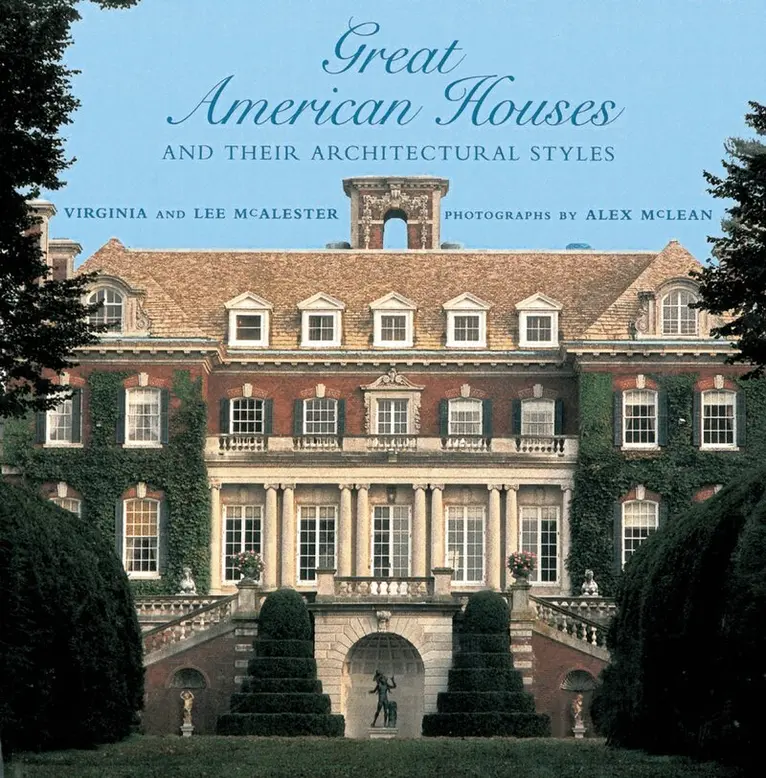
In this lavishly produced volume, authors Virginia and Lee McAlester explore outstanding landmark houses that exemplify America's major architectural and interior design styles from Colonial times to the mid-20th century. These 25 houses are illustrated with more than 350 specially commissioned full-colour photographs of interior and exterior views, 125 black-and-white line drawings and floor plans, historical paintings, and vintage photographs.The text not only discusses the houses architectural innovations and design elements but also profiles the architects and their clients. The featured houses were built by many of the country's leading architects - from Alexander Jackson Davis, Richard Morris Hunt, Henry Hobson Richardson, and McKim, Mead and White to Frank Lloyd Wright, the Greene brothers, and Walter Gropius - and owned by some of its most celebrated citizens, including Thomas Jefferson, Mark Twain, Thomas Edison, Jay Gould, the Guggenheim's, the Phippses', and the Vanderbilt's. As a result, the book is as much a cultural history as it is an architectural study. The authors also include an informative discussion of each style as it can be seen in vernacular versions around the country.Located all over the United States, most of the featured houses are open to the public, and the book provides their addresses and other helpful information for visitors. Great American Houses and Their Architectural Styles will be irresistible to all house lovers, architects, and designers, and will give readers a deeper understanding and appreciation of our rich architectural heritage