Y.C. Fung – författare
Visar alla böcker från författaren Y.C. Fung. Handla med fri frakt och snabb leverans.
6 produkter
6 produkter
Inbunden, Engelska, 1996
2 015 kr
Skickas inom 10-15 vardagar
The theory of blood circulation is the oldest and most advanced branch of biomechanics, with roots extending back to Huangti and Aristotle, and with contributions from Galileo, Santori, Descartes, Borelli, Harvey, Euler, Hales, Poiseuille, Helmholtz, and many others. It represents a major part of humanity's concept of itself. This book presents selected topics of this great body of ideas from a historical perspective, binding important experiments together with mathematical threads. The objectives and scope of this book remain the same as in the first edition: to present a treatment of circulatory biomechanics from the stand points of engineering, physiology, and medical science, and to develop the subject through a sequence of problems and examples. The name is changed from Biodynamics: Circulation to Biomechanics: Circulation to unify the book with its sister volumes, Biomechanics: Mechanical Properties of Living Tissues, and Biomechanics: Motion, Flow, Stress, and Growth. The major changes made in the new edition are the following: When the first edition went to press in 1984, the question of residual stress in the heart was raised for the first time, and the lung was the only organ analyzed on the basis of solid morphologic data and constitutive equations. The detailed analysis of blood flow in the lung had been done, but the physiological validation experiments had not yet been completed.
Inbunden, Engelska, 1990
3 353 kr
Skickas inom 10-15 vardagar
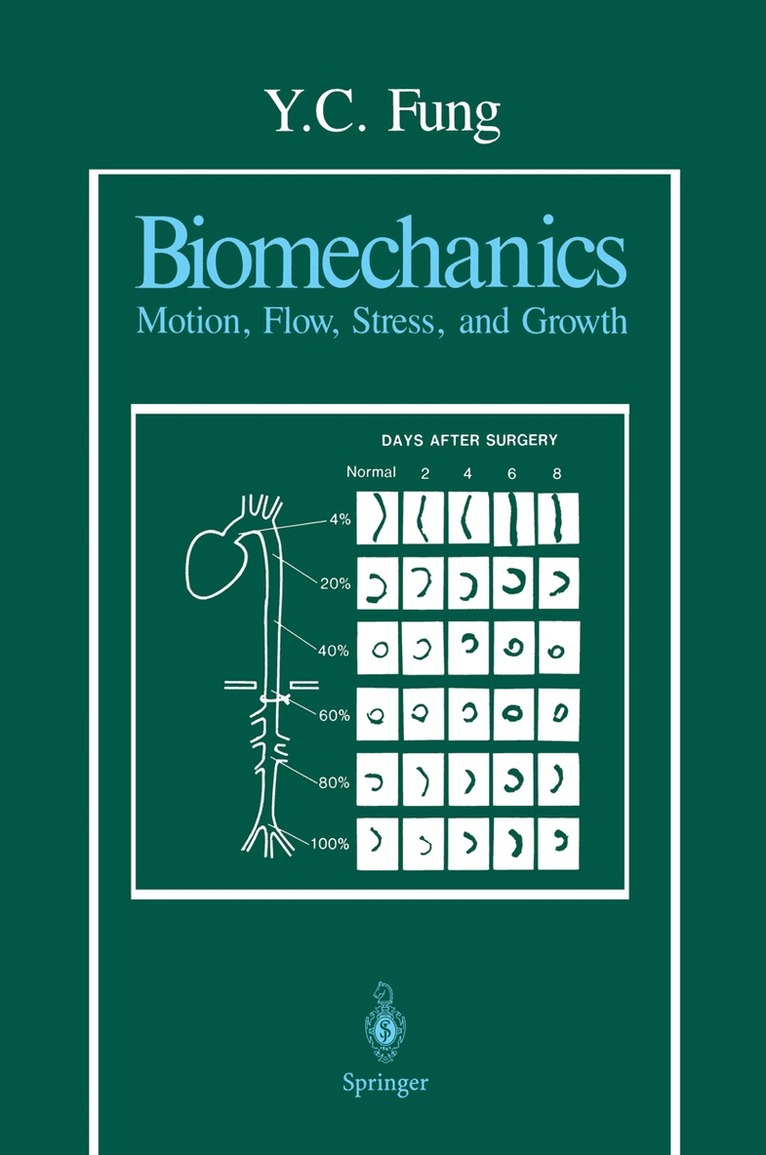
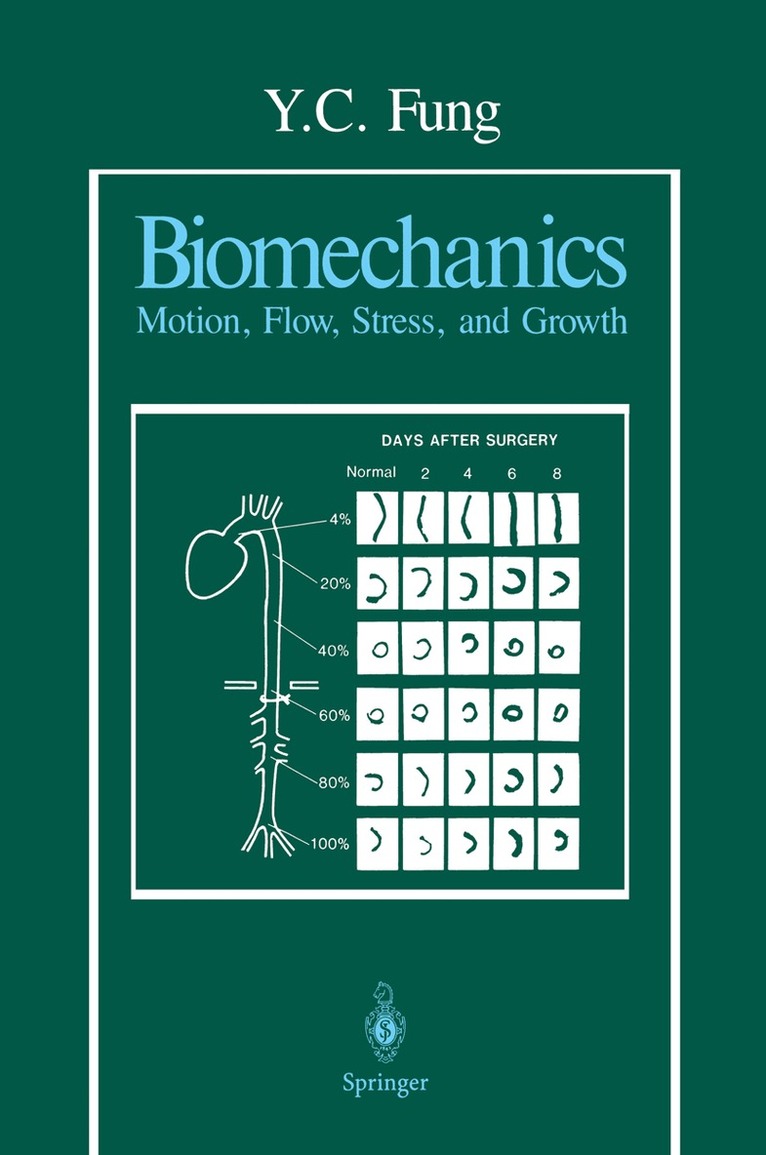
Biomechanics aims to explain the mechanics oflife and living. From molecules to organisms, everything must obey the laws of mechanics. Clarification of mechanics clarifies many things. Biomechanics helps us to appreciate life. It sensitizes us to observe nature. It is a tool for design and invention of devices to improve the quality of life. It is a useful tool, a simple tool, a valuable tool, an unavoidable tool. It is a necessary part of biology and engineering. The method of biomechanics is the method of engineering, which consists of observation, experimentation, theorization, validation, and application. To understand any object, we must know its geometry and materials of construc tion, the mechanical properties of the materials involved, the governing natural laws, the mathematical formulation of specific problems and their solutions, and the results of validation. Once understood, one goes on to develop applications. In my plan to present an outline of biomechanics, I followedthe engineering approach and used three volumes. In the first volume, Biomechanics: Mechanical Properties of Living Tissues, the geometrical struc ture and the rheological properties of various materials, tissues, and organs are presented. In the second volume, Biodynamics: Circulation, the physiology of blood circulation is analyzed by the engineering method.
Häftad, Engelska, 2010
2 015 kr
Skickas inom 10-15 vardagar
The theory of blood circulation is the oldest and most advanced branch of biomechanics, with roots extending back to Huangti and Aristotle, and with contributions from Galileo, Santori, Descartes, Borelli, Harvey, Euler, Hales, Poiseuille, Helmholtz, and many others. It represents a major part of humanity's concept of itself. This book presents selected topics of this great body of ideas from a historical perspective, binding important experiments together with mathematical threads. The objectives and scope of this book remain the same as in the first edition: to present a treatment of circulatory biomechanics from the stand points of engineering, physiology, and medical science, and to develop the subject through a sequence of problems and examples. The name is changed from Biodynamics: Circulation to Biomechanics: Circulation to unify the book with its sister volumes, Biomechanics: Mechanical Properties of Living Tissues, and Biomechanics: Motion, Flow, Stress, and Growth. The major changes made in the new edition are the following: When the first edition went to press in 1984, the question of residual stress in the heart was raised for the first time, and the lung was the only organ analyzed on the basis of solid morphologic data and constitutive equations. The detailed analysis of blood flow in the lung had been done, but the physiological validation experiments had not yet been completed.
E-bok
PDF, Engelska, 20134 015 kr
Läs direkt efter köp
Biomechanics aims to explain the mechanics oflife and living. From molecules to organisms, everything must obey the laws of mechanics. Clarification of mechanics clarifies many things. Biomechanics helps us to appreciate life. It sensitizes us to observe nature. It is a tool for design and invention of devices to improve the quality of life. It is a useful tool, a simple tool, a valuable tool, an unavoidable tool. It is a necessary part of biology and engineering. The method of biomechanics is the method of engineering, which consists of observation, experimentation, theorization, validation, and application. To understand any object, we must know its geometry and materials of construc tion, the mechanical properties of the materials involved, the governing natural laws, the mathematical formulation of specific problems and their solutions, and the results of validation. Once understood, one goes on to develop applications. In my plan to present an outline of biomechanics, I followedthe engineering approach and used three volumes. In the first volume, Biomechanics: Mechanical Properties of Living Tissues, the geometrical struc ture and the rheological properties of various materials, tissues, and organs are presented. In the second volume, Biodynamics: Circulation, the physiology of blood circulation is analyzed by the engineering method.
E-bok
PDF, Engelska, 20132 508 kr
Läs direkt efter köp
The theory of blood circulation is the oldest and most advanced branch of biomechanics, with roots extending back to Huangti and Aristotle, and with contributions from Galileo, Santori, Descartes, Borelli, Harvey, Euler, Hales, Poiseuille, Helmholtz, and many others. It represents a major part of humanity''s concept of itself. This book presents selected topics of this great body of ideas from a historical perspective, binding important experiments together with mathematical threads. The objectives and scope of this book remain the same as in the first edition: to present a treatment of circulatory biomechanics from the stand points of engineering, physiology, and medical science, and to develop the subject through a sequence of problems and examples. The name is changed from Biodynamics: Circulation to Biomechanics: Circulation to unify the book with its sister volumes, Biomechanics: Mechanical Properties of Living Tissues, and Biomechanics: Motion, Flow, Stress, and Growth. The major changes made in the new edition are the following: When the first edition went to press in 1984, the question of residual stress in the heart was raised for the first time, and the lung was the only organ analyzed on the basis of solid morphologic data and constitutive equations. The detailed analysis of blood flow in the lung had been done, but the physiological validation experiments had not yet been completed.
Häftad, Engelska, 2013
3 256 kr
Skickas inom 10-15 vardagar
Biomechanics aims to explain the mechanics oflife and living. It is a useful tool, a simple tool, a valuable tool, an unavoidable tool. In the first volume, Biomechanics: Mechanical Properties of Living Tissues, the geometrical struc ture and the rheological properties of various materials, tissues, and organs are presented.