Yun-Xia Song – författare
Visar alla böcker från författaren . Handla med fri frakt och snabb leverans.
2 produkter
2 produkter
Inbunden, Engelska, 2026
1 718 kr
Skickas inom 10-15 vardagar
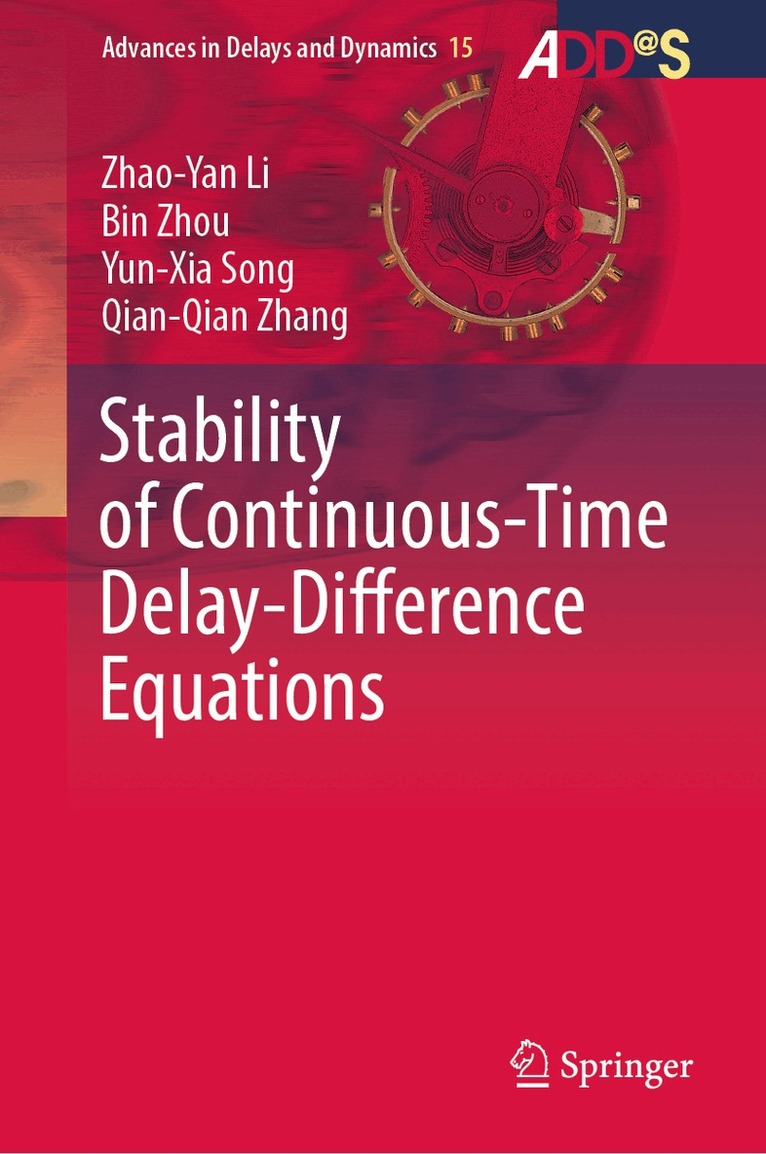
This book studies the stability analysis of continuous time delay-difference equations and their application in the predictor feedback control of input-delayed systems. Stability analysis for delay-difference equations is a central topic and is typically addressed through two methods: frequency-domain methods, which provide nonconservative conditions but are challenging for control synthesis; time-domain LKF methods, which are tractable but often conservative. This book analyzes the stability from both perspectives, deriving stability conditions via LMIs, characteristic equations, and spectral radius by using the KYP lemma, Jensen inequality, and the delay decomposition technique. It systematically investigates stability under various delay types (point, distributed, mixed delays) and Markovian switching and then applies the results to predictor feedback control. It is a useful resource for researchers, engineers, and graduate students in control, applied mathematics, and engineering.
E-bok
Engelska, 20262 201 kr
Läs direkt efter köp
This book studies the stability analysis of continuous time delay-difference equations and their application in the predictor feedback control of input-delayed systems. Stability analysis for delay-difference equations is a central topic and is typically addressed through two methods: frequency-domain methods, which provide nonconservative conditions but are challenging for control synthesis; time-domain LKF methods, which are tractable but often conservative. This book analyzes the stability from both perspectives, deriving stability conditions via LMIs, characteristic equations, and spectral radius by using the KYP lemma, Jensen inequality, and the delay decomposition technique. It systematically investigates stability under various delay types (point, distributed, mixed delays) and Markovian switching and then applies the results to predictor feedback control. It is a useful resource for researchers, engineers, and graduate students in control, applied mathematics, and engineering.