Otisk and Francel love being in Pazoten, a wondrous place, where life overflows with contentment, and whose landscape is a constant pleasure to explore. As a couple, they are delighted to work together as a responsible team. Yet, as time passes, they begin to formulate questions that no-one else wants to raise, much less answer. An enigmatic story that touches on a most sensitive aspect of the human condition.
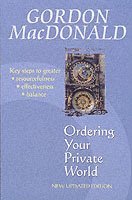
God has a calling for every Christian. He has also added appropriate and varied giftings. So how come so few achieve their potential? People set themselves up for defeat by skimping on inner development: failing to deepen their understanding of call, they spread themselves too thin or drive themselves to burnout. Now refreshed with up-to-date examples and references, Gordon MacDonald's book encourages readers to borrow from the workplace proven time-management and planning skills in order to free up space for spiritual growth. He then suggests key subjects that need to be covered to attain to those qualities of peace, resourcefulness, focus and balance that have adorned the lives of saints past and present.
Did God call the Church to be an institution? The Reformation gave Europe national churches, but these came to disappoint enthusiastic believers as lacking commitment. Was the right exit policy simply to join 'free' presbyterian or congregational-type churches, as found say in America? By the 1820s, the more strategic thinkers felt not. Some followed Newman into Catholicism: other pre-charismatics advocate an ongoing apostolate that would recapture prophetic gifts: J N Darby was led to the fierce conclusion that all churches, as man-made institutions, were bound to fail. The believer's true hope was the return of Jesus Christ. With others, Darby pioneered a less formal association of believers, free of clergy and founded on radical holiness. Darby was a tireless traveler, talented linguist and Bible translator. His influence is still felt in systematic theology, missionary societies, para- and house-church movements, possibly even in US foreign policy towards the state of Israel.
The thoughts of a younger man as he sorts through a collection of letters from a recently deceased older mentor. He not only gets to know his mentor better, but also begins to suspect that the mentoring relationship has somehow morphed rather than ended...
A roller coaster memoir charting a course through addiction, recovery and the search for meaning. Readers are taken through one aborted vocation to the priesthood, a season as a hippy, several failed marriages plus a return to academia. Early in life, John McMahon wanted to escape the parochialism and religious bigotry of 60s small-town Scotland. Alcohol is shown to put two traits into tension: the 'egotist' who behaves like he's God's gift to women versus the 'loser' who insists that nobody could possibly love him. As an addict, he is seen to obsess over various distorted images of the self and then acting up. The hinge of the story is how life situations reframed John's self-talk. After at first rejecting the 'well-meaning Alcoholics Anonymous' he came to experience 'that a Power greater than ourselves could restore us to sanity.'Later John found meaning in academia, developing recovery resources and a new found faith and marriage.