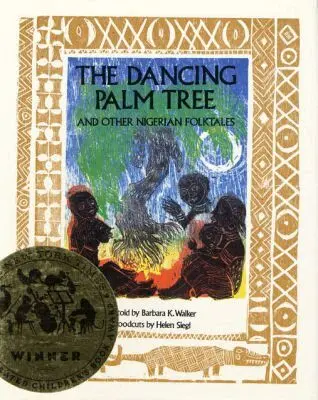
Imagine yourself for a moment in Western Nigeria on a moonlit evening. The day's work has been done, and friends and neighbors have gathered. Suddenly one among the group turns to an older man sitting at the edge of the piazza. 'Tell us a story', he begs. And he knows what he is asking. Many in the group can tell stories and very well indeed, for storytelling has been a tradition in Nigeria for hundreds of years. The old man rises and usually begins, 'Far away and long ago in a small village'. Somewhat in each story there is likely to be a moral, a human truth that is taught through what happens in the story, for an important purpose of storytelling in Nigeria has always been to teach as well as to entertain. But you will find that the truths taught in these stories prevail not only in Nigeria but all over the world, truths that people must learn to live by, no matter what country they call home. Earlier versions of these eleven tales were told to Barbara K. Walker by Olawale Idewu, a Nigerian student in a midwestern American college who was lonesome for his homeland and its culture and who was willing to share some of the tales from that culture. Now, young Americans can enjoy a sampling of the tales still told on moonlit evenings in Nigeria.
'In casting them into English, Walker has paid particular attention to capturing the flavor and excitement of the Turkish telling, while not infringing 'on the narrator's right to have the tale recreated as he had told it'. The Beauty, power, and appeal of the present volume for the general reading public, however, depends largely upon Barbara Walker's own consummate skill as a teller and re-teller of tales and her commitment to conveying as much of the Turkish performance context as possible. In a gesture which is perhaps symptomatic of the reasons for this volume's success, [Barbara Walker] recognizes in the Acknowledgments section each and every tale-teller by name - all forty of them, ranging in age from nine to ninety and coming from the many different walks of life, both urban and rural, to be found in twenty out of Turkey's seventy-four provinces from Mugla to Kars and from Istanbul to Diyarbakir. In presenting the works of 'all these generous bearers of tradition' to an English-speaking audience, [she] has achieved her aim of opening a small window on the art of the Turkish tale in a volume which stands as a tribute to the art of book making as well' - Sarah Moment Atis, Chair, Middle East Studies Program, University of Wisconsin-Madison President, Turkish Studies Association. 'This will stand as a fine, quintessential contribution. One hears the whispers of the original voices in these versions, all of which are artful, recast in colloquial rhythms, and couched in a style that conveys the substance, the shape, the spirit, and the sumptuousness or the simplicity of the tale' - Talat Sait Halman, Turkey's former Minister of Culture, then Ambassador for Cultural Affairs; now Professor of Near Eastern Languages and Literatures, New York University.
'A most significant yet unsung contribution within the field of Turkish studies over the past quarter of a century has been the work of Barbara K. Walker in collecting, preserving, and sharing Turkish oral narratives with an English-speaking audience. ""The Art of the Turkish Tale"", sets a new direction in Walker's work, one that will be received by folklore specialists and folktale fans alike' - Sarah Moment Atis, Chair, Middle East Studies Program, University of Wisconsin-Madison President, Turkish Studies Association. 'This collection should be read, first and foremost, for its inherent pleasure. Like all literary arts, the art of the tale's primarily a genre of joy. Traditional stories, modern storytelling, and the Walker versions cohere in giving us the pleasure of real life and imaginary events. These stories are full of delight. Although many of them go back several centuries, some perhaps more than a millennium, they sound fresh, almost contemporary. They should be savored for their optimism, because virtually every tale resolves a dilemma or saves the good person from a terrible plight. No wonder most of the tales culminate in the celebratory couplet: They have had their wish fulfilled; Let's go up to their bedstead' - Talat Sait Halman, Turkey's former Minister of Culture, then Ambassador for Cultural Affairs; now Professor of Near Eastern Languages and Literatures, New York University.