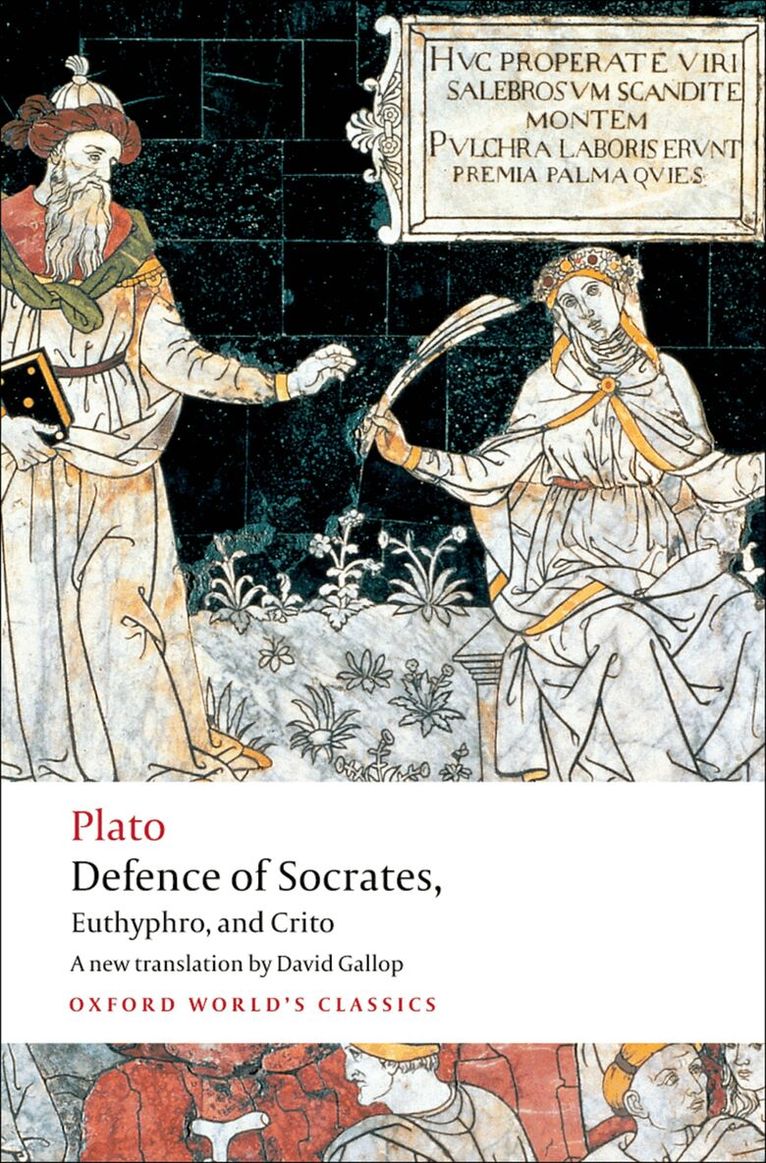
These new translations present Plato's remarkable dramatization of the momentous events surrounding the trial of Socrates in 399 BC, on charges of irreligion and corrupting the young. The Euthyphro, Defence of Socrates, and Crito form a dramatic and thematic sequence, raising fundamental questions about the basis of moral, religious, legal, and political obligation. Plato explores these issues with a freshness and directness that have never been surpassed. In the Defence of Socrates, Plato seeks not only to clear his master's name, but also to defend the whole Socratic way of life, and therefore philosophy itself. The result is an oratorical masterpiece. The Euthyphro, an inquiry into the nature of piety, probes the relationship between religion and morality. The Crito discusses the citizen's obligation to the state, in the context of a life-or-death issue confronting Socrates himself - whether or not to escape from prison. David Gallop's Introduction provides a stimulating philosophical and historical analysis of these texts, complemented by useful explanatory notes and an index of names, to make this edition invaluable to readers new to these timeless classics. ABOUT THE SERIES: For over 100 years Oxford World's Classics has made available the widest range of literature from around the globe. Each affordable volume reflects Oxford's commitment to scholarship, providing the most accurate text plus a wealth of other valuable features, including expert introductions by leading authorities, helpful notes to clarify the text, up-to-date bibliographies for further study, and much more.
David Gallop provides a Greek text and a new facing-page translation of the extant fragments of Parmenides' philosophical poem. He also includes the first complete translation into English of the contexts in which the fragments have been transmitted to us, and of the ancient testimonia regarding Parmenides' life and thought. All of the fragments have been translated in full and are arranged in the order that has become canonical since the publication of the fifth edition of Diels-Rranz's Die Fragmente der Vorsokratiker. Alternative renderings are provided for passages whose meaning is disputed or where major questions of interpretation hinge upon the text or translation adopted. In an extended introductory essay, Gallop offers guidance on the background of the poem, and a continuous exposition of it, together with a critical discussion of its basic argument. The volume also includes an extensive bibliography, a glossary of key terms in the poem, and a section on sources and authorities.
David Gallop provides a Greek text and a new facing-page translation of the extant fragments of Parmenides' philosophical poem. He also includes the first complete translation into English of the contexts in which the fragments have been transmitted to us, and of the ancient testimonia regarding Parmenides' life and thought. All of the fragments have been translated in full and are arranged in the order that has become canonical since the publication of the fifth edition of Diels-Rranz's Die Fragmente der Vorsokratiker. Alternative renderings are provided for passages whose meaning is disputed or where major questions of interpretation hinge upon the text or translation adopted. In an extended introductory essay, Gallop offers guidance on the background of the poem, and a continuous exposition of it, together with a critical discussion of its basic argument. The volume also includes an extensive bibliography, a glossary of key terms in the poem, and a section on sources and authorities.
David Gallop provides a Greek text and a new facing-page translation of the extant fragments of Parmenides' philosophical poem. He also includes the first complete translation into English of the contexts in which the fragments have been transmitted to us, and of the ancient testimonia regarding Parmenides' life and thought. All of the fragments have been translated in full and are arranged in the order that has become canonical since the publication of the fifth edition of Diels-Rranz's Die Fragmente der Vorsokratiker. Alternative renderings are provided for passages whose meaning is disputed or where major questions of interpretation hinge upon the text or translation adopted. In an extended introductory essay, Gallop offers guidance on the background of the poem, and a continuous exposition of it, together with a critical discussion of its basic argument. The volume also includes an extensive bibliography, a glossary of key terms in the poem, and a section on sources and authorities.