331 kr
Kathleen Blamey – översättare
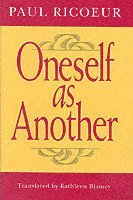
- Häftad, Engelska, 1995Paul Ricoeur has been hailed as one of the most important thinkers of the century. Oneself as Another, the clearest account of his "philosophical ethics," substantiates this position and lays the groundwork for a metaphysics of morals. Focusing on the concept of personal identity, Ricoeur develops a hermeneutics of the self that charts its epistemological path and ontological status.
- E-bokEngelska, 2025
301 kr
Läs direkt efter köp
Since the last decade of the twentieth century, there has been talk of a return of religion in Western societies - the very societies that were regarded by many people as undergoing an irreversible process of secularization. Paul Ricoeur's philosophical writings on religion are contemporaneous with this movement of secularization and return, while at the same time his work complicates the schema. In Ricoeur's view, religion is part of the universe of convictions in which subjects live concretely, convictions that deserve to be heard and placed under the lights of argumentation and discussion. For Ricoeur, religion is the other of philosophy, the non-philosophical par excellence. He did not write a systematic philosophy of religion, but he wrote extensively about religion as a meeting place for language and conviction. The essays in this volume, written between 1953 and 2003, attest to the coherence, richness, and variety of Ricoeur's secular and philosophical approach towards religion. They range over the problem of guilt, the legitimacy or otherwise of Freudian, Marxist, and other critiques of religion, the relation between experience and language in religious discourse, the study of biblical hermeneutics, the nature of religious belief, and reflections on sacrifice, gifts, and debt. Ricoeur draws on religion to think, while not neglecting the analysis of religion itself. These texts by one of the leading philosophers of the twentieth century will be of interest to students and scholars of philosophy and theology and to anyone concerned with the enduring role of religion in the modern world. - Häftad, Engelska, 2006
349 kr
Skickas inom 7-10 vardagar
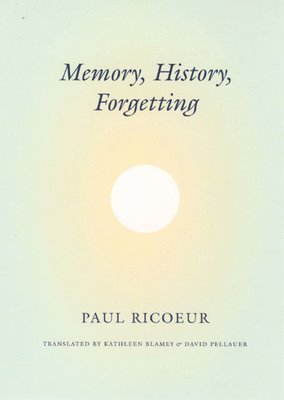
A landmark work, "Memory, History, Forgetting" examines the reciprocal relationship between remembering and forgetting, revealing how this symbiosis influences both the perception of historical experience and the production of historical narrative. A momentous achievement in Ricoeur's career, this book provides the crucial link between his "Time and Narrative" and "Oneself as Another", and his recent reflections on ethics and the problems of responsibility and representation. - Häftad, Engelska, 2020
248 kr
Skickas inom 7-10 vardagar
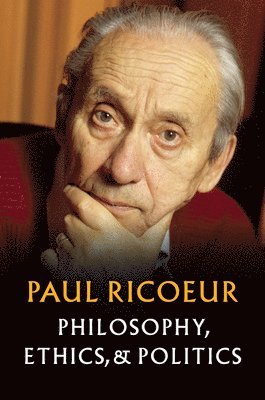
In this series of interviews and dialogues which took place between 1981 and 2003, Paul Ricoeur addresses some of the central questions of political philosophy and ethics: justice, violence, war, the environmental crisis, the question of evil, ethical and political action in the polis. Philosophical issues are brought to bear on present-day concerns and the practical realities of contemporary politics. How can the philosopher speak about politics without claiming superior insight or a higher order of knowledge? Ricoeur distinguishes three levels of society: ‘tools’ (modes of production and the accumulation of technology), ‘institutions’ (which are tied to national cultures) and ‘values’ (which claim to be universal). The philosopher’s task is to probe each of these levels and open up spaces for reflection, criticism and democratic deliberation. It is to explore the paradoxes of the political rather than invoking certainties dictated by conscience. Just as there no longer exists a grand narrative about the past, so too there is no longer any utopia capable of projecting the desired future. What remains is human creativity, which marks the source common to the institutional frameworks that are already present and the horizons that extend beyond them. The philosopher’s engagement lies in the promise to revive this source at the very moment it appears to dry up under the weight of the real. This volume of interviews and dialogues with one of the most important French philosophers of the post-war period will be of interest to anyone interested in the great political and ethical questions of our time. - Häftad, Engelska, 1990
366 kr
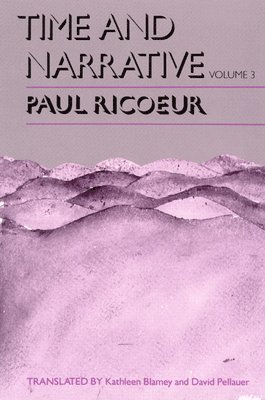
In the first two volumes of this work, Paul Ricoeur examined the relations between time and narrative in historical writing, fiction, and theories of literature. This final volume, a comprehensive reexamination and synthesis of the ideas developed in volumes 1 and 2, stands as Ricoeur's most complete and satisfying presentation of his own philosophy. Ricoeur's aim here is to explicate as fully as possible the hypothesis that has governed his inquiry, namely, that the effort of thinking at work in every narrative configuration is completed in a refiguration of temporal experience. To this end, he sets himself the central task of determing how far a poetics of narrative can be said to resolve the "aporias"—the doubtful or problematic elements—of time. Chief among these aporias are the conflicts between the phenomenological sense of time (that experienced or lived by the individual) and the cosmological sense (that described by history and physics) on the one hand and the oneness or unitary nature of time on the other. In conclusion, Ricoeur reflects upon the inscrutability of time itself and attempts to discern the limits of his own examination of narrative discourse. "As in his previous works, Ricoeur labors as an imcomparable mediator of often estranged philosophical approaches, always in a manner that compromises neither rigor nor creativity."—Mark Kline Taylor, Christian Century "In the midst of two opposing contemporary options—either to flee into ever more precious readings . . . or to retreat into ever more safe readings . . . —Ricoeur's work offers an alternative option that is critical, wide-ranging, and conducive to new applications."—Mary Gerhart, Journal of Religion - Häftad, Engelska, 2007
333 kr
Skickas inom 7-10 vardagar
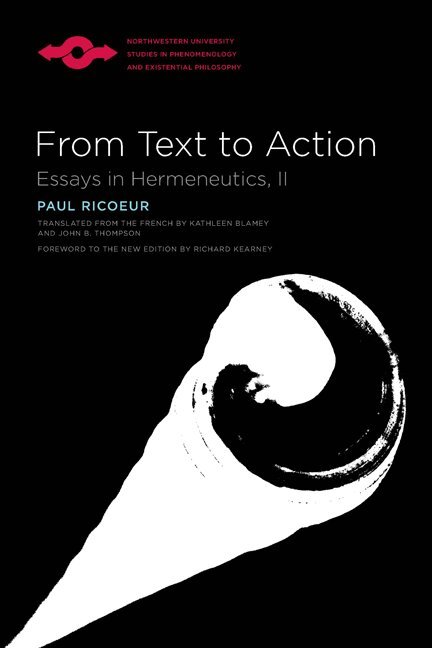
With his writings on phenomenology, psychoanalysis, Marxism, ideology, and religion, Paul Ricoeur has single-handedly redefined and revitalized the hermeneutic tradition. From Text to Action is an essential companion to the now classic The Conflict of Interpretations. Here, Ricoeur continues and extends his project of constructing a general theory of interpretation, positioning his work in relation to its own philosophical background: Hegel, Husserl, Gadamer, and Weber. He also responds to contemporary figures like K.O. Apel and Jürgen Habermas, connecting his own theorization of ideology to their version of ideology critique. - Häftad, Engelska, 2008
393 kr
Skickas inom 10-15 vardagar
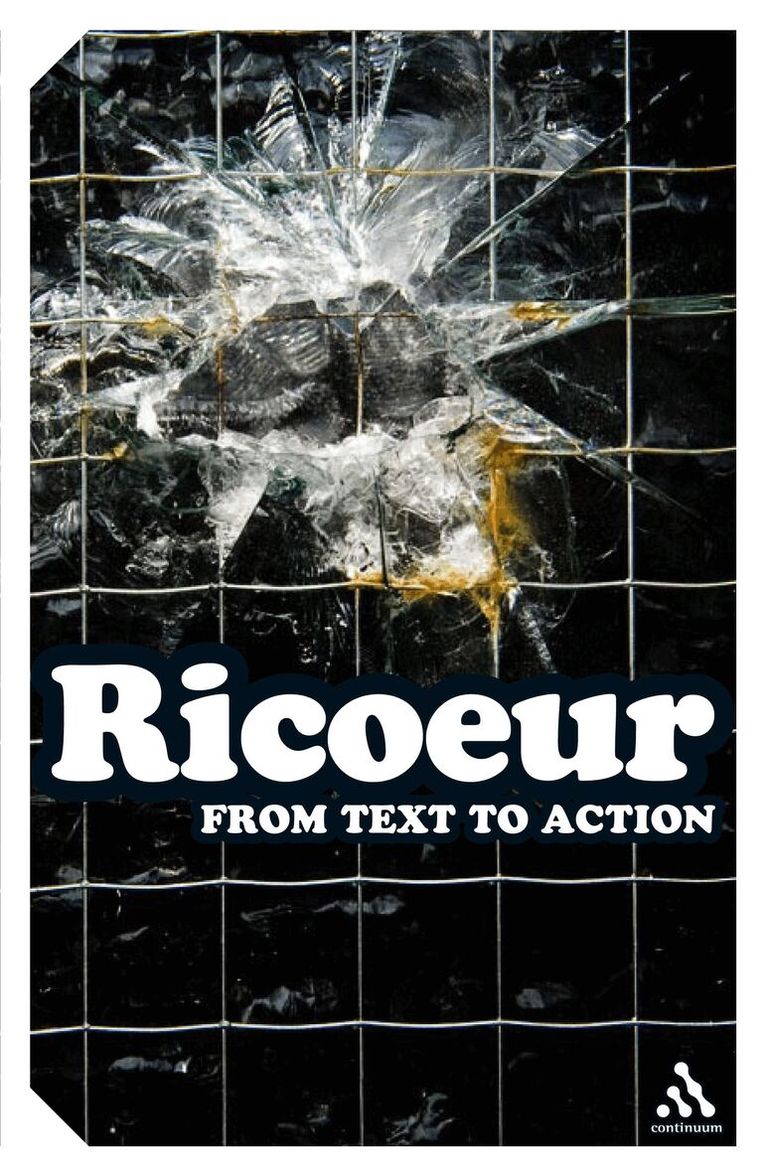
This book will be useful to those coming to the field of hermeneutics for the first time, as well as those already familiar with Ricoeur's work.Paul Ricoeur (1913-2005) was Professor of Philosophy at the University of Chicago and the University of Paris X, Nanterre, and a leading figure in twentieth-century French philosophy. "From Text to Action" provides an invaluable companion to Ricoeur's classic text, "The Conflict of Interpretations". Here he further develops his general theory of interpretation in relation to his own philosophical background and influences: Hegel, Husserl, Gadamer and Weber. This is a hugely important work from a key figure in contemporary philosophy that will be of interest to those starting out in the field of hermeneutics, as well as those already familiar with Ricoeur's work."The Continuum Impacts" are seminal works by the finest minds in contemporary thought, including Adorno, Badiou, Derrida, Heidegger and Deleuze. They are works of such power that they changed the philosophical and cultural landscape when they were first published and continue to resonate today.They represent landmark texts in the fields of philosophy, popular culture, politics and theology. - Inbunden, Engelska, 2020
715 kr
Skickas inom 7-10 vardagar
In this series of interviews and dialogues which took place between 1981 and 2003, Paul Ricoeur addresses some of the central questions of political philosophy and ethics: justice, violence, war, the environmental crisis, the question of evil, ethical and political action in the polis. Philosophical issues are brought to bear on present-day concerns and the practical realities of contemporary politics. How can the philosopher speak about politics without claiming superior insight or a higher order of knowledge? Ricoeur distinguishes three levels of society: ‘tools’ (modes of production and the accumulation of technology), ‘institutions’ (which are tied to national cultures) and ‘values’ (which claim to be universal). The philosopher’s task is to probe each of these levels and open up spaces for reflection, criticism and democratic deliberation. It is to explore the paradoxes of the political rather than invoking certainties dictated by conscience. Just as there no longer exists a grand narrative about the past, so too there is no longer any utopia capable of projecting the desired future. What remains is human creativity, which marks the source common to the institutional frameworks that are already present and the horizons that extend beyond them. The philosopher’s engagement lies in the promise to revive this source at the very moment it appears to dry up under the weight of the real. This volume of interviews and dialogues with one of the most important French philosophers of the post-war period will be of interest to anyone interested in the great political and ethical questions of our time. - E-bokEngelska, 2020
277 kr
Läs direkt efter köp
In this series of interviews and dialogues which took place between 1981 and 2003, Paul Ricoeur addresses some of the central questions of political philosophy and ethics: justice, violence, war, the environmental crisis, the question of evil, ethical and political action in the polis. Philosophical issues are brought to bear on present-day concerns and the practical realities of contemporary politics. How can the philosopher speak about politics without claiming superior insight or a higher order of knowledge? Ricoeur distinguishes three levels of society: ‘tools’ (modes of production and the accumulation of technology), ‘institutions’ (which are tied to national cultures) and ‘values’ (which claim to be universal). The philosopher’s task is to probe each of these levels and open up spaces for reflection, criticism and democratic deliberation. It is to explore the paradoxes of the political rather than invoking certainties dictated by conscience. Just as there no longer exists a grand narrative about the past, so too there is no longer any utopia capable of projecting the desired future. What remains is human creativity, which marks the source common to the institutional frameworks that are already present and the horizons that extend beyond them. The philosopher’s engagement lies in the promise to revive this source at the very moment it appears to dry up under the weight of the real. This volume of interviews and dialogues with one of the most important French philosophers of the post-war period will be of interest to anyone interested in the great political and ethical questions of our time. - Inbunden, Engelska, 2021
765 kr
Skickas inom 7-10 vardagar
The philosophy of Paul Ricoeur is rarely viewed through the lens of political philosophy, and yet questions of power, and of how to live together in the polis, were a constant preoccupation of his writings. This volume brings together a selection of his texts spanning six decades, from 1958 to 2003, which together present Ricoeur’s political project in its coherence and diversity.In Ricoeur’s view, the political is the realm of a tension between “rationality” (the attempt to provide a coherent explanation of the world) and “irrationality,” which manifests itself in force and repression. This “political paradox” lies at the heart of politics, for the claim to explain the world generates its own form of violence: the more one desires the good, the more one is inclined to impose it. Ricoeur warns citizens, the guardians of democracy, against any totalizing system of thought and any dogmatic understanding of history. Power should be divided and controlled, and Ricoeur defends a form of political liberalism in which states are conscious of the limits of their power and respectful of the freedom of their citizens.Ranging from questions of power and repression to those of ethics, identity, and responsibility, these little-known political texts by one of the leading philosophers of the twentieth century will be of interest to students and scholars of philosophy, politics, and theology and to anyone concerned with the great political questions of our time. - Häftad, Engelska, 2021
276 kr
Skickas inom 7-10 vardagar
The philosophy of Paul Ricoeur is rarely viewed through the lens of political philosophy, and yet questions of power, and of how to live together in the polis, were a constant preoccupation of his writings. This volume brings together a selection of his texts spanning six decades, from 1958 to 2003, which together present Ricoeur’s political project in its coherence and diversity.In Ricoeur’s view, the political is the realm of a tension between “rationality” (the attempt to provide a coherent explanation of the world) and “irrationality,” which manifests itself in force and repression. This “political paradox” lies at the heart of politics, for the claim to explain the world generates its own form of violence: the more one desires the good, the more one is inclined to impose it. Ricoeur warns citizens, the guardians of democracy, against any totalizing system of thought and any dogmatic understanding of history. Power should be divided and controlled, and Ricoeur defends a form of political liberalism in which states are conscious of the limits of their power and respectful of the freedom of their citizens.Ranging from questions of power and repression to those of ethics, identity, and responsibility, these little-known political texts by one of the leading philosophers of the twentieth century will be of interest to students and scholars of philosophy, politics, and theology and to anyone concerned with the great political questions of our time. - E-bokEngelska, 2021
308 kr
Läs direkt efter köp
The philosophy of Paul Ricoeur is rarely viewed through the lens of political philosophy, and yet questions of power, and of how to live together in the polis, were a constant preoccupation of his writings. This volume brings together a selection of his texts spanning six decades, from 1958 to 2003, which together present Ricoeur’s political project in its coherence and diversity.
In Ricoeur’s view, the political is the realm of a tension between “rationality” (the attempt to provide a coherent explanation of the world) and “irrationality,” which manifests itself in force and repression. This “political paradox” lies at the heart of politics, for the claim to explain the world generates its own form of violence: the more one desires the good, the more one is inclined to impose it. Ricoeur warns citizens, the guardians of democracy, against any totalizing system of thought and any dogmatic understanding of history. Power should be divided and controlled, and Ricoeur defends a form of political liberalism in which states are conscious of the limits of their power and respectful of the freedom of their citizens.
Ranging from questions of power and repression to those of ethics, identity, and responsibility, these little-known political texts by one of the leading philosophers of the twentieth century will be of interest to students and scholars of philosophy, politics, and theology and to anyone concerned with the great political questions of our time.

- Inbunden, Engelska, 2025
765 kr
Skickas inom 7-10 vardagar
Since the last decade of the twentieth century, there has been talk of a return of religion in Western societies - the very societies that were regarded by many people as undergoing an irreversible process of secularization. Paul Ricoeur's philosophical writings on religion are contemporaneous with this movement of secularization and return, while at the same time his work complicates the schema. In Ricoeur's view, religion is part of the universe of convictions in which subjects live concretely, convictions that deserve to be heard and placed under the lights of argumentation and discussion. For Ricoeur, religion is the other of philosophy, the non-philosophical par excellence. He did not write a systematic philosophy of religion, but he wrote extensively about religion as a meeting place for language and conviction. The essays in this volume, written between 1953 and 2003, attest to the coherence, richness, and variety of Ricoeur's secular and philosophical approach towards religion. They range over the problem of guilt, the legitimacy or otherwise of Freudian, Marxist, and other critiques of religion, the relation between experience and language in religious discourse, the study of biblical hermeneutics, the nature of religious belief, and reflections on sacrifice, gifts, and debt. Ricoeur draws on religion to think, while not neglecting the analysis of religion itself. These texts by one of the leading philosophers of the twentieth century will be of interest to students and scholars of philosophy and theology and to anyone concerned with the enduring role of religion in the modern world. - Häftad, Engelska, 2025
276 kr
Skickas inom 7-10 vardagar
Since the last decade of the twentieth century, there has been talk of a return of religion in Western societies - the very societies that were regarded by many people as undergoing an irreversible process of secularization. Paul Ricoeur's philosophical writings on religion are contemporaneous with this movement of secularization and return, while at the same time his work complicates the schema. In Ricoeur's view, religion is part of the universe of convictions in which subjects live concretely, convictions that deserve to be heard and placed under the lights of argumentation and discussion. For Ricoeur, religion is the other of philosophy, the non-philosophical par excellence. He did not write a systematic philosophy of religion, but he wrote extensively about religion as a meeting place for language and conviction. The essays in this volume, written between 1953 and 2003, attest to the coherence, richness, and variety of Ricoeur's secular and philosophical approach towards religion. They range over the problem of guilt, the legitimacy or otherwise of Freudian, Marxist, and other critiques of religion, the relation between experience and language in religious discourse, the study of biblical hermeneutics, the nature of religious belief, and reflections on sacrifice, gifts, and debt. Ricoeur draws on religion to think, while not neglecting the analysis of religion itself. These texts by one of the leading philosophers of the twentieth century will be of interest to students and scholars of philosophy and theology and to anyone concerned with the enduring role of religion in the modern world. - E-bokPDF, Engelska, 2025
871 kr
Läs direkt efter köp
Since the last decade of the twentieth century, there has been talk of a return of religion in Western societies - the very societies that were regarded by many people as undergoing an irreversible process of secularization. Paul Ricoeur's philosophical writings on religion are contemporaneous with this movement of secularization and return, while at the same time his work complicates the schema. In Ricoeur's view, religion is part of the universe of convictions in which subjects live concretely, convictions that deserve to be heard and placed under the lights of argumentation and discussion. For Ricoeur, religion is the other of philosophy, the non-philosophical par excellence. He did not write a systematic philosophy of religion, but he wrote extensively about religion as a meeting place for language and conviction. The essays in this volume, written between 1953 and 2003, attest to the coherence, richness, and variety of Ricoeur's secular and philosophical approach towards religion. They range over the problem of guilt, the legitimacy or otherwise of Freudian, Marxist, and other critiques of religion, the relation between experience and language in religious discourse, the study of biblical hermeneutics, the nature of religious belief, and reflections on sacrifice, gifts, and debt. Ricoeur draws on religion to think, while not neglecting the analysis of religion itself. These texts by one of the leading philosophers of the twentieth century will be of interest to students and scholars of philosophy and theology and to anyone concerned with the enduring role of religion in the modern world.