• Fri frakt över 249 kr
  • •
  • Snabba leveranser
  • •
  • Billiga böcker
Kundservice

Du är på sajten för privatpersoner.

Företag, bibliotek eller offentlig verksamhet?

Du handlar på classic.bokus.com, där alla dina funktioner finns intakta.
Till classic.bokus.com
Bokus logotyp. Gå till startsidan.
  • Erbjudanden
  • Nyheter
  • Student
  • Topplistor
  • Barn & ungdom
  • Bokus Play
  • E-böcker
  • Pocketböcker
  • Spel & pussel

10% rabatt på allt med kod NYSTART10 →

Sidfot

Mina sidor

    Hjälp

    • Kundservice
    • Vanliga frågor och svar
    • Frakt och leverans
    • Retur vid ångerrätt
    • Reklamera vara
    • Betalning
    • Köpvillkor
    • Allmänna villkor
    • Information om webbplatsens tillgänglighet

    Om Bokus

    • Om oss
    • Pressrum
    • För studenter
    • För företag
    • För bibliotek och offentlig verksamhet
    • För leverantörer
    • Hållbarhet

    Populärt

    • Aktuella erbjudanden
    • Presentkort
    • Studentlitteratur
    • Nya böcker
    • Topplistor
    • Signerade böcker
    • Engelska böcker

    Inspiration

    • Boktips
    • BookTok
    • Populära bokserier
    • Barnbokskaraktärer
    • Populära författare
    Logotyp för Bokus
    Följ oss på Facebook (extern länk)Följ oss på Instagram (extern länk)Följ oss på YouTube (extern länk)Följ oss på TikTok (extern länk)
    bokus @ CookiesAnpassa cookiesIntegritetspolicyKöpvillkor
    Till Citymail hemsida (extern länk)Till Budbee hemsida (extern länk)Till Postnord hemsida (extern länk)Till Schenker hemsida (extern länk)Till Early Bird hemsida (extern länk)Till Walleys hemsida (extern länk)
    1. Data och IT
    2. Programmeringsböcker
    3. Programspråk

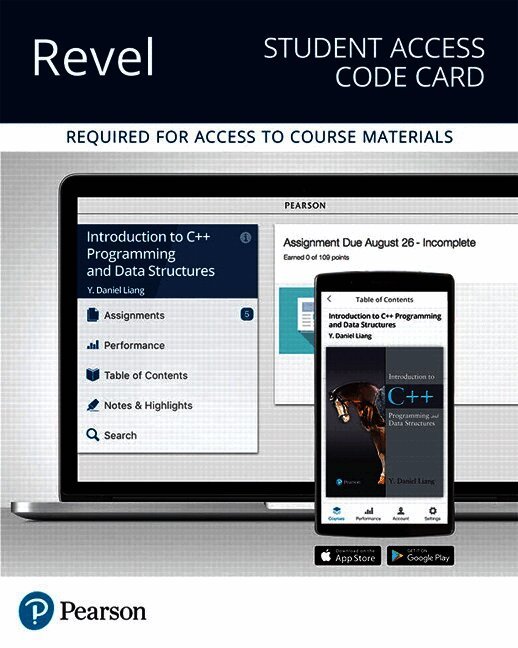
    Revel for Introduction to C++ Programming and Data Structures -- Access Card

    AvY. Liang

    Pearson Education

    2018

    9 kr

    Kommande

    Beskrivning

    For introductory courses in Computer Science and Computer Programming courses.

    A fundamentals first approach to programming helps students create efficient, elegant code

    RevelTM Introduction to Programming with C++ introduces students to basic programming concepts using a fundamentals-first approach that prepares them for learning object-oriented and advanced C++ programming. This approach presents programming concepts and techniques that include control statements, loops, functions, and arrays before discussing object-oriented programming. Students learn to approach programming as a method for problem solving with interesting and practical examples that illustrate syntax. The content incorporates a wide variety of problems with various levels of difficulty and covers many application areas to engage and motivate students.

    Revel is Pearson’s newest way of delivering our respected content. Fully digital and highly engaging, Revel replaces the textbook and gives students everything they need for the course. Informed by extensive research on how people read, think, and learn, Revel is an interactive learning environment that enables students to read, practice, and study in one continuous experience – for less than the cost of a traditional textbook.

    NOTE: Revel is a fully digital delivery of Pearson content. This ISBN is for the standalone Revel access card. In addition to this access card, you will need a course invite link, provided by your instructor, to register for and use Revel.

    Produktinformation

    • Märke:Pearson Education
    • Utgivningsdatum:2018-01-06
    • Höjd:216 x 279 x 2 mm
    • Vikt:14 g
    • Språk:Engelska
    • Antal sidor:9 998
    • Upplaga:4
    • Förlag:Pearson Education
    • EAN:9780134669854

    Utforska kategorier

    • Programspråk inom Data och IT

    Mer om författaren

    Dr. Daniel Liang earned his Ph.D. in Computer Science from the University of Oklahoma in 1991, and his M.S. and B.S. in Computer Science from Fudan University in Shanghai, China in 1986 and 1983. Prior to joining Armstrong State University (now merged with Georgia Southern University), he was an Associate Professor in computer science at Purdue University in Fort Wayne, Indiana, where he twice received the Excellence in Research award.Dr. Liang is currently a Professor of Computer Science at Georgia Southern University and has given lectures on programming internationally. He was trained in theoretical computer science. He has published in the SIAM Journal on Computing, Discrete Applied Mathematics, Acta Informatics, and Information Processing Letters. He is the author of more than thirty books and his popular computer science texts are widely used throughout the world.

    Innehållsförteckning

    • 1: Introduction to Computers, Programs, and C++1: Objectives1.1: Introduction1.2: What Is a Computer?1.3: Programming Languages1.4: Operating Systems1.5: History of C++1.6: A Simple C++ Program1.7: C++ Program-Development Cycle1.8: Programming Style and Documentation1.9: Programming ErrorsKey Terms: Chapter 1Chapter Summary: Chapter 1Programming Exercises From the Book: Chapter 12: Elementary Programming2: Objectives2.1: Introduction2.2: Writing a Simple Program2.3: Reading Input from the Keyboard2.4: Identifiers2.5: Variables2.6: Assignment Statements and Assignment Expressions2.7: Named Constants2.8: Numeric Data Types and Operations2.9: Evaluating Expressions and Operator Precedence2.10: Case Study: Displaying the Current Time2.11: Augmented Assignment Operators2.12: Increment and Decrement Operators2.13: Numeric Type Conversions2.14: Software Development Process2.15: Case Study: Counting Monetary Units2.16: Common ErrorsKey Terms: Chapter 2Chapter Summary: Chapter 2Programming Exercises From the Book: Chapter 23: Selections3: Objectives3.1: Introduction3.2: The bool Data Type3.3: if Statements3.4: Two-Way if-else Statements3.5: Nested if and Multi-Way if-else Statements3.6: Common Errors and Pitfalls3.7: Case Study: Computing Body Mass Index3.8: Case Study: Computing Taxes3.9: Generating Random Numbers3.10: Logical Operators3.11: Case Study: Determining Leap Year3.12: Case Study: Lottery3.13: switch Statements3.14: Conditional Operators3.15: Operator Precedence and Associativity3.16: DebuggingKey Terms: Chapter 3Chapter Summary: Chapter 3Programming Exercises From the Book: Chapter 34: Mathematical Functions, Characters, and Strings4: Objectives4.1: Introduction4.2: Mathematical Functions4.3: Character Data Type and Operations4.4: Case Study: Generating Random Characters4.5: Case Study: Guessing Birthdays4.6: Character Functions4.7: Case Study: Converting a Hexadecimal Digit to a Decimal Value4.8: The string Type4.9: Case Study: Revising the Lottery Program Using Strings4.10: Formatting Console Output4.11: Simple File Input and OutputKey Terms: Chapter 4Chapter Summary: Chapter 4Programming Exercises From the Book: Chapter 45: Loops5: Objectives5.1: Introduction5.2: The while Loop5.3: Case Study: Guessing Numbers5.4: Loop Design Strategies5.5: Controlling a Loop with User Confirmation5.6: Input and Output Redirections and Read All Data from a File5.7: The do-while Loop5.8: The for Loop5.9: Which Loop to Use?5.10: Nested Loops5.11: Minimizing Numeric Errors5.12: Case Studies5.13: Keywords break and continue5.14: Case Study: Checking Palindromes5.15: Case Study: Displaying Prime NumbersKey Terms: Chapter 5Chapter Summary: Chapter 5Programming Exercises From the Book: Chapter 56: Functions6: Objectives6.1: Introduction6.2: Defining a Function6.3: Calling a Function6.4: void Functions6.5: Passing Arguments by Value6.6: Modularizing Code6.7: Overloading Functions6.8: Function Prototypes6.9: Default Arguments6.10: Inline Functions6.11: Local, Global, and Static Local Variables6.12: Passing Arguments by Reference6.13: Constant Reference Parameters6.14: Case Study: Converting Hexadecimals to Decimals6.15: Function Abstraction and Stepwise RefinementKey Terms: Chapter 6Chapter Summary: Chapter 6Programming Exercises From the Book: Chapter 67: Single-Dimensional Arrays and C-Strings7: Objectives7.1: Introduction7.2: Array Basics7.3: Case Study: Analyzing Numbers7.4: Case Study: Deck of Cards7.5: Passing Arrays to Functions7.6: Preventing Changes of Array Arguments in Functions7.7: Returning Arrays from Functions7.8: Case Study: Counting the Occurrences of Each Letter7.9: Searching Arrays7.10: Sorting Arrays7.11: C-Strings7.12: Converting Numbers to StringsKey Terms: Chapter 7Chapter Summary: Chapter 7Programming Exercises From the Book: Chapter 78: Multidimensional Arrays8: Objectives8.1: Introduction8.2: Declaring Two-Dimensional Arrays8.3: Processing Two-Dimensional Arrays8.4: Passing Two-Dimensional Arrays to Functions8.5: Case Study: Grading a Multiple-Choice Test8.6: Case Study: Finding a Closest Pair8.7: Case Study: Sudoku8.8: Multidimensional ArraysKey Terms: Chapter 8Chapter Summary: Chapter 8Programming Exercises From the Book: Chapter 89: Objects and Classes9: Objectives9.1: Introduction9.2: Defining Classes for Objects9.3: Example: Defining Classes and Creating Objects9.4: Constructors9.5: Constructing and Using Objects9.6: Separating Class Definition from Implementation9.7: Preventing Multiple Inclusions9.8: Inline Functions in Classes9.9: Data Field Encapsulation9.10: The Scope of Variables9.11: Class Abstraction and EncapsulationKey Terms: Chapter 9Chapter Summary: Chapter 9Programming Exercises From the Book: Chapter 910: Object-Oriented Thinking10: Objectives10.1: Introduction10.2: The string Class10.3: Passing Objects to Functions10.4: Array of Objects10.5: Instance and Static Members10.6: Constant Member Functions10.7: Thinking in Objects10.8: Class Relationships10.9: Case Study: The StackOfIntegers Class10.10: Constructor Initializer Lists10.11: Class Design GuidelinesKey Terms: Chapter 10Chapter Summary: Chapter 10Programming Exercises From the Book: Chapter 1011: Pointers and Dynamic Memory Management11: Objectives11.1: Introduction11.2: Pointer Basics11.3: Defining Synonymous Types Using the typedef Keyword11.4: Using const with Pointers11.5: Arrays and Pointers11.6: Passing Pointer Arguments in a Function Call11.7: Returning a Pointer from Functions11.8: Useful Array Functions11.9: Dynamic Persistent Memory Allocation11.10: Creating and Accessing Dynamic Objects11.11: The this Pointer11.12: Destructors11.13: Case Study: The Course Class11.14: Copy Constructors11.15: Customizing Copy ConstructorsKey Terms: Chapter 11Chapter Summary: Chapter 11Chapter 11 Programming ProjectProgramming Exercises From the Book: Chapter 1112: Templates, Vectors, and Stacks12: Objectives12.1: Introduction12.2: Templates Basics12.3: Example: A Generic Sort12.4: Class Templates12.5: Improving the Stack Class12.6: The C++ vector Class12.7: Insertion and Deletion and Other Functions for a Vector12.8: Replacing Arrays Using the vector Class12.9: Case Study: Evaluating Expressions12.10: Using Smart Pointers for Automatic Object DestructionKey Terms: Chapter 12Chapter Summary: Chapter 12Programming Exercises From the Book: Chapter 1213: File Input and Output13: Objectives13.1: Introduction13.2: Text I/O13.3: Formatting Output13.4: Functions: getline, get, and put13.5: fstream and File Open Modes13.6: Testing Stream States13.7: Binary I/O13.8: Random Access File13.9: Updating FilesKey Terms: Chapter 13Chapter Summary: Chapter 13Programming Exercises From the Book: Chapter 1314: Operator Overloading14: Objectives14.1: Introduction14.2: The Rational Class14.3: Operator Functions14.4: Overloading the Subscript Operator []14.5: Overloading Augmented Assignment Operators14.6: Overloading the Unary Operators14.7: Overloading the ++ and —— Operators14.8: friend Functions and friend Classes14.9: Overloading the << and >> Operators14.10: Automatic Type Conversions14.11: Defining Nonmember Functions for Overloading Operators14.12: The Rational Class with Overloaded Function Operators14.13: Overloading the = OperatorsKey Terms: Chapter 14Chapter Summary: Chapter 14Chapter 14 Programming ProjectProgramming Exercises From the Book: Chapter 1415: Inheritance and Polymorphism15: Objectives15.1: Introduction15.2: Base Classes and Derived Classes15.3: Generic Programming15.4: Constructors and Destructors15.5: Redefining Functions15.6: Polymorphism15.7: Virtual Functions and Dynamic Binding15.8: The C+11 override and final Keywords15.9: The protected Keyword15.10: Abstract Classes and Pure Virtual Functions15.11: Casting: static_cast versus dynamic_castKey Terms: Chapter 15Chapter Summary: Chapter 15Chapter 15: Programing ProjectProgramming Exercises From the Book: Chapter 1516: Exception Handling16: Objectives16.1: Introduction16.2: Exception-Handling Overview16.3: Exception Classes16.4: Custom Exception Classes16.5: Multiple Catches16.6: Exception Propagation16.7: Rethrowin