• Fri frakt över 249 kr
  • •
  • Snabba leveranser
  • •
  • Billiga böcker
Kundservice

Du är på sajten för privatpersoner.

Företag, bibliotek eller offentlig verksamhet?

Du handlar på classic.bokus.com, där alla dina funktioner finns intakta.
Till classic.bokus.com
Bokus logotyp. Gå till startsidan.
  • Erbjudanden
  • Nyheter
  • Student
  • Topplistor
  • Barn & ungdom
  • Bokus Play
  • E-böcker
  • Pocketböcker
  • Spel & pussel

10% studentrabatt med kod TERM26

Sidfot

Mina sidor

    Hjälp

    • Kundservice
    • Vanliga frågor och svar
    • Frakt och leverans
    • Retur vid ångerrätt
    • Reklamera vara
    • Betalning
    • Köpvillkor
    • Allmänna villkor
    • Information om webbplatsens tillgänglighet

    Om Bokus

    • Om oss
    • Pressrum
    • För studenter
    • För företag
    • För bibliotek och offentlig verksamhet
    • För leverantörer
    • Hållbarhet

    Populärt

    • Aktuella erbjudanden
    • Presentkort
    • Studentlitteratur
    • Nya böcker
    • Topplistor
    • Signerade böcker
    • Engelska böcker

    Inspiration

    • Boktips
    • BookTok
    • Populära bokserier
    • Barnbokskaraktärer
    • Populära författare
    Logotyp för Bokus
    Följ oss på Facebook (extern länk)Följ oss på Instagram (extern länk)Följ oss på YouTube (extern länk)Följ oss på TikTok (extern länk)
    bokus @ CookiesAnpassa cookiesIntegritetspolicyKöpvillkor
    Till Citymail hemsida (extern länk)Till Budbee hemsida (extern länk)Till Postnord hemsida (extern länk)Till Schenker hemsida (extern länk)Till Early Bird hemsida (extern länk)Till Walleys hemsida (extern länk)
    1. Naturvetenskap och teknik
    2. Matematik och naturvetenskap
    3. Matematik

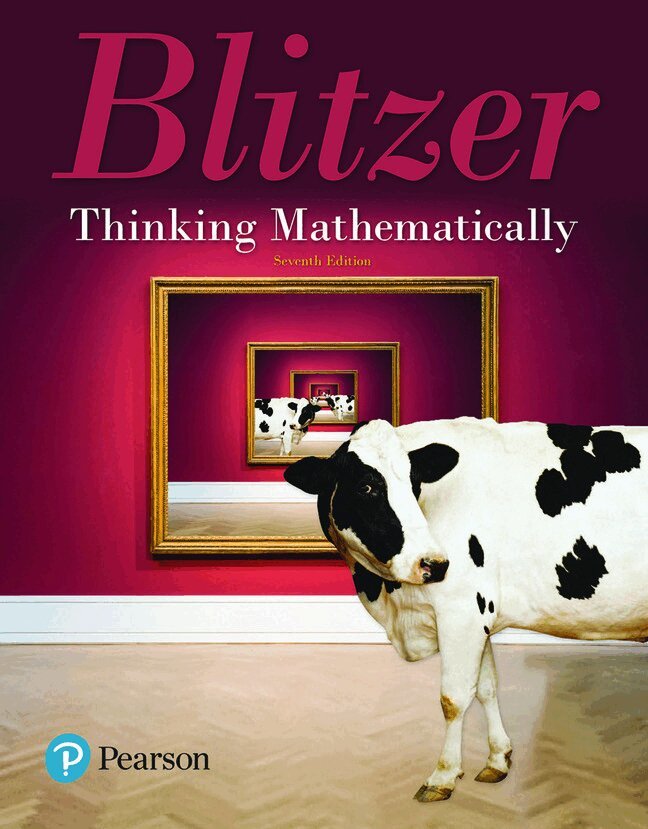
    MyLab Math with Pearson eText Access Code (24 Months) for Thinking Mathematically

    AvRobert Blitzer

    Pearson Education

    2018

    2 571 kr

    Tillfälligt slut

    Beskrivning

    MyLab Math Standalone Access Card to accompany Blitzer, Thinking Mathematically, 7/e

    This item is an access card for MyLabTM Math. This physical access card includes an access code for your MyLab Math course. In order to access the online course you will also need a CourseID, provided by your instructor.

    This title-specific access card provides access to the Blitzer, Thinking Mathematically, 7/e accompanying MyLab course ONLY.

    0134705092 / 9780134705095 MyLab Math with Pearson eText - Access Card - for Thinking Mathematically, 7/e

    MyLab Math is the world’s leading online tutorial, and assessment program designed to help you learn and succeed in your mathematics course. MyLab Math online courses are created to accompany one of Pearson’s best-selling math textbooks. Every MyLab Math course includes a complete, interactive eText. Learn more.

    ALERT:

    Before you purchase, check with your instructor or review your course syllabus to ensure that you select the correct ISBN.

    Used or rental books

    If you rent or purchase a used book with an access code, the access code may have been redeemed previously and you may have to purchase a new access code.

    Access codes

    Access codes that are purchased from sellers other than Pearson carry a higher risk of being either the wrong ISBN or a previously redeemed code. Check with the seller prior to purchase.

    Produktinformation

    • Märke:Pearson Education
    • Utgivningsdatum:2018-02-22
    • Höjd:150 x 226 x 1 mm
    • Vikt:22 g
    • Språk:Engelska
    • Antal sidor:9 998
    • Upplaga:7
    • Förlag:Pearson Education
    • EAN:9780134705095

    Utforska kategorier

    • Matematik inom Naturvetenskap och teknik

    Mer om författaren

    About our author Bob Blitzer is a native of Manhattan and received a Bachelor of Arts degree with dual majors in mathematics and psychology (minor: English literature) from the City College of New York. His unusual combination of academic interests led him toward a Master of Arts in mathematics from the University of Miami and a doctorate in behavioral sciences from Nova University. Bob’s love for teaching mathematics was nourished for nearly 30 years at Miami Dade College, where he received numerous teaching awards, including Innovator of the Year from the League for Innovations in the Community College and an endowed chair based on excellence in the classroom. In addition to Thinking Mathematically, Bob has written textbooks covering developmental mathematics, algebra & trigonometry, trigonometry, college algebra, and precalculus, all published by Pearson. When not secluded in his Northern California writer’s cabin, Bob can be found hiking the beaches and trails of Point Reyes National Seashore and tending to the chores required by his beloved entourage of horses, chickens, and irritable roosters.

    Innehållsförteckning

    • (NOTE: Each chapter concludes with a Chapter Summary, Review, and Test, and a comprehensive Chapter Test.) Problem Solving and Critical Thinking 1.1 Inductive and Deductive Reasoning1.2 Estimation, Graphs, and Mathematical Models1.3 Problem SolvingSet Theory 2.1 Basic Set Concepts2.2 Subsets2.3 Venn Diagrams and Set Operations2.4 Set Operations and Venn Diagrams with Three Sets2.5 Survey ProblemsLogic 3.1 Statements, Negations, and Quantified Statements3.2 Compound Statements and Connectives3.3 Truth Tables for Negation, Conjunction, and Disjunction3.4 Truth Tables for the Conditional and the Biconditional3.5 Equivalent Statements and Variations of Conditional Statements3.6 Negations of Conditional Statements and De Morgan’s Laws3.7 Arguments and Truth Tables3.8 Arguments and Euler DiagramsNumber Representation and Calculation 4.1 Our Hindu-Arabic System and Early Positional Systems4.2 Number Bases in Positional Systems4.3 Computation in Positional Systems4.4 Looking Back at Early Numeration SystemsNumber Theory and the Real Number System 5.1 Number Theory: Prime and Composite Numbers5.2 The Integers; Order of Operations5.3 The Rational Numbers5.4 The Irrational Numbers5.5 Real Numbers and Their Properties; Clock Addition5.6 Exponents and Scientific Notation5.7 Arithmetic and Geometric SequencesAlgebra: Equations and Inequalities 6.1 Algebraic Expressions and Formulas6.2 Linear Equations in One Variable and Proportions6.3 Applications of Linear Equations6.4 Linear Inequalities in One Variable6.5 Quadratic EquationsAlgebra: Graphs, Functions, and Linear Systems 7.1 Graphing and Functions7.2 Linear Functions and Their Graphs7.3 Systems of Linear Equations in Two Variables7.4 Linear Inequalities in Two Variables7.5 Linear Programming7.6 Modeling Data: Exponential, Logarithmic, and Quadratic FunctionsPersonal Finance 8.1 Percent, Sales Tax, and Discounts8.2 Income Tax8.3 Simple Interest8.4 Compound Interest8.5 Annuities, Methods of Saving, and Investments8.6 Cars8.7 The Cost of Home Ownership8.8 Credit CardsMeasurement 9.1 Measuring Length; The Metric System9.2 Measuring Area and Volume9.3 Measuring Weight and TemperatureGeometry 10.1 Points, Lines, Planes, and Angles10.2 Triangles10.3 Polygons, Perimeter, and Tessellations10.4 Area and Circumference10.5 Volume and Surface Area10.6 Right Triangle Trigonometry10.7 Beyond Euclidean GeometryCounting Methods and Probability Theory 11.1 The Fundamental Counting Principle11.2 Permutations11.3 Combinations11.4 Fundamentals of Probability11.5 Probability with the Fundamental Counting Principle, Permutations, and Combinations11.6 Events Involving Not and Or; Odds11.7 Events Involving And; Conditional Probability11.8 Expected ValueStatistics 12.1 Sampling, Frequency Distributions, and Graphs12.2 Measures of Central Tendency12.3 Measures of Dispersion12.4 The Normal Distribution12.5 Problem Solving with the Normal Distribution12.6 Scatter Plots, Correlation, and Regression LinesVoting and Apportionment 13.1 Voting Methods13.2 Flaws of Voting Methods13.3 Apportionment Methods13.4 Flaws of Apportionment MethodsGraph Theory 14.1 Graphs, Paths, and Circuits14.2 Euler Paths and Euler Circuits14.3 Hamilton Paths and Hamilton Circuits14.4 Trees Answers to Selected ExercisesCreditsSubject Index