• Fri frakt över 249 kr
  • •
  • Snabba leveranser
  • •
  • Billiga böcker
Kundservice

Du är på sajten för privatpersoner.

Företag, bibliotek eller offentlig verksamhet?

Du handlar på classic.bokus.com, där alla dina funktioner finns intakta.
Till classic.bokus.com
Bokus logotyp. Gå till startsidan.
  • Erbjudanden
  • Nyheter
  • Student
  • Topplistor
  • Barn & ungdom
  • Bokus Play
  • E-böcker
  • Pocketböcker
  • Spel & pussel

10% studentrabatt med kod TERM26

Sidfot

Mina sidor

    Hjälp

    • Kundservice
    • Vanliga frågor och svar
    • Frakt och leverans
    • Retur vid ångerrätt
    • Reklamera vara
    • Betalning
    • Köpvillkor
    • Allmänna villkor
    • Information om webbplatsens tillgänglighet

    Om Bokus

    • Om oss
    • Pressrum
    • För studenter
    • För företag
    • För bibliotek och offentlig verksamhet
    • För leverantörer
    • Hållbarhet

    Populärt

    • Aktuella erbjudanden
    • Presentkort
    • Studentlitteratur
    • Nya böcker
    • Topplistor
    • Signerade böcker
    • Engelska böcker

    Inspiration

    • Boktips
    • BookTok
    • Populära bokserier
    • Barnbokskaraktärer
    • Populära författare
    Logotyp för Bokus
    Följ oss på Facebook (extern länk)Följ oss på Instagram (extern länk)Följ oss på YouTube (extern länk)Följ oss på TikTok (extern länk)
    bokus @ CookiesAnpassa cookiesIntegritetspolicyKöpvillkor
    Till Citymail hemsida (extern länk)Till Budbee hemsida (extern länk)Till Postnord hemsida (extern länk)Till Schenker hemsida (extern länk)Till Early Bird hemsida (extern länk)Till Walleys hemsida (extern länk)
    1. Naturvetenskap och teknik
    2. Matematik och naturvetenskap
    3. Matematik

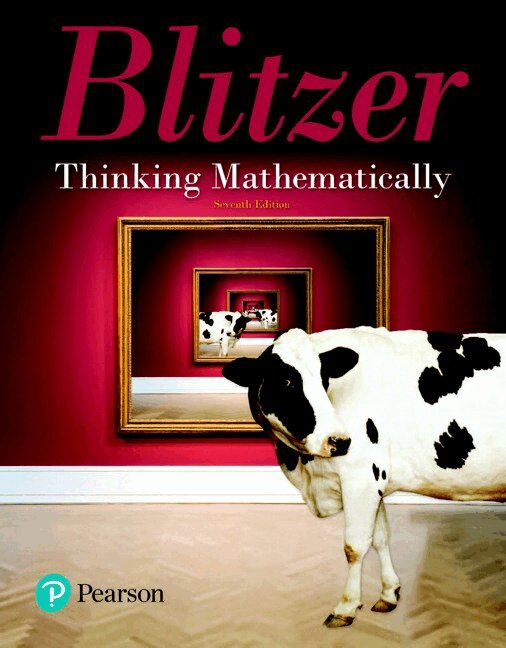
    Thinking Mathematically + MyLab Math with Pearson eText

    AvRobert Blitzer

    Pearson Education

    2018

    4 308 kr

    Tillfälligt slut

    Beskrivning

    NOTE: Before purchasing, check with your instructor to confirm the correct ISBN. Several versions of the MyLab™ and Mastering™ platforms exist for each title, and registrations are not transferable. To register for and use MyLab or Mastering, you may also need a Course ID, which your instructor will provide.


    Used books, rentals, and purchases made outside of Pearson

    If purchasing or renting from companies other than Pearson, the access codes for the MyLab platform may not be included, may be incorrect, or may be previously redeemed. Check with the seller before completing your purchase.


    For courses in Liberal Arts Mathematics.

    This package includes MyLab Math.


    Show students their world is profoundly mathematical, meaningful, and fun

    Students often struggle to find the relevance of math in their everyday lives.  In Thinking Mathematically, 7th Edition, Bob Blitzer’s distinctive and relatable voice engages students in the world of math through compelling, real-world applications — student-loan debt, time breakdown for an average NFL broadcast, and many more.


    Understanding that most students in this course are not math majors (and are unlikely to take another math class), Blitzer uses current data compiled from hundreds of books, magazines, and online sources to show students how truly meaningful and fun math can be.


    Reach every student by pairing this text with MyLab Math

    MyLab™ is the teaching and learning platform that empowers you to reach every student. By combining trusted author content with digital tools and a flexible platform, MyLab personalizes the learning experience and improves results for each student.


    013470830X / 9780134708300 Thinking Mathematically Plus MyLab Math - Access Card Package

    Package consists of:

    • 0134683714 / 9780134683713  Thinking Mathematically, 7/e

    • 0134705092 / 9780134705095  MyLab Math with Pearson eText - Access Card - for Thinking Mathematically, 7/e

    Produktinformation

    • Märke:Pearson Education
    • Utgivningsdatum:2018-02-19
    • Höjd:224 x 282 x 36 mm
    • Vikt:2 200 g
    • Språk:Engelska
    • Upplaga:7
    • Förlag:Pearson Education
    • EAN:9780134708300

    Utforska kategorier

    • Matematik inom Naturvetenskap och teknik

    Mer om författaren

    Bob Blitzer is a native of Manhattan and received a Bachelor of Arts degree with dual majors in mathematics and psychology (minor: English literature) from the City College of New York. His unusual combination of academic interests led him toward a Master of Arts in mathematics from the University of Miami and a doctorate in behavioral sciences from Nova University. Bob is most energized by teaching mathematics and has taught a variety of mathematics courses at Miami-Dade College for nearly 30 years. He has received numerous teaching awards, including Innovator of the Year from the League for Innovations in the Community College, and was among the first group of recipients at Miami-Dade College for an endowed chair based on excellence in the classroom. Bob has written Intermediate Algebra for College Students, Introductory Algebra for College Students, Essentials of Intermediate Algebra for College Students, Introductory and Intermediate Algebra for College Students, Essentials of Introductory and Intermediate Algebra for College Students, Algebra for College Students, Thinking Mathematically, College Algebra, Algebra and Trigonometry, Precalculus, and Trigonometry — all published by Pearson. When not secluded in his Northern California writer's cabin, Bob can be found hiking the beaches and trails of Point Reyes National Seashore, and tending to the chores required by his beloved entourage of horses, chickens, and irritable roosters.

    Innehållsförteckning

    • Table of Contents (NOTE: Each chapter concludes with a Chapter Summary, Review, and Test, and a comprehensive Chapter Test.) Problem Solving and Critical Thinking 1.1 Inductive and Deductive Reasoning1.2 Estimation, Graphs, and Mathematical Models1.3 Problem Solving Set Theory 2.1 Basic Set Concepts2.2 Subsets2.3 Venn Diagrams and Set Operations2.4 Set Operations and Venn Diagrams with Three Sets2.5 Survey ProblemsLogic 3.1 Statements, Negations, and Quantified Statements3.2 Compound Statements and Connectives3.3 Truth Tables for Negation, Conjunction, and Disjunction3.4 Truth Tables for the Conditional and the Biconditional3.5 Equivalent Statements and Variations of Conditional Statements3.6 Negations of Conditional Statements and De Morgan’s Laws3.7 Arguments and Truth Tables3.8 Arguments and Euler DiagramsNumber Representation and Calculation 4.1 Our Hindu-Arabic System and Early Positional Systems4.2 Number Bases in Positional Systems4.3 Computation in Positional Systems4.4 Looking Back at Early Numeration SystemsNumber Theory and the Real Number System 5.1 Number Theory: Prime and Composite Numbers5.2 The Integers; Order of Operations5.3 The Rational Numbers5.4 The Irrational Numbers5.5 Real Numbers and Their Properties; Clock Addition5.6 Exponents and Scientific Notation5.7 Arithmetic and Geometric SequencesAlgebra: Equations and Inequalities 6.1 Algebraic Expressions and Formulas6.2 Linear Equations in One Variable and Proportions6.3 Applications of Linear Equations6.4 Linear Inequalities in One Variable6.5 Quadratic EquationsAlgebra: Graphs, Functions, and Linear Systems 7.1 Graphing and Functions7.2 Linear Functions and Their Graphs7.3 Systems of Linear Equations in Two Variables7.4 Linear Inequalities in Two Variables7.5 Linear Programming7.6 Modeling Data: Exponential, Logarithmic, and Quadratic Functions Personal Finance 8.1 Percent, Sales Tax, and Discounts8.2 Income Tax8.3 Simple Interest8.4 Compound Interest8.5 Annuities, Methods of Saving, and Investments8.6 Cars8.7 The Cost of Home Ownership8.8 Credit Cards Measurement 9.1 Measuring Length; The Metric System9.2 Measuring Area and Volume9.3 Measuring Weight and Temperature Geometry 10.1 Points, Lines, Planes, and Angles10.2 Triangles10.3 Polygons, Perimeter, and Tessellations10.4 Area and Circumference10.5 Volume and Surface Area10.6 Right Triangle Trigonometry10.7 Beyond Euclidean Geometry Counting Methods and Probability Theory 11.1 The Fundamental Counting Principle11.2 Permutations11.3 Combinations11.4 Fundamentals of Probability11.5 Probability with the Fundamental Counting Principle, Permutations, and Combinations11.6 Events Involving Not and Or; Odds11.7 Events Involving And; Conditional Probability11.8 Expected Value Statistics 12.1 Sampling, Frequency Distributions, and Graphs12.2 Measures of Central Tendency12.3 Measures of Dispersion12.4 The Normal Distribution12.5 Problem Solving with the Normal Distribution12.6 Scatter Plots, Correlation, and Regression Lines Voting and Apportionment 13.1 Voting Methods13.2 Flaws of Voting Methods13.3 Apportionment Methods13.4 Flaws of Apportionment Methods Graph Theory 14.1 Graphs, Paths, and Circuits14.2 Euler Paths and Euler Circuits14.3 Hamilton Paths and Hamilton Circuits14.4 TreesAnswers to Selected Exercises Credits Subject Index