• Fri frakt över 249 kr
  • •
  • Snabba leveranser
  • •
  • Billiga böcker
Kundservice

Du är på sajten för privatpersoner.

Företag, bibliotek eller offentlig verksamhet?

Du handlar på classic.bokus.com, där alla dina funktioner finns intakta.
Till classic.bokus.com
Bokus logotyp. Gå till startsidan.
  • Erbjudanden
  • Nyheter
  • Student
  • Topplistor
  • Barn & ungdom
  • Bokus Play
  • E-böcker
  • Pocketböcker
  • Spel & pussel

10% rabatt på allt med kod NYSTART10 →

Sidfot

Mina sidor

    Hjälp

    • Kundservice
    • Vanliga frågor och svar
    • Frakt och leverans
    • Retur vid ångerrätt
    • Reklamera vara
    • Betalning
    • Köpvillkor
    • Allmänna villkor
    • Information om webbplatsens tillgänglighet

    Om Bokus

    • Om oss
    • Pressrum
    • För studenter
    • För företag
    • För bibliotek och offentlig verksamhet
    • För leverantörer
    • Hållbarhet

    Populärt

    • Aktuella erbjudanden
    • Presentkort
    • Studentlitteratur
    • Nya böcker
    • Topplistor
    • Signerade böcker
    • Engelska böcker

    Inspiration

    • Boktips
    • BookTok
    • Populära bokserier
    • Barnbokskaraktärer
    • Populära författare
    Logotyp för Bokus
    Följ oss på Facebook (extern länk)Följ oss på Instagram (extern länk)Följ oss på YouTube (extern länk)Följ oss på TikTok (extern länk)
    bokus @ CookiesAnpassa cookiesIntegritetspolicyKöpvillkor
    Till Citymail hemsida (extern länk)Till Budbee hemsida (extern länk)Till Postnord hemsida (extern länk)Till Schenker hemsida (extern länk)Till Early Bird hemsida (extern länk)Till Walleys hemsida (extern länk)
    1. Data och IT
    2. Nätverk och kommunikation

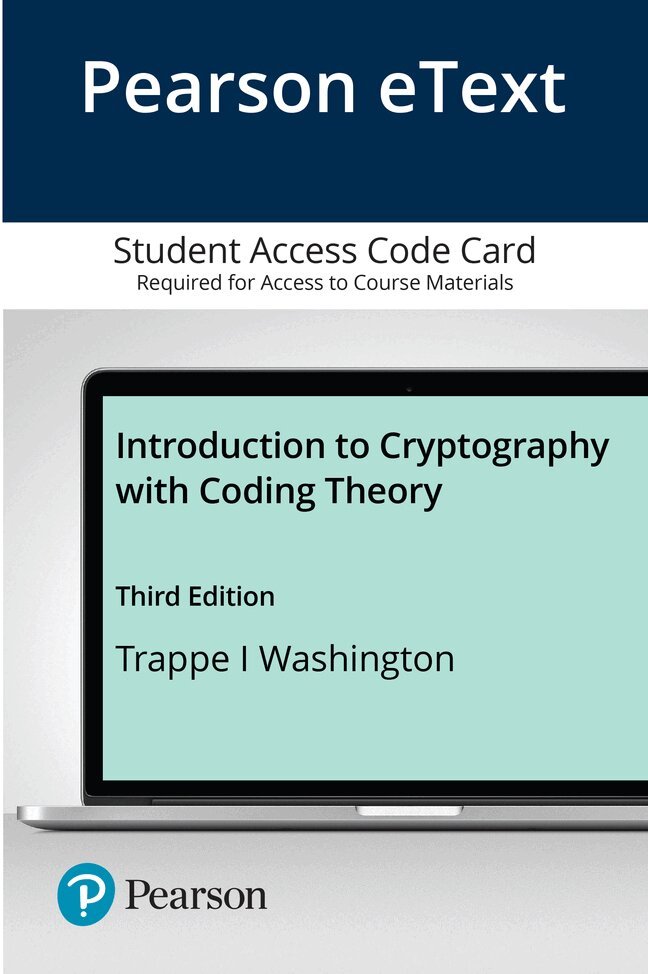
    Introduction to Cryptography with Coding Theory

    AvWade Trappe,Lawrence Washington

    Pearson Education

    2020

    632 kr

    Tillfälligt slut

    Fler format och utgåvor

    Inbunden

    3 411 kr

    Beskrivning

    A broad spectrum of cryptography topics, covered from a mathematical point of view.
    Extensively revised and updated, the 3rd Edition of Introduction to Cryptography with Coding Theory mixes applied and theoretical aspects to build a solid foundation in cryptography and security. The authors' lively, conversational tone and practical focus inform a broad coverage of topics from a mathematical point of view, and reflect the most recent trends in the rapidly changing field of cryptography.

    For courses in Cryptography, Network Security, and Computer Security.

    Pearson eText is an easy-to-use digital textbook that you can purchase on your own or instructors can assign for their course. The mobile app lets you keep on learning, no matter where your day takes you -- even offline. You can also add highlights, bookmarks, and notes in your Pearson eText to study how you like.

    NOTE: This ISBN is for the Pearson eText access card. Pearson eText is a fully digital delivery of Pearson content. Before purchasing, check that you have the correct ISBN. To register for and use Pearson eText, you may also need a course invite link, which your instructor will provide. Follow the instructions provided on the access card to learn more.

    Produktinformation

    • Märke:Pearson Education
    • Utgivningsdatum:2020-05-13
    • Höjd:100 x 100 x 100 mm
    • Vikt:100 g
    • Språk:Engelska
    • Antal sidor:580
    • Upplaga:3
    • Förlag:Pearson Education
    • EAN:9780134859064

    Utforska kategorier

    • Nätverk och kommunikation inom Data och IT
    • Matematik inom Naturvetenskap och teknik

    Mer om författaren

    About our author Wade Trappe is a Professor in the Electrical and Computer Engineering Department at Rutgers University, and Associate Director of the Wireless Information Network Laboratory (WINLAB). He has led several federally funded projects in the area of cybersecurity and communication systems. He was named Fellow of the Institute of Electrical and Electronics Engineers (IEEE) in 2014 for contributions to information and communication security.

    Innehållsförteckning

    • Overview of Cryptography and Its Applications 1.1 Secure Communications1.2 Cryptographic Applications Classical Cryptosystems 2.1 Shift Ciphers2.2 Affine Ciphers2.3 The VigenÈre Cipher2.4 Substitution Ciphers2.5 Sherlock Holmes2.6 The Playfair and ADFGX Ciphers2.7 Enigma2.8 Exercises2.9 Computer Problems Basic Number Theory 3.1 Basic Notions3.2 The Extended Euclidean Algorithm3.3 Congruences3.4 The Chinese Remainder Theorem3.5 Modular Exponentiation3.6 Fermat and Euler3.7 Primitive Roots3.8 Inverting Matrices Mod n3.9 Square Roots Mod n3.10 Legendre and Jacobi Symbols3.11 Finite Fields3.12 Continued Fractions3.13 Exercises3.14 Computer Problems The One-Time Pad 4.1 Binary Numbers and ASCII4.2 One-Time Pads4.3 Multiple Use of a One-Time Pad4.4 Perfect Secrecy of the One-Time Pad4.5 Indistinguishability and Security4.6 Exercises Stream Ciphers 5.1 Pseudo-Random Bit Generation5.2 LFSR Sequences5.3 RC45.4 Exercises5.5 Computer Problems Block Ciphers 6.1 Block Ciphers6.2 Hill Ciphers6.3 Modes of Operation6.4 Multiple Encryption6.5 Meet-in-the-Middle Attacks6.6 Exercises6.7 Computer Problems The Data Encryption Standard 7.1 Introduction7.2 A Simplified DES-Type Algorithm7.3 Differential Cryptanalysis7.4 DES7.5 Breaking DES7.6 Password Security7.7 Exercises7.8 Computer Problems The Advanced Encryption Standard: Rijndael 8.1 The Basic Algorithm8.2 The Layers8.3 Decryption8.4 Design Considerations8.5 Exercises The RSA Algorithm 9.1 The RSA Algorithm9.2 Attacks on RSA9.3 Primality Testing9.4 Factoring9.5 The RSA Challenge9.6 An Application to Treaty Verification9.7 The Public Key Concept9.8 Exercises9.9 Computer Problems Discrete Logarithms 10.1 Discrete Logarithms10.2 Computing Discrete Logs10.3 Bit Commitment10.4 Diffie-Hellman Key Exchange10.5 The ElGamal Public Key Cryptosystem10.6 Exercises10.7 Computer Problems Hash Functions 11.1 Hash Functions11.2 Simple Hash Examples11.3 The Merkle-Damg ̊ard Construction11.4 SHA-211.5 SHA-3/Keccak11.6 Exercises Hash Functions: Attacks and Applications 12.1 Birthday Attacks12.2 Multicollisions12.3 The Random Oracle Model12.4 Using Hash Functions to Encrypt12.5 Message Authentication Codes12.6 Password Protocols12.7 Blockchains12.8 Exercises12.9 Computer Problems Digital Signatures 13.1 RSA Signatures13.2 The ElGamal Signature Scheme13.3 Hashing and Signing13.4 Birthday Attacks on Signatures13.5 The Digital Signature Algorithm13.6 Exercises13.7 Computer Problems What Can Go Wrong 14.1 An Enigma ‘Feature’14.2 Choosing Primes for RSA14.3 WEP14.4 Exercises Security Protocols 15.1 Intruders-in-the-Middle and Impostors15.2 Key Distribution15.3 Kerberos15.4 Public Key Infrastructures (PKI)15.5 X.509 Certificates15.6 Pretty Good Privacy15.7 SSL and TLS15.8 Secure Electronic Transaction15.9 Exercises Digital Cash 16.1 Setting the Stage for Digital Economies16.2 A Digital Cash System16.3 Bitcoin Overview16.4 Cryptocurrencies16.5 Exercises Secret Sharing Schemes 17.1 Secret Splitting17.2 Threshold Schemes17.3 Exercises17.4 Computer Problems Games 18.1 Flipping Coins over the Telephone18.2 Poker over the Telephone18.3 Exercises Zero-Knowledge Techniques 19.1 The Basic Setup19.2 The Feige-Fiat-Shamir Identification Scheme19.3 Exercises Information Theory 20.1 Probability Review20.2 Entropy20.3 Huffman Codes20.4 Perfect Secrecy20.5 The Entropy of English20.6 Exercises Elliptic Curves 21.1 The Addition Law21.2 Elliptic Curves Mod p21.3 Factoring with Elliptic Curves21.4 Elliptic Curves in Characteristic 221.5 Elliptic Curve Cryptosystems21.6 Exercises21.7 Computer Problems Pairing-Based Cryptography 22.1 Bilinear Pairings22.2 The MOV Attack22.3 Tripartite Diffie-Hellman22.4 Identity-Based Encryption22.5 Signatures22.6 Keyword Search22.7 Exercises Lattice Methods 23.1 Lattices23.2 Lattice Reduction23.3 An Attack on RSA23.4 NTRU23.5 Another Lattice-Based Cryptosystem23.6 Post-Quantum Cryptography?23.7 Exercises Error Correcting Codes 24.1 Introduction24.2 Error Correcting Codes24.3 Bounds on General Codes24.4 Linear Codes24.5 Hamming Codes24.6 Golay Codes24.7 Cyclic Codes24.8 BCH Codes24.9 Reed-Solomon Codes24.10 The McEliece Cryptosystem24.11 Other Topics24.12 Exercises24.13 Computer Problems Quantum Techniques in Cryptography 25.1 A Quantum Experiment25.2 Quantum Key Distribution25.3 Shor’s Algorithm25.4 Exercises Mathematica® Examples A.1 Getting Started with MathematicaA.2 Some CommandsA.3 Examples for Chapter 2A.4 Examples for Chapter 3A.5 Examples for Chapter 5A.6 Examples for Chapter 6A.7 Examples for Chapter 9A.8 Examples for Chapter 10A.9 Examples for Chapter 12A.10 Examples for Chapter 17A.11 Examples for Chapter 18A.12 Examples for Chapter 21 Maple® Examples B.1 Getting Started with MapleB.2 Some CommandsB.3 Examples for Chapter 2B.4 Examples for Chapter 3B.5 Examples for Chapter 5B.6 Examples for Chapter 6B.7 Examples for Chapter 9B.8 Examples for Chapter 10B.9 Examples for Chapter 12B.10 Examples for Chapter 17B.11 Examples for Chapter 18B.12 Examples for Chapter 21 MATLAB® Examples C.1 Getting Started with MATLABC.2 Examples for Chapter 2C.3 Examples for Chapter 3C.4 Examples for Chapter 5C.5 Examples for Chapter 6C.6 Examples for Chapter 9C.7 Examples for Chapter 10C.8 Examples for Chapter 12C.9 Examples for Chapter 17C.10 Examples for Chapter 18C.11 Examples for Chapter 21 Sage Examples D.1 Computations for Chapter 2D.2 Computations for Chapter 3D.3 Computations for Chapter 5D.4 Computations for Chapter 6D.5 Computations for Chapter 9D.6 Computations for Chapter 10D.7 Computations for Chapter 12D.8 Computations for Chapter 17D.9 Computations for Chapter 18D.10 Computations for Chapter 21 E. Answers and Hints for Selected Odd-Numbered Exercises F. Suggestions for Further Reading Bibliography Index