• Fri frakt över 249 kr
  • •
  • Snabba leveranser
  • •
  • Billiga böcker
Kundservice

Du är på sajten för privatpersoner.

Företag, bibliotek eller offentlig verksamhet?

Du handlar på classic.bokus.com, där alla dina funktioner finns intakta.
Till classic.bokus.com
Bokus logotyp. Gå till startsidan.
  • Erbjudanden
  • Nyheter
  • Student
  • Topplistor
  • Barn & ungdom
  • Bokus Play
  • E-böcker
  • Pocketböcker
  • Spel & pussel

10% studentrabatt med kod TERM26

Sidfot

Mina sidor

    Hjälp

    • Kundservice
    • Vanliga frågor och svar
    • Frakt och leverans
    • Retur vid ångerrätt
    • Reklamera vara
    • Betalning
    • Köpvillkor
    • Allmänna villkor
    • Information om webbplatsens tillgänglighet

    Om Bokus

    • Om oss
    • Pressrum
    • För studenter
    • För företag
    • För bibliotek och offentlig verksamhet
    • För leverantörer
    • Hållbarhet

    Populärt

    • Aktuella erbjudanden
    • Presentkort
    • Studentlitteratur
    • Nya böcker
    • Topplistor
    • Signerade böcker
    • Engelska böcker

    Inspiration

    • Boktips
    • BookTok
    • Populära bokserier
    • Barnbokskaraktärer
    • Populära författare
    Logotyp för Bokus
    Följ oss på Facebook (extern länk)Följ oss på Instagram (extern länk)Följ oss på YouTube (extern länk)Följ oss på TikTok (extern länk)
    bokus @ CookiesAnpassa cookiesIntegritetspolicyKöpvillkor
    Till Citymail hemsida (extern länk)Till Budbee hemsida (extern länk)Till Postnord hemsida (extern länk)Till Schenker hemsida (extern länk)Till Early Bird hemsida (extern länk)Till Walleys hemsida (extern länk)
    1. Naturvetenskap och teknik
    2. Matematik och naturvetenskap
    3. Matematik
    4. Algebra

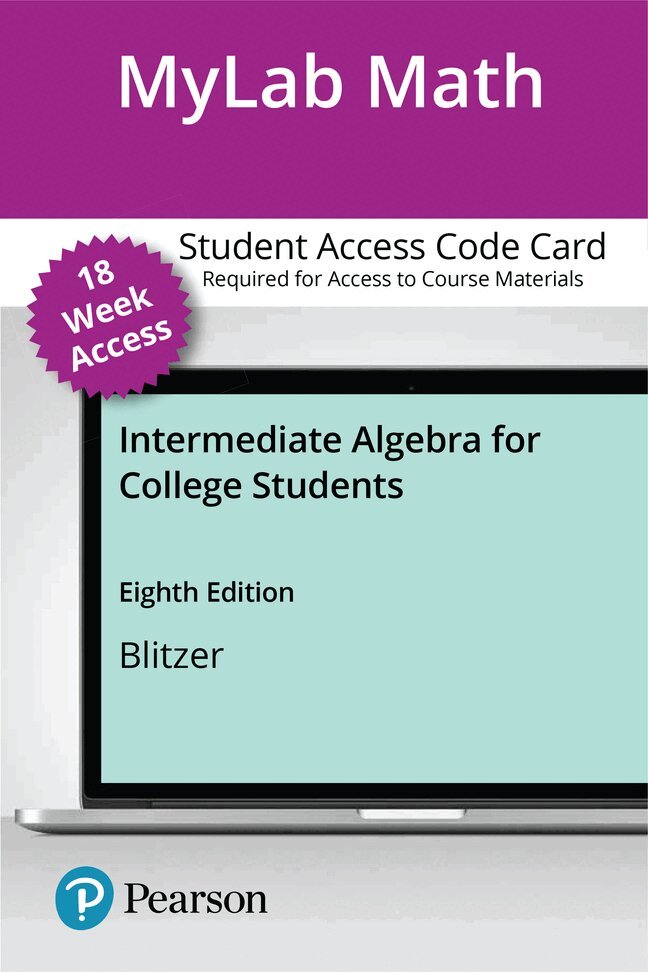
    MyLab Math with Pearson eText Access Code for Intermediate Algebra for College Students

    AvRobert Blitzer

    Pearson Education

    2022

    1 576 kr

    Tillfälligt slut

    Beskrivning

    NOTE: Before purchasing, check with your instructor to ensure you select the correct ISBN. Several versions of the MyLabTMand MasteringTM platforms exist for each title, and registrations are not transferable. To register for and use MyLab or Mastering, you may also need a Course ID, which your instructor will provide.

    Used books, rentals, and purchases made outside of Pearson

    If purchasing or renting from companies other than Pearson, the access codes for the MyLab platform may not be included, may be incorrect, or may be previously redeemed. Check with the seller before completing your purchase.

    For courses in Intermediate Algebra.

    This is the standalone 18-week access card for MyLab Math.

    Gets them engaged. Keeps them engaged.

    Bob Blitzer’s Developmental Algebra Series shows developmental students at all levels how math applies to their daily lives and culture. Blitzer’s use of realistic, interesting applications instantly piques students’ curiosity about mathematical concepts in the world around them. These applications are apparent throughout the entire program – from his student-friendly examples, unique writing style, and thought-provoking features to the digital resources in the MyLab Math course.

    In this revision Blitzer updates his hallmark applications, pulling from topics that are relevant to college students – often from pop culture, the news, and everyday life – to ensure that they will actually use their learning resources to achieve success.

    Personalize learning with MyLab Math

    By combining trusted author content with digital tools and a flexible platform, MyLab Math personalizes the learning experience and improves results for each student.

    0136553885 / 9780136553885 MYLAB MATH WITH PEARSON ETEXT -- ACCESS CARD -- FOR INTERMEDIATE ALGEBRA FOR COLLEGE STUDENTS (18-WEEKS), 8/e

    Produktinformation

    • Märke:Pearson Education
    • Utgivningsdatum:2022-06-08
    • Vikt:20 g
    • Språk:Engelska
    • Upplaga:8
    • Förlag:Pearson Education
    • EAN:9780136553885

    Utforska kategorier

    • Algebra inom Naturvetenskap och teknik

    Mer om författaren

    About our author Bob Blitzer is a native of Manhattan and received a Bachelor of Arts degree with dual majors in mathematics and psychology (minor: English literature) from the City College of New York. His unusual combination of academic interests led him toward a Master of Arts in mathematics from the University of Miami and a doctorate in behavioral sciences from Nova University. Bob’s love for teaching mathematics was nourished for nearly 30 years at Miami Dade College, where he received numerous teaching awards, including Innovator of the Year from the League for Innovations in the Community College and an endowed chair based on excellence in the classroom. Bob has written textbooks covering developmental mathematics, introductory algebra, intermediate algebra, algebra & trigonometry, trigonometry, college algebra, precalculus, and liberal arts mathematics, all published by Pearson. When not secluded in his Northern California writer’s cabin, Bob can be found hiking the beaches and trails of Point Reyes National Seashore and tending to the chores required by his beloved entourage of horses, chickens, and irritable roosters.

    Innehållsförteckning

    • Algebra, Mathematical Models, and Problem Solving 1.1 Algebraic Expressions, Real Numbers, and Interval Notation1.2 Operations with Real Numbers and Simplifying Algebraic Expressions1.3 Graphing Equations1.4 Solving Linear EquationsMid-Chapter Check Point1.5 Problem Solving and Using Formulas1.6 Properties of Integral Exponents1.7 Scientific NotationFunctions and Linear Functions 2.1 Introduction to Functions2.2 Graphs of Functions2.3 The Algebra of FunctionsMid-Chapter Check Point2.4 Linear Functions and Slope2.5 The Point-Slope Form of the Equation of a LineSystems of Linear Equations 3.1 Systems of Linear Equations in Two Variables3.2 Problem Solving and Business Applications Using Systems of Equations3.3 Systems of Linear Equations in Three VariablesMid-Chapter Check Point3.4 Matrix Solutions to Linear Systems3.5 Determinants and Cramer’s RuleInequalities and Problem Solving 4.1 Solving Linear Inequalities4.2 Compound Inequalities4.3 Equations and Inequalities Involving Absolute ValueMid-Chapter Check Point4.4 Linear Inequalities in Two Variables4.5 Linear ProgrammingPolynomials, Polynomial Functions, and Factoring 5.1 Introduction to Polynomials and Polynomial Functions5.2 Multiplication of Polynomials5.3 Greatest Common Factors and Factoring by Grouping5.4 Factoring TrinomialsMid-Chapter Check Point5.5 Factoring Special Forms5.6 A General Factoring Strategy5.7 Polynomial Equations and Their ApplicationsRational Expressions, Functions, and Equations 6.1 Rational Expressions and Functions; Multiplying and Dividing6.2 Adding and Subtracting Rational Expressions6.3 Complex Rational Expressions6.4 Division of PolynomialsMid-Chapter Check Point6.5 Synthetic Division and the Remainder Theorem6.6 Rational Equations6.7 Formulas and Applications of Rational Equations6.8 Modeling Using VariationRadicals, Radical Functions, and Rational Exponents 7.1 Radical Expressions and Functions7.2 Rational Exponents7.3 Multiplying and Simplifying Radical Expressions7.4 Adding, Subtracting, and Dividing Radical ExpressionsMid-Chapter Check Point7.5 Multiplying with More Than One Term and Rationalizing Denominators7.6 Radical Equations7.7 Complex NumbersQuadratic Equations and Functions 8.1 The Square Root Property and Completing the Square8.2 The Quadratic Formula8.3 Quadratic Functions and Their GraphsMid-Chapter Check Point8.4 Equations Quadratic in Form8.5 Polynomial and Rational InequalitiesExponents and Logarithmic Functions 9.1 Exponential Functions9.2 Composite and Inverse Functions9.3 Logarithmic Functions9.4 Properties of LogarithmsMid-Chapter Check Point9.5 Exponential and Logarithmic Equations9.6 Exponential Growth and Decay; Modeling DataConic Sections and Systems of Nonlinear Equations 10.1 Distance and Midpoint Formulas; Circles10.2 The Ellipse10.3 The HyperbolaMid-Chapter Check Point10.4 The Parabola; Identifying Conic Sections10.5 Systems of Nonlinear Equations in Two VariablesSequences, Series, and the Binomial Theorem 11.1 Sequences and Summation Notation11.2 Arithmetic Sequences11.3 Geometric Sequences and SeriesMid-Chapter Check Point11.4 The Binomial Theorem