• Fri frakt över 249 kr
  • •
  • Snabba leveranser
  • •
  • Billiga böcker
Kundservice

Du är på sajten för privatpersoner.

Företag, bibliotek eller offentlig verksamhet?

Du handlar på classic.bokus.com, där alla dina funktioner finns intakta.
Till classic.bokus.com
Bokus logotyp. Gå till startsidan.
  • Erbjudanden
  • Nyheter
  • Student
  • Topplistor
  • Barn & ungdom
  • Bokus Play
  • E-böcker
  • Pocketböcker
  • Spel & pussel

10% rabatt på allt med kod: NYSTART10 →

Sidfot

Mina sidor

    Hjälp

    • Kundservice
    • Vanliga frågor och svar
    • Frakt och leverans
    • Retur vid ångerrätt
    • Reklamera vara
    • Betalning
    • Köpvillkor
    • Allmänna villkor
    • Information om webbplatsens tillgänglighet

    Om Bokus

    • Om oss
    • Pressrum
    • För studenter
    • För företag
    • För bibliotek och offentlig verksamhet
    • För leverantörer
    • Hållbarhet

    Populärt

    • Aktuella erbjudanden
    • Presentkort
    • Studentlitteratur
    • Nya böcker
    • Topplistor
    • Signerade böcker
    • Engelska böcker

    Inspiration

    • Boktips
    • BookTok
    • Populära bokserier
    • Barnbokskaraktärer
    • Populära författare
    Logotyp för Bokus
    Följ oss på Facebook (extern länk)Följ oss på Instagram (extern länk)Följ oss på YouTube (extern länk)Följ oss på TikTok (extern länk)
    bokus @ CookiesAnpassa cookiesIntegritetspolicyKöpvillkor
    Till Citymail hemsida (extern länk)Till Budbee hemsida (extern länk)Till Postnord hemsida (extern länk)Till Schenker hemsida (extern länk)Till Early Bird hemsida (extern länk)Till Walleys hemsida (extern länk)
    1. Ekonomi och Ledarskap
    2. Ledarskapsböcker
    3. Projektledning

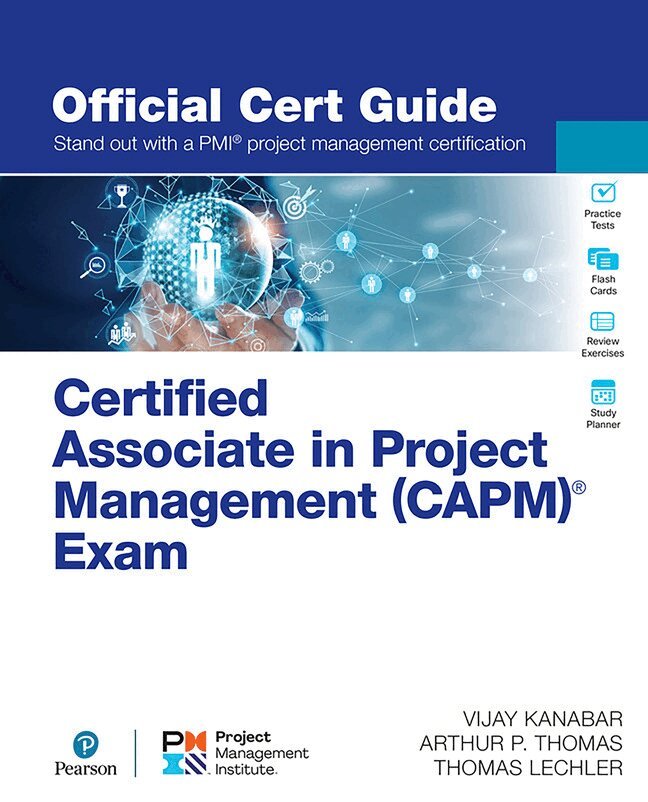
    Certified Associate in Project Management (CAPM)® Exam Official Cert Guide

    AvVijay Kanabar,Arthur Thomas

    Pearson Education

    2023

    Del i serien Certification Guide

    494 kr

    Beställningsvara. Skickas inom 7-10 vardagar. Fri frakt över 249 kr.

    Beskrivning

    Corrected Answer Key Available 

    The issue regarding the incorrect answer key for Chapter 2 has been addressed. Download the revised answer key under the Updates tab on the books web page at pearsonitcertification.com/capm/update to get the correct information. 

    Jump start your project management career with the Official Cert Guide to the Certified Associate in Project Management (CAPM)® Exam

    Exam Update: This product covers content for the new CAPM® Exam released by PMI on July 25, 2023. Learn more at pmi.org/CAPM

    Learn, prepare, and practice for test day success with the Certified Associate in Project Management (CAPM)® Exam Official Cert Guide, a Project Management Institute (PMI)®authorized self-study resource. This comprehensive guide from instructors and authors Vijay Kanabar, Arthur P. Thomas, and Thomas Lechler addresses the all-new 2023 CAPM®Exam domains:

    • Project management fundamentals and core concepts
    • Predictive, plan-based methodologies
    • Agile frameworks/methodologies
    • Business analysis frameworks

    CAPM is an essential first step in building your career at any stage as a project manager and a stepping-stone to the Project Management Professional (PMP)® Certification. CAPM is globally recognized as providing candidates with a solid foundation in hands-on project management skills and knowledge. The CAPM exam covers a broad range of project management approaches and prepares candidates in the skills, tools, and techniques that can be applied in the field of project management.

    The Certified Associate in Project Management (CAPM)® Exam Official Cert Guide features

    • Complete coverage of all CAPM exam topics
    • Do I Know This Already? quizzes identify knowledge gaps
    • Chapter exercises to review key concepts
    • A suggested study plan to optimize your final review

    You also get access to valuable study tools on the book's companion website, including

    • Two full-length practice exams powered by Pearson Test Prep practice software with realistic question sets, customization options, and detailed performance reports
    • Key term flash cards
    • Appendices and glossary downloads

    This complete study package offers a deep dive on CAPM exam topics:

    • Organizing for project performance
    • Predicative methodologies
    • Adaptive frameworks
    • Measurement, tracking, and managing uncertainty
    • Business analysis frameworks and domains
    • …and more!

    Pearson is an authorized content provider for PMI. This title is also available as a multi-format Premium Edition eBook with two additional practice tests.

    Produktinformation

    • Märke:Pearson Education
    • Utgivningsdatum:2023-07-26
    • Höjd:188 x 236 x 30 mm
    • Vikt:960 g
    • Språk:Engelska
    • Serie:Certification Guide
    • Antal sidor:528
    • Upplaga:1
    • Förlag:Pearson Education
    • EAN:9780137918096

    Utforska kategorier

    • Projektledning inom Ekonomi och Ledarskap
    • Programmeringsböcker inom Data och IT

    Mer om författaren

    Vijay Kanabar, Ph.D., is the director and associate professor of Project Management programs at Boston University, Metropolitan College. He is one of the earliest PMP credentialed practitioners from the Project Management Institute. He created one of the earliest PMP exam corporate training materials three decades ago and has introduced several thousand students and practitioners to the core exam concepts of both the CAPM® and Project Management Professional (PMP)® exams. Vijay also is an agile practitioner and has earned the PMI-ACP credential. He has authored several books and more than 75 research papers in IT and project management. He received the prestigious PMI Linn Stuckenbruck Teaching Excellence Award in 2017 for his commitment to teaching and enhancing the project management discipline in higher education.Arthur P. Thomas, Ed.M., Ph.D., is the executive director for the Office of Professional Acceleration and Microcredentials in the College of Professional Studies at Syracuse University, where he is also the program director for the Master of Professional Studies in Project Management. He has been teaching at SU since 2001 and has been a professor of practice since 2009, focusing his academic work on developing and administering project management courses and degree programs. Art is also the director of the iConsult Collaborative at Syracuse University, an experiential learning program he began leading in 2012 in which university students are engaged with client organizations in a diverse portfolio of information-related projects. Art was formerly the associate dean for Career Services and Experiential Learning, the associate dean for Academic Affairs, and the director of two information technology master's degree programs, all at Syracuse University's School of Information Studies (the iSchool). Positions on the corporate side of his career have ranged from programmer to chief information officer, and from trainer to chief learning officer. With his more than 30 years of added consulting experience, his contracts have taken him from the United States to Europe and the Middle East, where he led two projects for the Ministry of Education in the Sultanate of Oman.Thomas G. Lechler, Ph.D., is an associate professor at the School of Business, Stevens Institute of Technology in Hoboken, New Jersey. His doctorate is from the University of Karlsruhe, Germany. He teaches project management and entrepreneurship. His research focuses on value creation in projects under situations of risk and uncertainty. Thomas has published his research in leading international research journals, including Research Policy, R&D Management, IEEE Transactions on Engineering Management, Small Business Economics, International Journal of Project Management, and Project Management Journal, and he has authored several books in the fields of project management and entrepreneurship. He was awarded the Project Management Journal Paper of the Year, has received several research grants from PMI, and was a NASA research fellow.

    Innehållsförteckning

    • Introduction xxiPart I Project Management FundamentalsChapter 1 Becoming a Certified Associate in Project Management (CAPM) 2Foundation Topics 3Understanding Project Management 3Certified Associate in Project Management (CAPM) 3Scope of the CAPM Exam 4How This Book Is Organized 8Part I: Project Management Fundamentals 9Part II: Predictive Approach 9Part III: Adaptive Approach 10Part IV: Business Analysis 10Part V: Appendixes 11Steps to Becoming a Certified Associate in Project Management (CAPM)11Study and Exam-Taking Strategies 13Suggested Reading and Resources 13Chapter 2 Projects and Project Management 16“Do I Know This Already?” Quiz 17Foundation Topics 20What Is a Project? 20A Project 21Project Manager 22Understanding Project Management 22Projects vs. Operational Work 23The Role of Projects in Operations 24Project-Based Operations 24Programs and Portfolios 25Creating Value Through Project Management 26Project Management Process Groups 35Project Management Challenges 36Challenges with Issues, Risks, Assumptions, and Constraints 37Project Management Trends 41Business Analysis 41Adaptive Project Management 41Principles of Project Management 42Summary 42Exam Preparation Tasks 42Chapter 3 Organizing for Project Performance 44“Do I Know This Already?” Quiz 45Foundation Topics 50Project Performance Domains 50The Stakeholder Performance Domain 52Identifying Stakeholders 52Types of Stakeholders in a Project 53Stakeholder Analysis 54Types of Stakeholder Communication 55Stakeholder Performance Domain Successful Outcomes 56The Project Manager's Role 56Roles of the Project Manager in a Project 58The Project Manager's Required Skills 58Project Organization Structures 70Project Structure Concepts 70Functional Project Organization Structures 70Matrix Project Organization Structures 72Projectized Project Organization Structures 73The Power of Project Managers in Different Organization Structures 73Project Management Office (PMO) and Steering Committees 74The Project Management Office 75The Steering Committee 75The Team Performance Domain 76Effective Execution of Projects 78High-Performing Teams 78Leadership and Interpersonal Skills Affecting All Team Members 78Project Team Development Models 79Conducting Meetings 80Responsibility Assignment Matrix 83Project Team Culture 84Expectations for the Team Performance Domain 86Applying the PMI Code of Ethics and Professional Conduct 86Summary 88Exam Preparation Tasks 88Chapter 4 Development Approach and Life Cycle Performance Domain 92“Do I Know This Already?” Quiz 93Foundation Topics 97Fundamentals of the Project Life Cycle 97The Concept of a Project Life Cycle 97Visualizing a Project Life Cycle 98Stage Gates 99Project Life Cycle vs. Project Management Process Groups 100Project Life Cycle vs. Product Life Cycle 103Development Approach and Life Cycle Performance Domain Concepts 103Terms Relevant to the Development Approach and Life Cycle Performance Domain 104Choosing the Predictive Approach 105Choosing the Adaptive Approach 105Choosing a Hybrid Approach 106Life Cycles in Practice 107Industry Application: Predictive Life Cycle 107Industry Application: Adaptive Life Cycle 110Industry Application: Hybrid Life Cycle 111Considerations for Selecting a Development Approach 112Product, Service, or Result 113Project 114Organization 114Project Activity, Deliverables, and Milestones 115Project Activities 115Deliverables 115Measuring Deliverables 116Milestones 116Summary 118Exam Preparation Tasks 118Part II Predictive ApproachChapter 5 Planning, Project Work, and Delivery: Predictive Methodologies 120“Do I Know This Already?” Quiz 122Foundation Topics 127Choosing the Predictive, Plan-Based Methodology 127Process Groups of the Predictive, Plan-Based Approach 128Initiating Processes 128Planning Processes 129Executing Processes 129Monitoring and Controlling Processes 129Closing Processes 129Creating a Tailored Predictive Life Cycle 130Performance Domains 130Develop Project Charter 134Develop Project Team 136Develop Project Management Plan 137Collect Requirements and Define Scope Statement 139Create Work Breakdown Structure (WBS) 141Define and Sequence Activities 144Estimate Time and Resources 149Identify Critical Path 151Develop Schedule 156Direct and Manage Project Work 157Monitor and Control Project Work 159Issues Management 159Change Requests and Control 160Monitoring and Controlling Project Cost and Schedule 162Close Project or Phase 163Foundations of Earned Value Analysis 165Planned Value (PV) 166Earned Value (EV) 166Actual Cost (AC) 166Cost Variance (CV) 166Schedule Variance (SV) 166Cost Performance Index (CPI) 166Forecasting Final Project Costs 167More Information About Earned Value Analysis 167The Planning Performance Domain 167Schedule Compression Factors and Techniques 168Scaling 169Summary 169Exam Preparation Tasks 170Chapter 6 Project Work and Delivery 172“Do I Know This Already?” Quiz 173Foundation Topics 177Project Work Performance Domain 177Planning and Managing Procurement 178Bidding: Soliciting and Entering Bids 180Control Procurements 181Engaging Stakeholders 182Managing Project Communications 184Managing Risk 189Threats 190Opportunities 191Project Delivery Performance Domain 192Delivery of Value 193Quality Management 194Quality Management Tools 197Six Sigma 203Project Controls and Forecasting 203Project Integration 207Components of Project Integration 208Achieving Project Integration 209Summary 209Exam Preparation Tasks 210Part III Adaptive ApproachChapter 7 Planning, Project Work, and Delivery: Adaptive Approaches 212“Do I Know This Already?” Quiz 213Foundation Topics 217When to Use the Adaptive Approach 217Team Structure in Adaptive Projects 221Requirements for the Adaptive Project Environment 222Adaptive Mindset 222Servant Leadership 224The Structure and Culture of Adaptive Teams 225Value-Driven Delivery 227Factors That Facilitate Adaptive Approaches: OPA and EEF 228Apparent Stages of Adaptive Projects 229Stage 1: Concept 231Stage 2: Construct and Deliver 233Stage 3: Close 237Work Groups for Adaptive Project Stages 238Agile Life Cycles 238Case Study 7-1: Building a Website for a Conference 239Hybrid Project Approaches 251Hybrid Approach Scenario 1: Revisiting the APC Conference 251Hybrid Approach Scenario 2: Virtual Restaurant Business 252Hybrid Approach Scenario 3: Specification for Tax Software 253Summary 254Exam Preparation Tasks 254Chapter 8 Overview of Adaptive Frameworks 256“Do I Know This Already?” Quiz 259Foundation Topics 262Lean 262Eliminating Waste 263Value Streaming Using the Lean Approach 264Case Study 8-1: Getting a Book from the Library 264Iteration-Based Agile 267Flow-Based Agile 267Scrum 268Roles 268Processes and Artifacts 269Scrum Core Values 270Timeboxing 271Challenges with Scrum 272Kanban 272Suitability of the Kanban Method 272Limiting Work in Progress (WIP) 273Workflow Focus 273Comparing Kanban and Scrum 274ScrumBan 274Extreme Programming 275Roles 275Core Practices of XP 275What Can We Learn from XP? 276FDD, DSD, and Crystal 277Feature-Driven Development 277Dynamic Systems Development Method 278Crystal 279Frameworks for Scale 279Scaled Agile Framework (SAFe) 283Scrum of Scrums 284Disciplined Agile284Which Approach for Scale? 286Summary 288Exam Preparation Tasks 288Chapter 9 Measurement, Tracking, and Managing Uncertainty 290“Do I Know This Already?” Quiz 291Foundation Topics 294Problem Detection and Resolution 294The Measurement Performance Domain 295Prioritization Techniques 295What Gets Prioritized 298Key Performance Indicators (KPIs) for Project Control 300Progress Tracking 301Decision Making 301Communication of Adaptive Project KPIs 301Who Makes the Estimates? 306Throughput, Cycle Time, and Lead Time 306The Uncertainty Performance Domain 311Uncertainty 312Strategies to Address Project Uncertainty 313Risk 315Strategies to Reduce the Likelihood of Uncertainty 316Opportunities 316Threats 316Tracking and Managing Risk in Adaptive Projects 317Team Workspace Design 318Tracking Progress to Manage Risk in Adaptive Approaches 318Summary 321Exam Preparation Tasks 321Part IV Business AnalysisChapter 10 Business Analysis Frameworks 324“Do I Know This Already?” Quiz 325Foundation Topics 328The Importance of Business Analysis 328The Role of a Business Analyst 329Skills Needed to Perform Business Analysis 330Comparing Business Analysis with Project Management 331Requirements: The Focus of Business Analysis 332Requirement Types 332Case Study 10-1: Requirements for a Toll Collection System 333Requirements Documentation 337Requirements Management Plan 337Stakeholders and the Business Analyst 338Identify Stakeholders 338Stakeholder Analysis 341Business Analysis Planning 342Transition to a Future State 343Influence of Project Approaches on Business Analysis 343Business Analysis in the Predictive Approach 343Business Analysis in the Adaptive Approach 344Summary 347Exam Preparation Tasks 347Chapter 11 Business Analysis Domains 350“Do I Know This Already?” Quiz 351Foundation Topics 354Domain 1: Needs Assessment 354Why Perform Needs Assessments? 355When Do Needs Assessments Occur? 355Who Is Involved in Needs Assessment? 356What Are the Key Business Analysis Tasks During Needs Assessment? 356What Are the Needs Assessment Processes? 357Domain Summary 365Domain 2: Business Analysis Planning 366Domain 3: Requirements Elicitation and Analysis 368Elicit Requirements 369Analyze Requirements 377Document the Solution Requirements 398Domain 4: Traceability and Monitoring 398Trace Requirements 399Monitor Requirements 401Update Requirements and Communicate Requirements Status 402Manage Changes to Requirements 403Domain Summary 404Domain 5: Solution Evaluation 405Evaluate Solution Performance 406Determine Solution Evaluation Approach 407Evaluate Acceptance Results and Address Defects 409Obtain Solution Acceptance for Release 410Evaluate Deployed Solution 410Domain Summary 410Summary 411Exam Preparation Tasks 411Chapter 12 Tailoring and Final Preparation 414“Do I Know This Already?” Quiz: Tailoring Section 415Foundation Topics 417Tailoring 417The Tailoring Process 418Aspects of Projects That Can Be Tailored 419How to Tailor the Project Approach 420Case Study 12-1: Design and Introduction of Portable CT Scanner Products 421Summary: Project Tailoring Concepts 422Final Preparation 422Scope and Key Concepts 422Suggested Plan for Final Review and Study 427Summary 428Exam Preparation Tasks 428Part V AppendixesAppendix A Answers to the “Do I Know This Already?” Quizzes 430Appendix B PMI Project Management Process Groups and Processes 436Appendix C PMBOK 7 Project Performance Domains and Project Management Principles 438Appendix D PMI Certified Associate in Project Management (CAPM) Exam Official Cert Guide Updates 442Appendix E Business Analysis Models and Their Usages 444Glossary 450 Online Elements:Appendix F Study PlannerGlossary9780137918096 TOC 3/3/2023