• Fri frakt över 249 kr
  • •
  • Snabba leveranser
  • •
  • Billiga böcker
Kundservice

Du är på sajten för privatpersoner.

Företag, bibliotek eller offentlig verksamhet?

Du handlar på classic.bokus.com, där alla dina funktioner finns intakta.
Till classic.bokus.com
Bokus logotyp. Gå till startsidan.
  • Erbjudanden
  • Nyheter
  • Student
  • Topplistor
  • Barn & ungdom
  • Bokus Play
  • E-böcker
  • Pocketböcker
  • Spel & pussel

10% rabatt på allt med kod NYSTART10 →

Sidfot

Mina sidor

    Hjälp

    • Kundservice
    • Vanliga frågor och svar
    • Frakt och leverans
    • Retur vid ångerrätt
    • Reklamera vara
    • Betalning
    • Köpvillkor
    • Allmänna villkor
    • Information om webbplatsens tillgänglighet

    Om Bokus

    • Om oss
    • Pressrum
    • För studenter
    • För företag
    • För bibliotek och offentlig verksamhet
    • För leverantörer
    • Hållbarhet

    Populärt

    • Aktuella erbjudanden
    • Presentkort
    • Studentlitteratur
    • Nya böcker
    • Topplistor
    • Signerade böcker
    • Engelska böcker

    Inspiration

    • Boktips
    • BookTok
    • Populära bokserier
    • Barnbokskaraktärer
    • Populära författare
    Logotyp för Bokus
    Följ oss på Facebook (extern länk)Följ oss på Instagram (extern länk)Följ oss på YouTube (extern länk)Följ oss på TikTok (extern länk)
    bokus @ CookiesAnpassa cookiesIntegritetspolicyKöpvillkor
    Till Citymail hemsida (extern länk)Till Budbee hemsida (extern länk)Till Postnord hemsida (extern länk)Till Schenker hemsida (extern länk)Till Early Bird hemsida (extern länk)Till Walleys hemsida (extern länk)
    1. Data och IT
    2. Programmeringsböcker

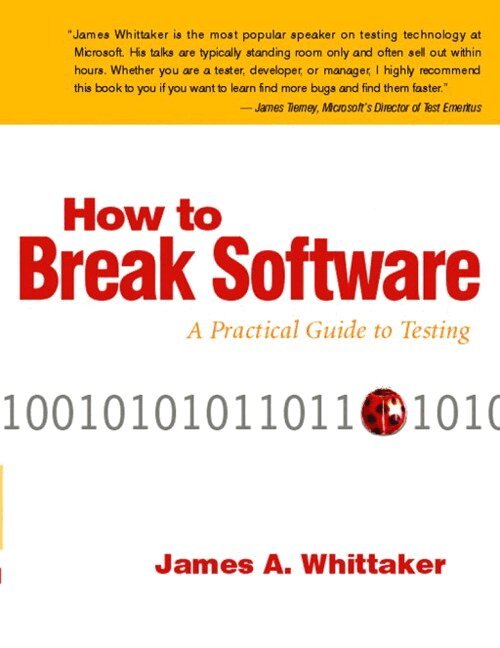
    How to Break Software

    A Practical Guide to Testing

    AvJames Whittaker

    Pearson Education (US)

    2002

    1 240 kr

    Beställningsvara. Skickas inom 3-6 vardagar. Fri frakt över 249 kr.

    Beskrivning

    How to Break Software is a departure from conventional testing in which testers prepare a written test plan and then use it as a script when testing the software. The testing techniques in this book are as flexible as conventional testing is rigid. And flexibility is needed in software projects in which requirements can change, bugs can become features and schedule pressures often force plans to be reassessed. Software testing is not such an exact science that one can determine what to test in advance and then execute the plan and be done with it. Instead of a plan, intelligence, insight, experience and a "nose for where the bugs are hiding" should guide testers. This book helps testers develop this insight. The techniques presented in this book not only allow testers to go off-script, they encourage them to do so. Don't blindly follow a document that may be out of date and that was written before the product was even testable. Instead, use your head! Open your eyes! Think a little, test a little and then think a little more. This book does teach planning, but in an "on- the-fly while you are testing" way. It also encourages automation with many repetitive and complex tasks that require good tools (one such tool is shipped with this book on the companion CD). However, tools are never used as a replacement for intelligence. Testers do the thinking and use tools to collect data and help them explore applications more efficiently and effectively.

    Produktinformation

    • Märke:Pearson Education (US)
    • Utgivningsdatum:2002-06-21
    • Höjd:205 x 233 x 11 mm
    • Vikt:370 g
    • Språk:Engelska
    • Antal sidor:208
    • Förlag:Pearson Education (US)
    • EAN:9780201796193

    Utforska kategorier

    • Programmeringsböcker inom Data och IT

    Mer om författaren

    James A. Whittaker is a well-known speaker and consultant, as well as seasoned professor.

    Innehållsförteckning

    • Preface. Dedication. Chapter Summaries. I. INTRODUCTION. 1. A Fault Model to Guide Software Testing. The Purpose of Software Testing. Understanding Software Behavior. Understanding Software's Environment. The Human User. File System User. The Operating System User. The Software User. Understanding Software's Capabilities. Testing Input. Testing Output. Testing Data. Testing Competition. Summary and Conclusion. Exercises. References. II. USER INTERFACE ATTACKS. 2. Testing from the User Interface: Inputs and Outputs. Using the Fault Model to Guide Testing. Exploring the Input Domain. First Attack: Apply inputs that force all the error messages to occur. Second Attack: Apply inputs that force the software to establish default values. Third Attack: Explore allowable character sets and data types. Fourth Attack: Overflow input buffers. Fifth Attack: Find inputs that may interact and test various combinations of their values. Sixth Attack: Repeat the same input or series of inputs numerous times. Exploring Outputs. Seventh Attack: Force different outputs to be generated for each input. Eighth Attack: Force invalid outputs to be generated. Ninth Attack: Force properties of an output to change. Tenth Attack: Force the screen to refresh. Conclusion. Exercises. References. 3. Testing from the User Interface: Data and Computation. Testing Inside the Box. Exploring Stored Data. Eleventh Attack: Apply inputs using a variety of initial conditions. Twelfth Attack: Force a data structure to store too many/too few values. Thirteenth Attack: Investigate alternate ways to modify internal data constraints. Exploring Computation and Feature Interaction. Fifteenth Attack: Force a function to call itself recursively. Sixteenth Attack: Force computation results to be too large or too small. Seventeenth Attack: Find features that share data or interact poorly. Conclusion. Exercises. III. SYSTEM INTERFACE ATTACKS. 4. Testing from the File System Interface. Attacking Software from the File System Interface. Media-based Attacks. First Attack: Inject faults that simulate memory access problems. Second Attack: Inject faults that simulate network problems. Third Attack: Damage the media. File-based Attacks. Fourth Attack: Assign an invalid file name. Fifth Attack: Vary file access permissions. Sixth Attack: Vary/corrupt file contents. Exercises. 5. Testing from the Software/OS Interface. Attacking Software from Software Interfaces. Record-and-Simulate Attacks. Observe-and-Fail Attacks. Conclusion. Exercises. IV. CONCLUSION. 6. Some Parting Advice. You'll Never Know Everything. Bug Hunts. Friday Afternoon Bug Fests. Conclusion. References. APPENDICES. Annotated Glossary of Programming Terms. Appendix A. Testing Exception and Error Cases Using Runtime Fault Injection. Introduction. A Mechanism for Runtime Fault Injection. Fault Selection. Conclusions. Acknowledgments. References. Appendix B. Using HEAT: The Hostile Environment Application Tester. Canned HEAT User Guide. The Application Band. The Monitor Band. Fault Injection Bands and Their Functionality. The Network Band. Disk Storage. Memory. Appendix C. What is Software Testing? And Why is it so Hard? Introduction. The Software Testing Process. Phase One: Modeling the Software's Environment. Phase Two: Selecting Test Scenarios. Phase Three: Running and Evaluating Test Scenarios. Phase Four: Measuring Testing Progress. Conclusion. References. The Software Testing Problem.