• Fri frakt över 249 kr
  • •
  • Snabba leveranser
  • •
  • Billiga böcker
Kundservice

Du är på sajten för privatpersoner.

Företag, bibliotek eller offentlig verksamhet?

Du handlar på classic.bokus.com, där alla dina funktioner finns intakta.
Till classic.bokus.com
Bokus logotyp. Gå till startsidan.
  • Erbjudanden
  • Nyheter
  • Student
  • Topplistor
  • Barn & ungdom
  • Bokus Play
  • E-böcker
  • Pocketböcker
  • Spel & pussel

10% rabatt på allt med kod: NYSTART10 →

Sidfot

Mina sidor

    Hjälp

    • Kundservice
    • Vanliga frågor och svar
    • Frakt och leverans
    • Retur vid ångerrätt
    • Reklamera vara
    • Betalning
    • Köpvillkor
    • Allmänna villkor
    • Information om webbplatsens tillgänglighet

    Om Bokus

    • Om oss
    • Pressrum
    • För studenter
    • För företag
    • För bibliotek och offentlig verksamhet
    • För leverantörer
    • Hållbarhet

    Populärt

    • Aktuella erbjudanden
    • Presentkort
    • Studentlitteratur
    • Nya böcker
    • Topplistor
    • Signerade böcker
    • Engelska böcker

    Inspiration

    • Boktips
    • BookTok
    • Populära bokserier
    • Barnbokskaraktärer
    • Populära författare
    Logotyp för Bokus
    Följ oss på Facebook (extern länk)Följ oss på Instagram (extern länk)Följ oss på YouTube (extern länk)Följ oss på TikTok (extern länk)
    bokus @ CookiesAnpassa cookiesIntegritetspolicyKöpvillkor
    Till Citymail hemsida (extern länk)Till Budbee hemsida (extern länk)Till Postnord hemsida (extern länk)Till Schenker hemsida (extern länk)Till Early Bird hemsida (extern länk)Till Walleys hemsida (extern länk)
    1. Naturvetenskap och teknik
    2. Matematik och naturvetenskap
    3. Fysik

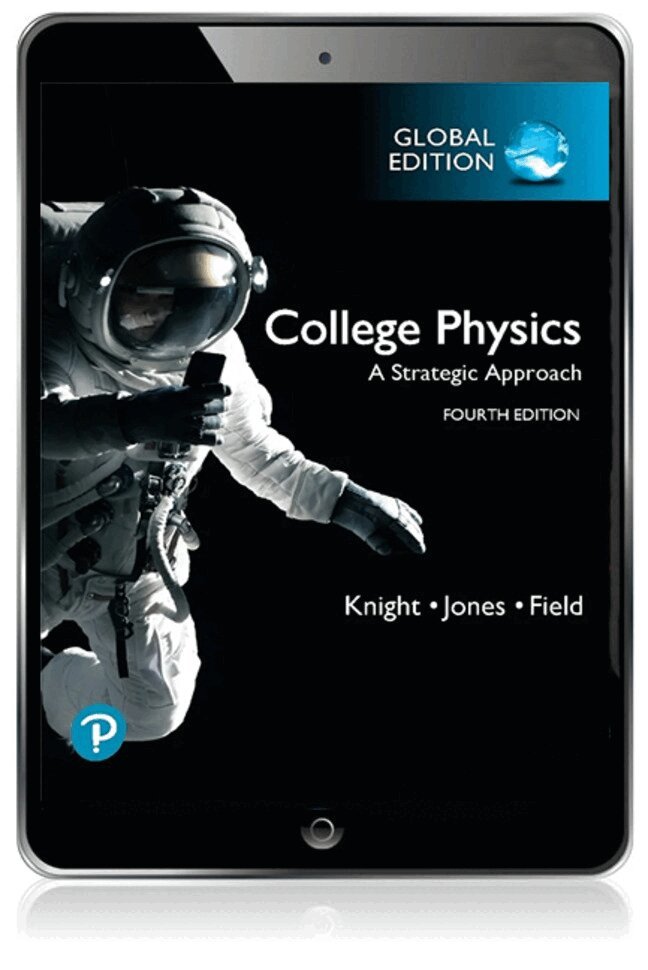
    College Physics: A Strategic Approach, Global Edition

    AvRandall Knight,Brian Jones

    Pearson Education

    2024

    668 kr

    Beställningsvara. Skickas inom 7-10 vardagar. Fri frakt över 249 kr.

    Fler format och utgåvor

    Häftad

    994 kr

    Beskrivning

    For courses in algebra-based introductory physics.

    Make physics relevant for today's mixed-majors students

    College Physics: A Strategic Approach, 4th Edition expands its focus from how mixed majors students learn physics to focusing on why these students learn physics. The authors apply the best results from educational research and MasteringTM Physics metadata to present basic physics in real world examples that engage students and connect physics with other fields, including biological sciences, architecture, and natural resources. From these connections, students not only learn in research-driven ways but also understand why they are taking the course and how it applies to other areas.

    Extensive new media and an interactive Pearson eText pique student interest while challenging misconceptions and fostering critical thinking. New examples, explanations, and problems use real data from research to show physics at work in relatable situations, and help students see that physics is the science underlying everything around them. A Strategic Approach, 4th Edition, encourages today's students to understand the big picture, gain crucial problem-solving skills and come to class both prepared and confident.

    Also available with Mastering Physics

    MasteringTM is the teaching and learning platform that empowers you to reach every student. By combining trusted author content with digital tools developed to engage students and emulate the office-hour experience, Mastering personalizes learning and often improves results for each student. With Learning CatalyticsTM instructors can expand on key concepts and encourage student engagement during lecture through questions answered individually or in pairs and groups. Students also master concepts through book-specific Mastering Physics assignments, which provide hints and answer-specific feedback that build problem-solving skills. Mastering Physics now provides students with the new Physics Primer for remediation of math skills needed in the college physics course.

    Produktinformation

    • Märke:Pearson Education
    • Utgivningsdatum:2024-05-29
    • Språk:Engelska
    • Upplaga:4
    • Förlag:Pearson Education
    • EAN:9781292465166

    Utforska kategorier

    • Fysik inom Naturvetenskap och teknik

    Innehållsförteckning

    • Full Version, All Chapters: Chs 1-30Volume 1: Chs 1-16Volume 2: Chs 17-30PART I FORCE AND MOTION OVERVIEW The Science of Physics Representing Motion 1.1 Motion: A First Look1.2 Models and Modeling1.3 Position and Time: Putting Numbers on Nature1.4 Velocity1.5 A Sense of Scale: Significant Figures, Scientific Notation, and Units1.6 Vectors and Motion: A First Look1.7 Where Do We Go from Here?SUMMARYQUESTIONS AND PROBLEMS Motion in One Dimension 2.1 Describing Motion2.2 Uniform Motion2.3 Instantaneous Velocity2.4 Acceleration2.5 Motion with Constant Acceleration2.6 Solving One-Dimensional Motion Problems2.7 Free FallSUMMARYQUESTIONS AND PROBLEMS Vectors and Motion in Two Dimensions 3.1 Using Vectors3.2 Coordinate Systems and Vector Components3.3 Motion on a Ramp3.4 Motion in Two Dimensions3.5 Projectile Motion3.6 Projectile Motion: Solving Problems3.7 Circular Motion3.8 Relative MotionSUMMARYQUESTIONS AND PROBLEMS Forces and Newton's Laws of Motion 4.1 Motion and Forces4.2 A Short Catalog of Forces4.3 Identifying Forces4.4 What Do Forces Do?4.5 Newton's Second Law4.6 Free-Body Diagrams4.7 Newton's Third LawSUMMARYQUESTIONS AND PROBLEMS Applying Newton's Laws 5.1 Equilibrium5.2 Dynamics and Newton's Second Law5.3 Mass and Weight5.4 Normal Forces5.5 Friction5.6 Drag5.7 Interacting Objects5.8 Ropes and PulleysSUMMARYQUESTIONS AND PROBLEMS Circular Motion, Orbits, and Gravity 6.1 Uniform Circular Motion6.2 Dynamics of Uniform Circular Motion6.3 Apparent Forces in Circular Motion6.4 Circular Orbits and Weightlessness6.5 Newton's Law of Gravity6.6 Gravity and OrbitsSUMMARYQUESTIONS AND PROBLEMS Rotational Motion 7.1 Describing Circular and Rotational Motion7.2 The Rotation of a Rigid Body7.3 Torque7.4 Gravitational Torque and the Center of Gravity7.5 Rotational Dynamics and Moment of Inertia7.6 Using Newton's Second Law for Rotation7.7 Rolling MotionSUMMARYQUESTIONS AND PROBLEMS Equilibrium and Elasticity 8.1 Torque and Static Equilibrium8.2 Stability and Balance8.3 Springs and Hooke's Law8.4 Stretching and Compressing Materials8.5 Forces and Torques in the BodySUMMARYQUESTIONS AND PROBLEMS PART I SUMMARY Force and MotionONE STEP BEYOND Dark Matter and the Structure of the UniversePART I PROBLEMSPART II CONSERVATION LAWS OVERVIEW Why Some Things Stay the Same Momentum 9.1 Impulse9.2 Momentum and the Impulse-Momentum Theorem9.3 Solving Impulse and Momentum Problems9.4 Conservation of Momentum9.5 Inelastic Collisions9.6 Momentum and Collisions in Two Dimensions9.7 Angular MomentumSUMMARYQUESTIONS AND PROBLEMS Energy and Work 10.1 The Basic Energy Model10.2 Work10.3 Kinetic Energy10.4 Potential Energy10.5 Thermal Energy10.6 Conservation of Energy10.7 Energy Diagrams10.8 Molecular Bonds and Chemical Energy10.9 Energy in Collisions10.10 PowerSUMMARYQUESTIONS AND PROBLEMS Using Energy 11.1 Transforming Energy11.2 Energy in the Body11.3 Temperature, Thermal Energy, and Heat11.4 The First Law of Thermodynamics11.5 Heat Engines11.6 Heat Pumps11.7 Entropy and the Second Law of Thermodynamics11.8 Systems, Energy, and EntropySUMMARYQUESTIONS AND PROBLEMS PART II SUMMARY Conservation LawsONE STEP BEYOND Order Out of ChaosPART II PROBLEMSPART III PROPERTIES OF MATTER OVERVIEW Beyond the Particle Model Thermal Properties of Matter 12.1 The Atomic Model of Matter12.2 The Atomic Model of an Ideal Gas12.3 Ideal-Gas Processes12.4 Thermal Expansion12.5 Specific Heat and Heat of Transformation12.6 Calorimetry12.7 Specific Heats of Gases12.8 Heat Transfer12.9 DiffusionSUMMARYQUESTIONS AND PROBLEMS Fluids 13.1 Fluids and Density13.2 Pressure13.3 Buoyancy13.4 Fluids in Motion13.5 Fluid Dynamics13.6 Viscosity and Poiseuille's Equation13.7 The Circulatory SystemSUMMARYQUESTIONS AND PROBLEMS PART III SUMMARY Properties of MatterONE STEP BEYOND Size and LifePART III PROBLEMSPART IV OSCILLATIONS AND WAVES OVERVIEW Motion That Repeats Again and Again Oscillations 14.1 Equilibrium and Oscillation14.2 Linear Restoring Forces and SHM14.3 Describing Simple Harmonic Motion14.4 Energy in Simple Harmonic Motion14.5 Pendulum Motion14.6 Damped Oscillations14.7 Driven Oscillations and ResonanceSUMMARYQUESTIONS AND PROBLEMS Traveling Waves and Sound 15.1 The Wave Model15.2 Traveling Waves15.3 Graphical and Mathematical Descriptions of Waves15.4 Sound and Light Waves15.5 Energy and Intensity15.6 Loudness of Sound15.7 The Doppler Effect and Shock WavesSUMMARYQUESTIONS AND PROBLEMS Superposition and Standing Waves 16.1 The Principle of Superposition16.2 Standing Waves16.3 Standing Waves on a String16.4 Standing Sound Waves16.5 Speech and Hearing16.6 The Interference of Waves from Two Sources16.7 BeatsSUMMARYQUESTIONS AND PROBLEMS PART IV SUMMARY Oscillations and WavesONE STEP BEYOND Waves in the Earth and the OceanPART IV PROBLEMSPART V OPTICS OVERVIEW Light Is a Wave Wave Optics 17.1 What Is Light?17.2 The Interference of Light17.3 The Diffraction Grating17.4 Thin-Film Interference17.5 Single-Slit Diffraction17.6 Circular-Aperture DiffractionSUMMARYQUESTIONS AND PROBLEMS Ray Optics 18.1 The Ray Model of Light18.2 Reflection18.3 Refraction18.4 Image Formation by Refraction18.5 Thin Lenses: Ray Tracing18.6 Image Formation with Spherical Mirrors18.7 The Thin-Lens EquationSUMMARYQUESTIONS AND PROBLEMS Optical Instruments 19.1 The Camera19.2 The Human Eye19.3 The Magnifier19.4 The Microscope19.5 The Telescope19.6 Color and Dispersion19.7 Resolution of Optical InstrumentsSUMMARYQUESTIONS AND PROBLEMS PART V SUMMARY OpticsONE STEP BEYOND Scanning Confocal MicroscopyPART V PROBLEMSPART VI ELECTRICITY AND MAGNETISM OVERVIEW Charges, Currents, and Fields Electric Fields and Forces 20.1 Charges and Forces20.2 Charges, Atoms, and Molecules20.3 Coulomb's Law20.4 The Concept of the Electric Field20.5 The Electric Field from Arrangements of Charges20.6 Conductors and Electric Fields20.7 Forces and Torques in Electric FieldsSUMMARYQUESTIONS AND PROBLEMS Electric Potential 21.1 Electric Potential Energy and Electric Potential21.2 Sources of Electric Potential21.3 Electric Potential and Conservation of Energy21.4 Calculating the Electric Potential21.5 Connecting Potential and Field21.6 The Electrocardiogram21.7 Capacitance and Capacitors21.8 Energy and CapacitorsSUMMARYQUESTIONS AND PROBLEMS Current and Resistance 22.1 A Model of Current22.2 Defining and Describing Current22.3 Batteries and emf22.4 Connecting Potential and Current22.5 Ohm's Law and Resistor Circuits22.6 Energy and PowerSUMMARYQUESTIONS AND PROBLEMS Circuits 23.1 Circuit Elements and Diagrams23.2 Kirchhoff's Laws23.3 Series and Parallel Circuits23.4 Measuring Voltage and Current23.5 More Complex Circuits23.6 Capacitors in Parallel and Series23.7 RC Circuits23.8 Electricity in the Nervous SystemSUMMARYQUESTIONS AND PROBLEMS Magnetic Fields and Forces 24.1 Magnetism24.2 The Magnetic Field24.3 Electric Currents Also Create Magnetic Fields24.4 Calculating the Magnetic Field Due to a Current24.5 Magnetic Fields Exert Forces on Moving Charges24.6 Magnetic Fields Exert Forces on Currents24.7 Magnetic Fields Exert Torques on Dipoles24.8 Magnets and Magnetic MaterialsSUMMARYQUESTIONS AND PROBLEMS EM Induction and EM Waves 25.1 Induced Currents25.2 Motional emf25.3 Magnetic Flux and Lenz's Law25.4 Faraday's Law25.5 Electromagnetic Waves25.6 The Photon Model of Electromagnetic Waves25.7 The Electromagnetic SpectrumSUMMARYQUESTIONS AND PROBLEMS AC Electricity 26.1 Alternating Current26.2 AC Electricity and Transformers26.3 Household Electricity26.4 Biological Effects and Electrical Safety26.5 Capacitor Circuits26.6 Inductors and Inductor Circuits26.7 Oscillation CircuitsSUMMARYQUESTIONS AND PROBLEMS PART VI SUMMARY Electricity and MagnetismONE STEP BEYOND The Greenhouse Effect and Global WarmingPART VI PROBLEMSPART VII MODERN PHYSICS OVERVIEW New Ways of Looking at the World Relativity 27.1 Relativity: What's It All About?27.2 Galilean Relativity27.3 Einstein's Principle of Relativity27.4 Events and Measurements27.5 The Relativity of Simultaneity27.6 Time Dilation27.7 Length Contraction27.8 Velocities of Objects in Special Relativity27.9 Relativistic Momentum27.10 Relativistic EnergySUMMARYQUESTIONS AND PROBLEMS Quantum Physics 28.1 X Rays and X-Ray Diffraction28.2 The Photoelectric Effect28.3 Photons28.4 Matter Waves28.5 Energy Is Quantized28.6 Energy Levels and Quantum Jumps28.7 The Uncertainty Principle28.8 Applications and Implications of Quantum TheorySUMMARYQUESTIONS AND PROBLEMS Atoms and Molecules 29.1 Spectroscopy29.2 Atoms29.3 Bohr's Model of Atomic Quantization29.4 The Bohr Hydrogen Atom29.5 The Quantum-Mechanical Hydrogen Atom29.6 Multi-electron Atoms29.7 Excited States and Spectra29.8 Molecules29.9 Stimulated Emission and LasersSUMMARYQUESTIONS AND PROBLEMS Nuclear Physics 30.1 Nuclear Structure30.2 Nuclear Stability30.3 Forces and Energy in the Nucleus30.4 Radiation and Radioactivity30.5 Nuclear Decay and Half-Lives30.6 Medical Applications of Nuclear Physics30.7 The Ultimate Building Blocks of MatterSUMMARYQUESTIONS AND PROBLEMS PART VII SUMMARY MODERN PHYSICSONE STEP BEYOND The Physics of Very Cold AtomsPART VII PROBLEMSAPPENDICES Mathematics ReviewPeriodic Table of ElementsAtomic and Nuclear DataAnswers to Odd-Numbered Problems