• Fri frakt över 249 kr
  • •
  • Snabba leveranser
  • •
  • Billiga böcker
Kundservice

Du är på sajten för privatpersoner.

Företag, bibliotek eller offentlig verksamhet?

Du handlar på classic.bokus.com, där alla dina funktioner finns intakta.
Till classic.bokus.com
Bokus logotyp. Gå till startsidan.
  • Erbjudanden
  • Nyheter
  • Student
  • Topplistor
  • Barn & ungdom
  • Bokus Play
  • E-böcker
  • Pocketböcker
  • Spel & pussel

10% rabatt på allt med kod: NYSTART10 →

Sidfot

Mina sidor

    Hjälp

    • Kundservice
    • Vanliga frågor och svar
    • Frakt och leverans
    • Retur vid ångerrätt
    • Reklamera vara
    • Betalning
    • Köpvillkor
    • Allmänna villkor
    • Information om webbplatsens tillgänglighet

    Om Bokus

    • Om oss
    • Pressrum
    • För studenter
    • För företag
    • För bibliotek och offentlig verksamhet
    • För leverantörer
    • Hållbarhet

    Populärt

    • Aktuella erbjudanden
    • Presentkort
    • Studentlitteratur
    • Nya böcker
    • Topplistor
    • Signerade böcker
    • Engelska böcker

    Inspiration

    • Boktips
    • BookTok
    • Populära bokserier
    • Barnbokskaraktärer
    • Populära författare
    Logotyp för Bokus
    Följ oss på Facebook (extern länk)Följ oss på Instagram (extern länk)Följ oss på YouTube (extern länk)Följ oss på TikTok (extern länk)
    bokus @ CookiesAnpassa cookiesIntegritetspolicyKöpvillkor
    Till Citymail hemsida (extern länk)Till Budbee hemsida (extern länk)Till Postnord hemsida (extern länk)Till Schenker hemsida (extern länk)Till Early Bird hemsida (extern länk)Till Walleys hemsida (extern länk)
    1. Naturvetenskap och teknik
    2. Matematik och naturvetenskap
    3. Fysik
    4. Tillämpad fysik

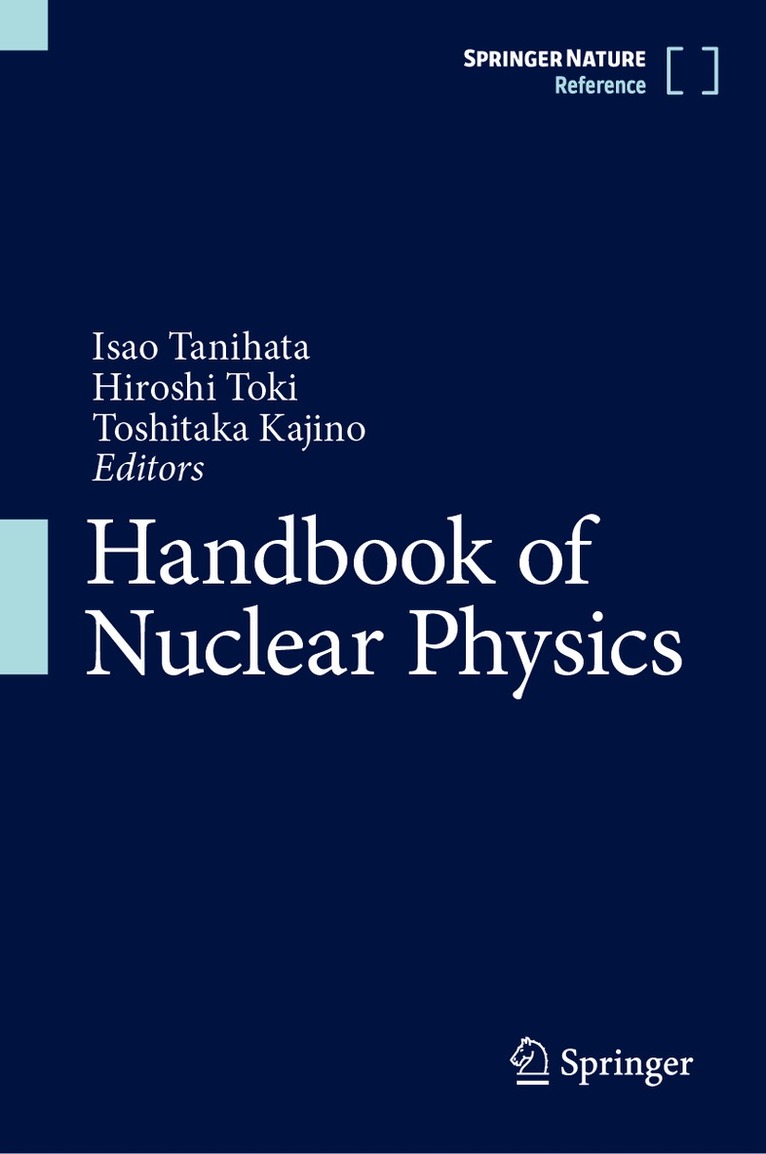
    Handbook of Nuclear Physics

    AvIsao Tanihata,Hiroshi Toki

    Springer Verlag, Singapore

    2023

    20 369 kr

    Beställningsvara. Skickas inom 10-15 vardagar. Fri frakt över 249 kr.

    Beskrivning

    This handbook is a comprehensive, systematic source of modern nuclear physics. It aims to summarize experimental and theoretical discoveries and an understanding of unstable nuclei and their exotic structures, which were opened up by the development of radioactive ion (RI) beam in the late 1980s.The handbook comprises three major parts. In the first part, the experiments and measured facts are well organized and reviewed. The second part summarizes recognized theories to explain the experimental facts introduced in the first part. Reflecting recent synergistic progress involving both experiment and theory, the chapters both parts are mutually related. The last part focuses on cosmo-nuclear physics—one of the mainstream subjects in modern nuclear physics. Those comprehensive topics are presented concisely.Supported by introductory reviews, all chapters are designed to present their topics in a manner accessible to readers at the graduate level. The book therefore serves as a valuable source for beginners as well, helping them to learn modern nuclear physics.

    Produktinformation

    • Märke:Springer Verlag, Singapore
    • Utgivningsdatum:2023-09-06
    • Höjd:155 x 235 x 198 mm
    • Vikt:8 152 g
    • Språk:Engelska
    • Antal sidor:4 207
    • Förlag:Springer Verlag, Singapore
    • EAN:9789811963445

    Utforska kategorier

    • Tillämpad fysik inom Naturvetenskap och teknik
    • Fysik inom Naturvetenskap och teknik

    Mer om författaren

    Professor Isao Tanihata is a specially appointed professor at the Research Center of Nuclear Physics (RCNP) of Osaka University (Japan) and a professor at the School of Physics at Beihang University (China). He received his Doctor of Science degree from Osaka University in 1975.After his doctoral program, he moved to the Lawrence Berkeley National Laboratory (LBL) as a fellow. At that time, the first high-energy heavy ion was accelerated at the Bevatron and Bevalac, and he joined an experimental group led by Shoji Nagamiya, Owen Chamberlain, and Emilio Segrè and worked on heavy-ion collisions to look for extreme states of nuclear matter.Together with K. Sugimoto, his doctoral supervisor, he discovered the possibility of using radioactive nuclear beams, working at the University of California, Berkeley to develop the method. The first experiment that led to the discovery of neutron halos was started in 1983 under the collaboration between the LBL and the Institute of Nuclear Study, The University of Tokyo. The first several papers he published in 1985 and the following years opened a new era in nuclear physics.After serving as an assistant professor and associate professor at The University of Tokyo, he moved to RIKEN as a chief scientist. His main research subject was nuclear physics using the Ring Cyclotron in RIKEN and the Heavy-Ion Synchrotron SIS-18 facility at the GSI Helmholtz Centre for Heavy Ion Research in Germany. Observing a steady development of radioactive ion (RI) beam science, together with Masayasu Ishihara and Yasushige Yano he proposed the RI Beam Factory project (currently called RIBF), which is currently a leading facility in the field of nuclear physics.After leaving RIKEN in 2004, he worked at the Argonne National Laboratory in the United States, TRIUMF in Canada, and GANIL in France and was appointed to his current position at RCNP in 2012. He was also appointed as a Thousand Talent Program professor in 2010 and has served in another current position at Beihang University since 2016.After an accident at the Fukushima nuclear power plant following the 2011 Japan earthquake and tsunami, he organized a national project of for measurement of radioactivity in soil in the greater Fukushima region within 150 km from the plant, and the environmental radioactivity research continues as of 2023. He also develops the education system for environmental radiation for university students in all fields of science, including natural and social sciences.He has been honored with various awards: The Millar Award in 1979 from the Miller Institute for Basic Research in Science, the University of California; the Nishina Prize in 1989; was named an APS fellow in 1994; was named Professor honoris causa by Bucharest University in Romania in 1997; became a Thousand Talents Plan professor in 2010; and received the Humboldt Scientific Award in 2011. He is also a member of the Academy of Europe.Dr. Hiroshi Toki is a distinguished professor at RCNP, Osaka University, where he retired in 2011 after a remarkable career spanning several decades. He served as the director of RCNP in 2001–2007, and his exceptional leadership skills and expertise made a significant impact on the center. Despite his retirement in 2011, he continues to contribute to the academic community as a specially appointed professor in the Co-creation Center, Graduate School of Engineering Science, and Health and Counseling Center at Osaka University.His numerous outstanding contributions to the field of nuclear physics, as well as his expertise in various other fields, continue to inspire students and researchers worldwide. With over 400 peer-reviewed journal articles to his name, numerous edited books, conference proceedings, and several authored books in both English and Japanese, he has an impressive track record as an author, editor, and conference organizer. His areas of expertise includetheoretical nuclear physics and noise theory in electric circuits, and he has played a leading role in nuclear physics conferences since 1995, including co-chairing the XVI International Conference on Particles and Nuclei in Osaka in 2002.Prof. Toki is a prominent researcher in nuclear physics with diverse interests spanning several fields. He has worked on nuclear deformation, structural changes in high spin states, pion physics in nuclei and deeply bound pionic atoms, and the role of chiral symmetry breaking in quark nuclear physics. In recent years, he has focused on understanding the role of the tensor interaction caused by pion exchange among nucleons in nuclear structure. His work sheds light on the fundamental nature of nuclear interactions, facilitating better understanding of the behavior of nuclear matter under extreme conditions. In addition to nuclear physics, he has expanded his research interests to other fields including the noise theory of electric circuits, mutation and evolution in biological systems, and the application of machine learning technology in health science.He obtained his Ph.D. from Osaka University in 1974. After his Ph.D. program, he worked as a researcher at Kernforschungsanlage Jülich in 1974–1977 and as a guest associate professor at Regensburg University in West Germany in 1977–1980. He moved to the United States and worked as an associate professor at Michigan State University in 1980–1983. He then returned to Japan and continued his research and education as an associate professor at Tokyo Metropolitan University in1983–1994. Later, he served as a professor at Osaka University until his retirement. He received the Humboldt Research Award in 2001. He was also awarded the Japan Physical Society Paper Prize in 1993 and 2011. Dr. Toshitaka Kajino received his Ph.D. from The University of Tokyo in 1984. After his Ph.D. program, he joined Tokyo Metropolitan University as an assistant professor, moved to the National Astronomical Observatory of Japan, and joined the faculty of the Department of Astronomy, the Graduate School of Science, The University of Tokyo in 1993. In 2004 he was elected a fellow of the American Physical Society for significant contributions to nuclear astrophysics and theoretical nuclear physics and for the promotion of scientific exchange between Japan and the international science community. In 2016 he was honored with a Thousand Talents Plan foreign expert in China and is currently a university distinguished professor at the School of Physics, Beihang University. He is also the first director of the International Research Center for Big-Bang Cosmology and Element Genesis and a professor of the Peng Huanwu Collaborative Center for Research and Education at Beihang University. His research areas of expertise include nucleosynthesis in the big-bang, stars, supernovae and neutron star mergers, nuclear structure and reactions of astrophysical interest, neutrino oscillation, galactic chemical evolution, particle cosmology, and astrobiology. He has published more than 250 peer-reviewed journal articles and has presented over 300 international conference talks. He serves on various domestic and international review committees and editorial boards of research journals and has been the chairman of the International Symposium “Nuclei in the Cosmos (NIC)” and many other international conferences. He is a proponent of the bi-annual international conference series “Origin of Matter and Evolution of Galaxies (OMEG)”, which is the oldest conference in the interdisciplinary field of nuclear physics, astrophysics, cosmology, astronomy, and space science, inaugurated in Tokyo in 1988.

    Innehållsförteckning

    • Production of Exotic Nuclei.- Introduction to Exotic Nuclei and their Separation.- Masses of Exotic Nuclei.- Lifetimes of Exotic Nuclei.- Matter Radii and Density Distributions.- Nuclear charge radii.- Spins, Electric and Magnetic moments.- Beta Decay: Probe for Nuclear Structure and the Weak Interaction.- Charged particle decays.- Heaviest Elements – Decay and Laser Spectroscopy.