Advances in Environmental Science – serie
Visar alla böcker i serien Advances in Environmental Science. Handla med fri frakt och snabb leverans.
8 produkter
8 produkter
2 129 kr
Skickas inom 10-15 vardagar
countries accelerating to reach a consensus on the role that atmospheric emissions and acidic precipitation play in the environment, publication of this series is timely. The editors thank the contributors to this volume for their efforts in describing a wide array of atmospheric topics, all of which are important to an understanding of the acidic precipitation issue. Oak Ridge, Tennessee Steven E Lindberg Riverside, California Albert L. Page Orono, Maine Stephen A. Norton Contents Series Preface .................................................... v Preface... ....... ...... ..... ... .. ............................... .. vii Contributors ..................................................... xiii Sources of Acids, Bases, and Their Precursors in the Atmosphere . . . 1 Roger L. Tanner I. Introduction and Definitions. . . . . . . . . . . . . . . . . . . . . . . . . . . . . . . . . . . . . . 1 II. Sources of Acids ............................................... 3 III. Sources of Acid-Neutralizing Substances (Bases) ................... 9 IV. Distribution of Atmospheric Acids and Bases ...................... 10 V. Gas-Aerosol Equilibria and Boundary Layer Mixing ................ 14 VI. Summary of Significant Acid-Formation Pathways.............. . .. . 15 References ................................•................... 17 Aerosol Sulfur Association with Aluminum in Eastern North America: Evidence for Solubilization of Atmospheric Trace Metals before Deposition ......... . . . . . . . . . . 21 . . .
2 129 kr
Skickas inom 10-15 vardagar
various places of the world. Thus, it is hoped that this up-to-date subseries would increase the "awareness" of the world's citizens and encourage governments to devote more attention and resources to address this issue. The series editors thank the international panel of contributors for bringing this timely series into completion. We also wish to acknowledge the very insightful input of the following colleagues: Prof. A. L. Page ofthe University of California, Prof. T. C. Hutchinson of the University of Toronto, and Dr. Steve Lindberg of the Oak Ridge National Laboratory. We also wish to thank the superb effort and cooperation of the volume editors in handling their respective volumes. The constructive criticisms of chapter reviewers also deserve much appreciation. Finally, we wish to convey our appreciation to my secretary, Ms. Brenda Rosier, and my technician, Ms. Claire Carlson, for their very able assistance in various aspects of this series. Aiken, South Carolina Domy C. Adriano Coordinating Editor Preface to Acidic Precipitation, Volume 4 (Advances in Environmental Science) Acidic precipitation and its effects have been the focus ofintense research for over two decades. Initially, research centered on the acidity status and acidification of surface waters and consequent impact on the status of sports fisheries; evidence suggested impacts on fisheries in Sweden and Norway, and in North America, in eastern Ontario, Quebec, and in the Adirondack Mountains of New York.
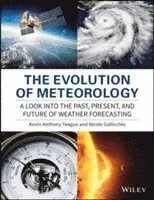
Evolution of Meteorology
A Look into the Past, Present, and Future of Weather Forecasting
Häftad, Engelska, 2017
888 kr
Skickas inom 5-8 vardagar
The essential guide to the history, current trends, and the future of meteorology This comprehensive review explores the evolution of the field of meteorology, from its infancy in 3000 bc, through the birth of fresh ideas and the naming of the field as a science, to the technology boom, to today. The Evolution of Meteorology reveals the full story of where meteorology was then to where it is now, where the field is heading, and what needs to be done to get the field to levels never before imagined. Authored by experts of the topic, this book includes information on forecasting technologies, organizations, governmental agencies, and world cooperative projects.The authors explore the ancient history of the first attempts to understand and predict weather and examine the influence of the very early birth of television, computers, and technologies that are useful to meteorology. This modern-day examination of meteorology is filled with compelling research, statistics, future paths, ideas, and suggestions. This vital resource: Examines current information on climate change and recent extreme weather eventsStarts with the Ancient Babylonians and ends with the largest global agreement of any kind with the Paris AgreementIncludes current information on the most authoritative research in the field of meteorologyContains data on climate change theories and understanding, as well as extreme weather statistics and historiesThis enlightening text explores in full the history of the study of meteorology in order to bring awareness to the overall path and future prospects of meteorology.
537 kr
Skickas inom 10-15 vardagar
"awareness" of the world's citizens and encourage governments to devote more attention and resources to address this issue. The series editors thank the international panel of contributors for bringing this timely series into completion. We also wish to acknowledge the very insightful input of the following colleagues: Prof. A.L. Page of the University of California, Prof. T.C. Hutchinson of the University of Toronto, and Dr. Steve Lindberg of the Oak Ridge National Laboratory. We also wish to thank the superb effort and cooperation of the volume editors in handling their respective volumes. The constructive criticisms of chapter review ers also deserve much appreciation. Finally, we wish to convey our appreciation to my secretary, Ms. Brenda Rosier, and my technician, Ms. Claire Carlson, for their very able assistance in various aspects of this series. Aiken, South Carolina Domy C. Adriano Coordinating Editor Preface to Acidic Precipitation, Volume 1 (Advances in Environmental Science) As a result of pioneering research in the 1960s and because of the perceived and acidic real environmental effects described during the ensuing years, the terms rain, acidic deposition, or acidic precipitation have become commonplace in the scientific and popular literature. In the last decade, governments throughout the world have responded to public pressure and to the concerns of the scientific community by establishing research programs on national and international scales.
2 129 kr
Skickas inom 10-15 vardagar
countries accelerating to reach a consensus on the role that atmospheric emissions and acidic precipitation play in the environment, publication of this series is timely. The editors thank the contributors to this volume for their efforts in describing a wide array of atmospheric topics, all of which are important to an understanding of the acidic precipitation issue. Oak Ridge, Tennessee Steven E Lindberg Riverside, California Albert L. Page Orono, Maine Stephen A. Norton Contents Series Preface .................................................... v Preface... ....... ...... ..... ... .. ............................... .. vii Contributors ..................................................... xiii Sources of Acids, Bases, and Their Precursors in the Atmosphere . . . 1 Roger L. Tanner I. Introduction and Definitions. . . . . . . . . . . . . . . . . . . . . . . . . . . . . . . . . . . . . . 1 II. Sources of Acids ............................................... 3 III. Sources of Acid-Neutralizing Substances (Bases) ................... 9 IV. Distribution of Atmospheric Acids and Bases ...................... 10 V. Gas-Aerosol Equilibria and Boundary Layer Mixing ................ 14 VI. Summary of Significant Acid-Formation Pathways.............. . .. . 15 References ................................•................... 17 Aerosol Sulfur Association with Aluminum in Eastern North America: Evidence for Solubilization of Atmospheric Trace Metals before Deposition ......... . . . . . . . . . . 21 . . .
2 129 kr
Skickas inom 10-15 vardagar
various places of the world. Thus, it is hoped that this up-to-date subseries would increase the "awareness" of the world's citizens and encourage governments to devote more attention and resources to address this issue. The series editors thank the international panel of contributors for bringing this timely series into completion. We also wish to acknowledge the very insightful input of the following colleagues: Prof. A. L. Page ofthe University of California, Prof. T. C. Hutchinson of the University of Toronto, and Dr. Steve Lindberg of the Oak Ridge National Laboratory. We also wish to thank the superb effort and cooperation of the volume editors in handling their respective volumes. The constructive criticisms of chapter reviewers also deserve much appreciation. Finally, we wish to convey our appreciation to my secretary, Ms. Brenda Rosier, and my technician, Ms. Claire Carlson, for their very able assistance in various aspects of this series. Aiken, South Carolina Domy C. Adriano Coordinating Editor Preface to Acidic Precipitation, Volume 4 (Advances in Environmental Science) Acidic precipitation and its effects have been the focus ofintense research for over two decades. Initially, research centered on the acidity status and acidification of surface waters and consequent impact on the status of sports fisheries; evidence suggested impacts on fisheries in Sweden and Norway, and in North America, in eastern Ontario, Quebec, and in the Adirondack Mountains of New York.
Del 2 - Advances in Environmental Science
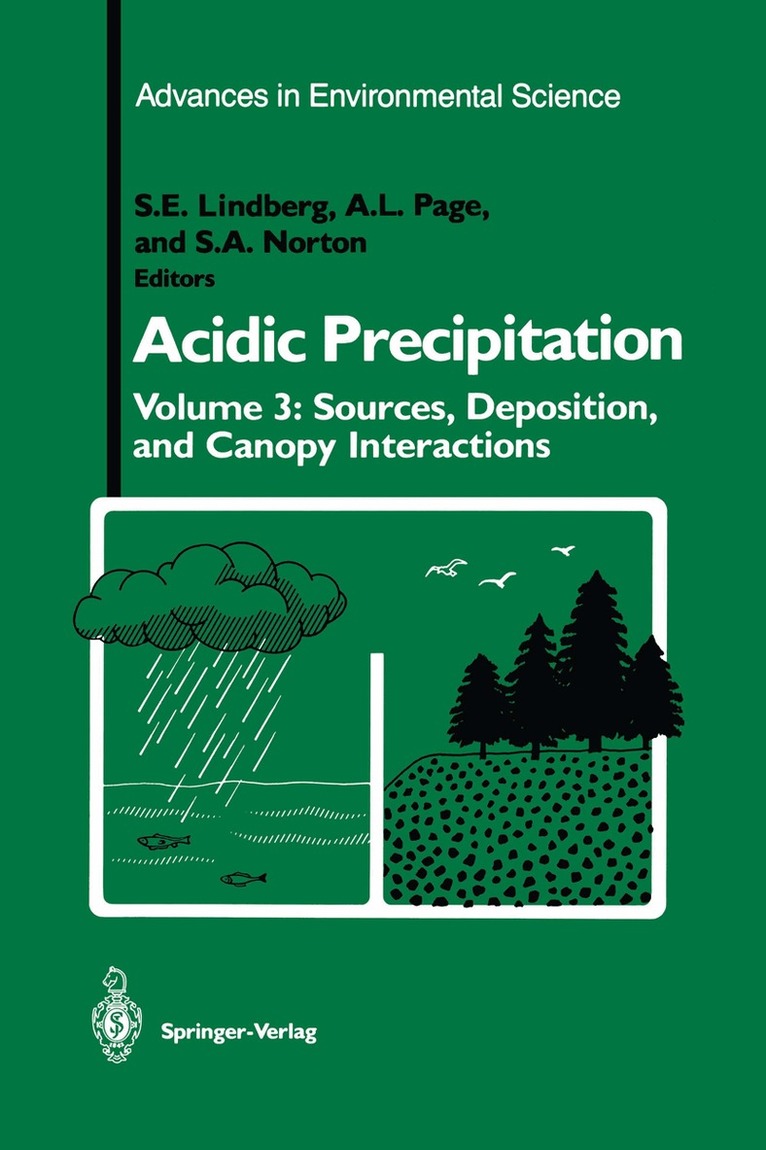
Acidic Precipitation
Biological and Ecological Effects
Häftad, Engelska, 2012
537 kr
Skickas inom 10-15 vardagar
various places of the world. Thus, it is hoped that this up-to-date subseries would increase the "awareness" of the world's citizens and encourage governments to devote more attention and resources to address this issue. The series editors thank the international panel of contributors for bringing this timely series into completion. We also wish to acknowledge the very insightful input of the following colleagues: Prof. A.L. Page of the University of California, Prof. T.C. Hutchinson of the University of Toronto, and Dr. Steve Lindberg of the Oak Ridge National Laboratory. We also wish to thank the superb effort and cooperation of the volume editors in handling their respective volumes. The constructive criticisms of chapter reviewers also deserve much appreciation. Finally, we wish to convey our appreciation to my secretary, Ms. Brenda Rosier, and my technician, Ms. Claire Carlson, for their very able assistance in various aspects of this series.
Del 5 - Advances in Environmental Science
Acidic Precipitation
International Overview and Assessment
Häftad, Engelska, 2011
537 kr
Skickas inom 10-15 vardagar
"awareness" of the world's citizens and encourage governments to devote more attention and resources to address this issue. The series editors thank the international panel of contributors for bringing this timely series into completion. We also wish to acknowledge the very insightful input of the following colleagues: Prof. A. L. Page of the University of California, Prof. T . C. Hutchinson of the University of Toronto , and Dr. Steve Lindberg of the Oak Ridge National Laboratory. We also wish to thank the superb effort and cooperation of the volume editors in handling their respective volumes. The constructive criticisms of chapter review ers also deserve much appreciation. Finally, we wish to convey our appreciation to my secretary, Ms. Brenda Rosier, and my technician, Ms. Claire Carlson, for their very able assistance in various aspects of this series. Aiken, South Carolina Domy C. Adriano Coordinating Editor Preface to Acidic Precipitation, Volume 5 (Advances in Environmental Science) Acidification research has been ongoing for several decades. It was not until the 1980s, however, that scientists began to recognize the complex ity of the factors causing the decline in forest growth and deterioration of fish populations in acidified lakes. The general feeling, based on correla tive research, was that long-range transported air pollution was the main cause. Proof, however, was difficult to obtain because of complex interac tions of various stress factors including natural ones.