Advances In Logic - Böcker
Visar alla böcker i serien Advances In Logic. Handla med fri frakt och snabb leverans.
5 produkter
5 produkter
1 213 kr
Skickas inom 5-8 vardagar
This book covers a broad range of up-to-date issues in non-classical logic that are of interest not only to philosophical and mathematical logicians but also to computer scientists and researchers in artificial intelligence. The problems addressed range from methodological issues in paraconsistent and deontic logic to the revision theory of truth and infinite Turing machines. The book identifies a number of important current trends in contemporary non-classical logic. Among them are dialogical and substructural logic, the classification of concepts of negation, truthmaker theory, and mathematical and foundational aspects of modal and temporal logic.
Del 2 - Advances In Logic
Fork Algebras In Algebra, Logic And Computer Science
Inbunden, Engelska, 2002
1 255 kr
Tillfälligt slut
Fork algebras are a formalism based on the relational calculus, with interesting algebraic and metalogical properties. Their representability is especially appealing in computer science, since it allows a closer relationship between their language and models. This book gives a careful account of the results and presents some applications of Fork algebras in computer science, particularly in system specification and program construction. Many applications of Fork algebras in formal methods can be applied in many ways, and the book covers all the essentials in order to provide the reader with a better understanding.
1 066 kr
Tillfälligt slut
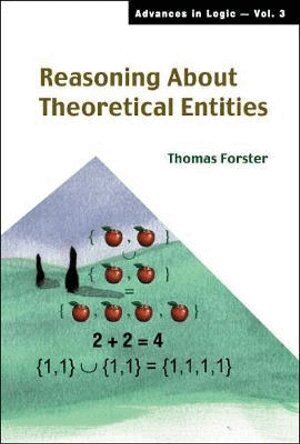
Reductionism is one of those philosophical myths that are either enthusiastically embraced or wholeheartedly rejected. And, like all other philosophical myths, it rarely gets serious consideration. Reasoning About Theoretical Entities strives to give reductionism its day in court, as it were, by explicitly developing several versions of the reductionist project and assessing their merits within the framework of modern symbolic logic. Not since the days of Carnap's Aufbau has reductionism received such close attention (albeit in a necessarily restricted and regimented setting such as that of modern mathematical logic). As such this book fills a void in the philosophical literature and presents a challenge to every would-be (anti-)reductionist. It should be required reading for every first-year graduate student in philosophy.
2 411 kr
Skickas inom 5-8 vardagar
Many approaches in the field of nonmonotonic and “commonsense” reasoning are actually different representations of the same basic ideas and constructions. This book gives a logical formalization of the original, explanatory approach to nonmonotonic reasoning. It uses the basic formalism of biconsequence relations, as well as derived systems of default, autoepistemic and causal inference, to cover in a single framework such diverse systems as default logic, autoepistemic and modal nonmonotonic logics, input/output and causal logics, argumentation theory, and semantics of general logic programs with negation as failure. This approach provides a clear separation between logical (monotonic) and nonmonotonic aspects of nonmonotonic reasoning. The separation allows, in particular, to single out the logics underlying modern logic programming and restore thereby the connection between logic programming and logic.
Del 5 - Advances In Logic
Functional Interpretation Of Logical Deduction, The
Inbunden, Engelska, 2011
1 467 kr
Skickas inom 5-8 vardagar
This comprehensive book provides an adequate framework to establish various calculi of logical inference. Being an ‘enriched’ system of natural deduction, it helps to formulate logical calculi in an operational manner. By uncovering a certain harmony between a functional calculus on the labels and a logical calculus on the formulas, it allows mathematical foundations for systems of logic presentation designed to handle meta-level features at the object-level via a labelling mechanism, such as the D Gabbay's Labelled Deductive Systems. The book truly demonstrates that introducing ‘labels’ is useful to understand the proof-calculus itself, and also to clarify its connections with model-theoretic interpretations.