Advances in Visual Cognition - Böcker
Visar alla böcker i serien Advances in Visual Cognition. Handla med fri frakt och snabb leverans.
4 produkter
4 produkter
515 kr
Skickas inom 7-10 vardagar
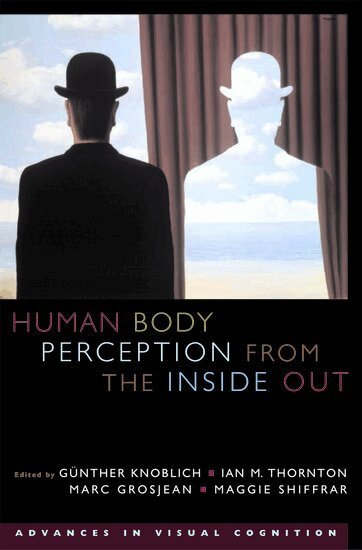
The human body has long inspired artists, philosophers, musicians, and writers. Researchers in the psychological sciences, however, have only relatively recently begun to acknowledge the role the body plays in perception. With the general notion of cognition recently broadening to include its embodied nature, researchers' accounts of perception have increasingly come to include the body's special status as a window on the world and to accommodate the specific perceptual requirements for identifying, interpreting, and interacting with other bodies. This volume presents a comprehensive overview of the rapid progress that has been made in understanding the human body and its relationship to perception. It will help to unify the relevant research from several independent areas of cognitive psychology and cognitive neuroscience and facilitate the development of an integrated framework for the study of human-body perception. Its sections cover the four major lines of research that have contributed and will continue to contribute to this new framework: body and multimodal perception, body representation, perception of biological motion, and intention and action in body perception. Each chapter provides a state-of-the-art account of exciting theoretical developments and empirical advances, and section introductions integrate the chapters and establish each section's place in the broader context of human-body-perception research. This volume will be an invaluable guide for student and professional researchers in visual perception, cognitive psychology, and cognitive neuroscience.
1 362 kr
Skickas inom 7-10 vardagar
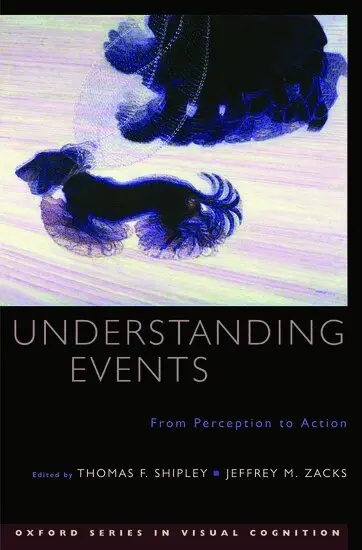
We effortlessly remember all sorts of events - from simple events like people walking to complex events like leaves blowing in the wind. We can also remember and describe these events, and in general, react appropriately to them, for example, in avoiding an approaching object. Our phenomenal ease interacting with events belies the complexity of the underlying processes we use to deal with them. Driven by an interest in these complex processes, research on even perception has been growing rapidly. Events are the basis of all experience, so understanding how humans perceive, represent, and act on them will have a significant impact on many areas of psychology. Unfortunately, much of the research on event perception - in visual perception, motor control, linguistics, and computer science - has progressed without much interaction. This book is the first to bring together computational, neurological, and psychological research on how humans detect, classify, remember, and act on events. It provides professional and student researchers with a comprehensive collection of the latest reserach in these diverse fields.
1 091 kr
Skickas inom 7-10 vardagar
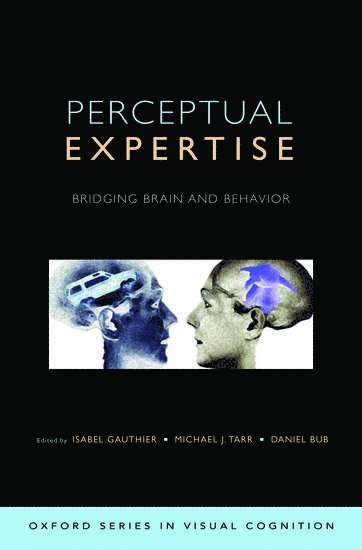
This book presents a comprehensive survey of perceptual expertise in visual object recognition, and introduces a novel collaborative model, codified as the "Perceptual Expertise Network" (PEN). This unique group effort is focused on delineating the domain-general principles of high-level visual learning that can account for how different object categories are processed and come to be associated with spatially localized activity in the primate brain. PEN's approach brings together different traditions and techniques to address questions such as how expertise develops, whether there are different kinds of experts, whether some disorders such as autism or prosopagnosia can be understood as a lack or loss of expertise, and how conceptual and perceptual information interact when experts recognize and categorize objects. The research and results that have been generated by these questions are presented here, along with a variety of other questions, background information, and extant issues that have emerged from recent studies, making this book a complete overview on the topic.
Del 2 - Advances in Visual Cognition
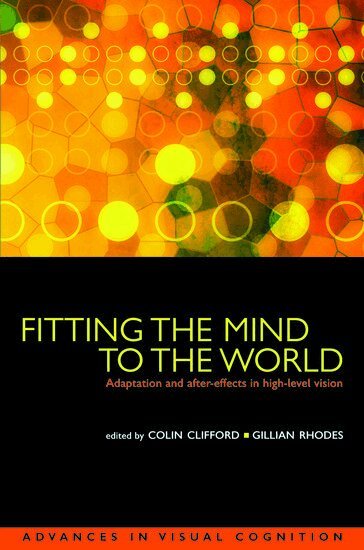
Fitting the Mind to the World
Adaptation and After-Effects in High-Level Vision
Inbunden, Engelska, 2005
1 827 kr
Skickas inom 7-10 vardagar
Adaptation phenomena provide striking examples of perceptual plasticity and offer valuable insight into the mechanisms of visual coding. The technique of psychophysical adaptation has aptly been termed the psychologist's microelectrode because of its usefulness in investigating the coding of sensory information in the human brain. Its broader relevance though is illustrated by the increasing use of adaptation to study more cognitive aspects of vision such as the mechanisms of face perception and the neural substrates of visual awareness.This book brings together a collection of studies from international researchers, which demonstrate the brain's remarkable capacity to adapt its representation of the visual world in response to changes in its environment. A major theme throughout is that adaptation at all stages of visual processing serves a functional role in the efficient representation of the prevailing visual environment. Information about the visual world is coded in the rate at which neurons fire. However, neurons can only respond over a certain range of firing rates. Adaptation of the way in which neurons code visual information tends to make optimal use of this limited response range. Though these principles are well established at the level of light adaptation in the retina, it is only relatively recently that researchers have started to look for analogous behaviour at the higher levels of the visual system. This book is the first to bring together evidence that adaptation in high-level vision, as at the lower levels, serves to fit the mind to the world.