Advancing Weather and Climate Science – serie
Visar alla böcker i serien Advancing Weather and Climate Science. Handla med fri frakt och snabb leverans.
14 produkter
14 produkter
1 691 kr
Skickas inom 7-10 vardagar
This book presents a unique and comprehensive view of the fundamental dynamical and thermodynamic principles underlying the large circulations of the coupled ocean-atmosphere systemDynamics of The Tropical Atmosphere and Oceans provides a detailed description of macroscale tropical circulation systems such as the monsoon, the Hadley and Walker Circulations, El Niño, and the tropical ocean warm pool. These macroscale circulations interact with a myriad of higher frequency systems, ranging from convective cloud systems to migrating equatorial waves that attend the low-frequency background flow. Towards understanding and predicting these circulation systems.A comprehensive overview of the dynamics and thermodynamics of large-scale tropical atmosphere and oceans is presented using both a “reductionist” and “holistic” perspectives of the coupled tropical system. The reductionist perspective provides a detailed description of the individual elements of the ocean and atmospheric circulations. The physical nature of each component of the tropical circulation such as the Hadley and Walker circulations, the monsoon, the incursion of extratropical phenomena into the tropics, precipitation distributions, equatorial waves and disturbances described in detail. The holistic perspective provides a physical description of how the collection of the individual components produces the observed tropical weather and climate. How the collective tropical processes determine the tropical circulation and their role in global weather and climate is provided in a series of overlapping theoretical and modelling constructs.The structure of the book follows a graduated framework. Following a detailed description of tropical phenomenology, the reader is introduced to dynamical and thermodynamical constraints that guide the planetary climate and establish a critical role for the tropics. Equatorial wave theory is developed for simple and complex background flows, including the critical role played by moist processes. The manner in which the tropics and the extratropics interact is then described, followed by a discussion of the physics behind the subtropical and near-equatorial precipitation including arid regions. The El Niño phenomena and the monsoon circulations are discussed, including their covariance and predictability. Finally, the changing structure of the tropics is discussed in terms of the extent of the tropical ocean warm pool and its relationship to the intensity of global convection and climate change.Dynamics of the Tropical Atmosphere and Oceans is aimed at advanced undergraduate and early career graduate students. It also serves as an excellent general reference book for scientists interested in tropical circulations and their relationship with the broader climate system.
752 kr
Skickas
The Atmosphere and Ocean The Atmosphere and Ocean is a fully revised and updated student friendly physical introduction to the atmosphere and ocean. Now in its Third Edition, the book continues to provide students with an accessible description of the atmosphere and ocean with emphasis on their physical properties and interdependence. Clearly structured throughout, the book demonstrates that the atmosphere and ocean are both subject to the influence of the Earth’s rotation and therefore they have a common dynamical basis. The author clearly demonstrates the fundamental differences between the two environments and provides the reader with a much better understanding of the atmosphere and the ocean and an appreciation of their close interactive relationship. There have been many developments in the field over the past ten years and the latest edition of this highly successful textbook brings together new material on the ocean-atmosphere system and climate, the observed circulation of the atmosphere and ocean and radiation in the atmosphere and ocean. Fully revised and updated Third Edition of student friendly physical introduction to the atmosphere and ocean.Now includes new chapters on observed circulation of the atmosphere and ocean, energy flows in the ocean atmosphere system, modeling the ocean and atmosphere, the ocean atmosphere system and climate.Well structured and written in an authoritative yet accessible style suitable for 2nd and 3rd year students taking courses in meteorology, oceanography and related Earth Sciences or as an introduction for graduate students.Emphasis placed on physical properties and inter-dependence of the ocean and climate.
1 627 kr
Skickas inom 5-8 vardagar
The Atmosphere and Ocean The Atmosphere and Ocean is a fully revised and updated student friendly physical introduction to the atmosphere and ocean. Now in its Third Edition, the book continues to provide students with an accessible description of the atmosphere and ocean with emphasis on their physical properties and interdependence. Clearly structured throughout, the book demonstrates that the atmosphere and ocean are both subject to the influence of the Earth’s rotation and therefore they have a common dynamical basis. The author clearly demonstrates the fundamental differences between the two environments and provides the reader with a much better understanding of the atmosphere and the ocean and an appreciation of their close interactive relationship. There have been many developments in the field over the past ten years and the latest edition of this highly successful textbook brings together new material on the ocean-atmosphere system and climate, the observed circulation of the atmosphere and ocean and radiation in the atmosphere and ocean. Fully revised and updated Third Edition of student friendly physical introduction to the atmosphere and ocean.Now includes new chapters on observed circulation of the atmosphere and ocean, energy flows in the ocean atmosphere system, modeling the ocean and atmosphere, the ocean atmosphere system and climate.Well structured and written in an authoritative yet accessible style suitable for 2nd and 3rd year students taking courses in meteorology, oceanography and related Earth Sciences or as an introduction for graduate students.Emphasis placed on physical properties and inter-dependence of the ocean and climate.
741 kr
Skickas inom 7-10 vardagar
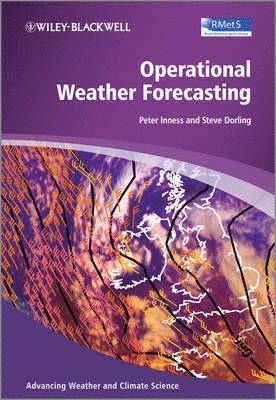
This book offers a complete primer, covering the end-to-end process of forecast production, and bringing together a description of all the relevant aspects together in a single volume; with plenty of explanation of some of the more complex issues and examples of current, state-of-the-art practices.Operational Weather Forecasting covers the whole process of forecast production, from understanding the nature of the forecasting problem, gathering the observational data with which to initialise and verify forecasts, designing and building a model (or models) to advance those initial conditions forwards in time and then interpreting the model output and putting it into a form which is relevant to customers of weather forecasts. Included is the generation of forecasts on the monthly-to-seasonal timescales, often excluded in text-books despite this type of forecasting having been undertaken for several years.This is a rapidly developing field, with a lot of variations in practices between different forecasting centres. Thus the authors have tried to be as generic as possible when describing aspects of numerical model design and formulation. Despite the reliance on NWP, the human forecaster still has a big part to play in producing weather forecasts and this is described, along with the issue of forecast verification – how forecast centres measure their own performance and improve upon it.Advanced undergraduates and postgraduate students will use this book to understand how the theory comes together in the day-to-day applications of weather forecast production. In addition, professional weather forecasting practitioners, professional users of weather forecasts and trainers will all find this new member of the RMetS Advancing Weather and Climate series a valuable tool. Provides an end-to-end description of the weather forecasting processClearly structured and pitched at an accessible level, the book discusses the practical choices that operational forecasting centres have to make in terms of what numerical models they use and when they are run.Takes a very practical approach, using real life case-studies to contextualize informationDiscusses the latest advances in the area, including ensemble methods, monthly to seasonal range prediction and use of ‘nowcasting’ tools such as radar and satellite imageryFull colour throughoutWritten by a highly respected team of authors with experience in both academia and practice.Part of the RMetS book series ‘Advancing Weather and Climate’
1 247 kr
Tillfälligt slut
This book offers a complete primer, covering the end-to-end process of forecast production, and bringing together a description of all the relevant aspects together in a single volume; with plenty of explanation of some of the more complex issues and examples of current, state-of-the-art practices.Operational Weather Forecasting covers the whole process of forecast production, from understanding the nature of the forecasting problem, gathering the observational data with which to initialise and verify forecasts, designing and building a model (or models) to advance those initial conditions forwards in time and then interpreting the model output and putting it into a form which is relevant to customers of weather forecasts. Included is the generation of forecasts on the monthly-to-seasonal timescales, often excluded in text-books despite this type of forecasting having been undertaken for several years.This is a rapidly developing field, with a lot of variations in practices between different forecasting centres. Thus the authors have tried to be as generic as possible when describing aspects of numerical model design and formulation. Despite the reliance on NWP, the human forecaster still has a big part to play in producing weather forecasts and this is described, along with the issue of forecast verification – how forecast centres measure their own performance and improve upon it.Advanced undergraduates and postgraduate students will use this book to understand how the theory comes together in the day-to-day applications of weather forecast production. In addition, professional weather forecasting practitioners, professional users of weather forecasts and trainers will all find this new member of the RMetS Advancing Weather and Climate series a valuable tool. Provides an end-to-end description of the weather forecasting processClearly structured and pitched at an accessible level, the book discusses the practical choices that operational forecasting centres have to make in terms of what numerical models they use and when they are run.Takes a very practical approach, using real life case-studies to contextualize informationDiscusses the latest advances in the area, including ensemble methods, monthly to seasonal range prediction and use of ‘nowcasting’ tools such as radar and satellite imageryFull colour throughoutWritten by a highly respected team of authors with experience in both academia and practice.Part of the RMetS book series ‘Advancing Weather and Climate’
878 kr
Skickas inom 7-10 vardagar
Mesoscale Meteorology in Mid-Latitudes presents the dynamics of mesoscale meteorological phenomena in a highly accessible, student-friendly manner. The book's clear mathematical treatments are complemented by high-quality photographs and illustrations. Comprehensive coverage of subjects including boundary layer mesoscale phenomena, orographic phenomena and deep convection is brought together with the latest developments in the field to provide an invaluable resource for mesoscale meteorology students. Mesoscale Meteorology in Mid-Latitudes functions as a comprehensive, easy-to-use undergraduate textbook while also providing a useful reference for graduate students, research scientists and weather industry professionals. Illustrated in full colour throughout Covers the latest developments and research in the field Comprehensive coverage of deep convection and its initiation Uses real life examples of phenomena taken from broad geographical areas to demonstrate the practical aspects of the science
917 kr
Skickas inom 7-10 vardagar
Thermal Physics of the Atmosphere offers a concise and thorough introduction on how basic thermodynamics naturally leads on to advanced topics in atmospheric physics.The book starts by covering the basics of thermodynamics and its applications in atmospheric science. The later chapters describe major applications, specific to more specialized areas of atmospheric physics, including vertical structure and stability, cloud formation, and radiative processes. The book concludes with a discussion of non-equilibrium thermodynamics as applied to the atmosphere.This book provides a thorough introduction and invaluable grounding for specialised literature on the subject. Introduces a wide range of areas associated with atmospheric physicsStarts from basic level thermal physicsIdeally suited for readers with a general physics backgroundSelf-assessment questions included for each chapterSupplementary website to accompany the book
584 kr
Skickas inom 7-10 vardagar
This book gives a coherent development of the current understanding of the fluid dynamics of the middle latitude atmosphere. It is primarily aimed at post-graduate and advanced undergraduate level students and does not assume any previous knowledge of fluid mechanics, meteorology or atmospheric science. The book will be an invaluable resource for any quantitative atmospheric scientist who wishes to increase their understanding of the subject. The importance of the rotation of the Earth and the stable stratification of its atmosphere, with their implications for the balance of larger-scale flows, is highlighted throughout.Clearly structured throughout, the first of three themes deals with the development of the basic equations for an atmosphere on a rotating, spherical planet and discusses scale analyses of these equations. The second theme explores the importance of rotation and introduces vorticity and potential vorticity, as well as turbulence. In the third theme, the concepts developed in the first two themes are used to give an understanding of balanced motion in real atmospheric phenomena. It starts with quasi-geostrophic theory and moves on to linear and nonlinear theories for mid-latitude weather systems and their fronts. The potential vorticity perspective on weather systems is highlighted with a discussion of the Rossby wave propagation and potential vorticity mixing covered in the final chapter.
1 426 kr
Skickas inom 7-10 vardagar
This book gives a coherent development of the current understanding of the fluid dynamics of the middle latitude atmosphere. It is primarily aimed at post-graduate and advanced undergraduate level students and does not assume any previous knowledge of fluid mechanics, meteorology or atmospheric science. The book will be an invaluable resource for any quantitative atmospheric scientist who wishes to increase their understanding of the subject. The importance of the rotation of the Earth and the stable stratification of its atmosphere, with their implications for the balance of larger-scale flows, is highlighted throughout.Clearly structured throughout, the first of three themes deals with the development of the basic equations for an atmosphere on a rotating, spherical planet and discusses scale analyses of these equations. The second theme explores the importance of rotation and introduces vorticity and potential vorticity, as well as turbulence. In the third theme, the concepts developed in the first two themes are used to give an understanding of balanced motion in real atmospheric phenomena. It starts with quasi-geostrophic theory and moves on to linear and nonlinear theories for mid-latitude weather systems and their fronts. The potential vorticity perspective on weather systems is highlighted with a discussion of the Rossby wave propagation and potential vorticity mixing covered in the final chapter.
1 064 kr
Skickas inom 11-20 vardagar
Time Series Analysis in Meteorology and Climatology provides an accessible overview of this notoriously difficult subject. Clearly structured throughout, the authors develop sufficient theoretical foundation to understand the basis for applying various analytical methods to a time series and show clearly how to interpret the results. Taking a unique approach to the subject, the authors use a combination of theory and application to real data sets to enhance student understanding throughout the book. This book is written for those students that have a data set in the form of a time series and are confronted with the problem of how to analyse this data. Each chapter covers the various methods that can be used to carry out this analysis with coverage of the necessary theory and its application. In the theoretical section topics covered include; the mathematical origin of spectrum windows, leakage of variance and understanding spectrum windows. The applications section includes real data sets for students to analyse. Scalar variables are used for ease of understanding for example air temperatures, wind speed and precipitation.Students are encouraged to write their own computer programmes and data sets are provided to enable them to recognize quickly whether their programme is working correctly- one data set is provided with artificial data and the other with real data where the students are required to physically interpret the results of their periodgram analysis.Based on the acclaimed and long standing course at the University of Oklahoma and part of the RMetS Advancing Weather and Climate Science Series, this book is distinct in its approach to the subject matter in that it is written specifically for readers in meteorology and climatology and uses a mix of theory and application to real data sets.
819 kr
Skickas inom 5-8 vardagar
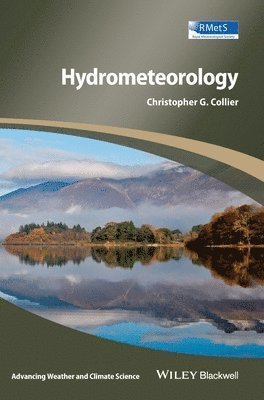
Hydrometeorology presents an introduction to relevant topics in the interdisciplinary fields of hydrology and meteorology. This book is one of the few books aiming to provide a balance between aspects of meteorological and hydrological processes. The transfer of energy and water between the land surface and lower atmosphere within the hydrological cycle is addressed followed by a description of the nature of precipitation, and how it is formed. Forecasting precipitation is reviewed on all scales, and the range of rainfall-runoff models and coastal surge models and forecasts (including tsunamis) which have been, and are being, used are discussed.The mechanisms of snow, ice (glacier, sea and tundra), evaporation and transpiration, how drought occurs and the representation of wind are described. How rainfall (including radar measurements) and river flow information is gathered and analysed (including, frequency analysis, Probable Maximum Precipitation and Flood) are presented. Satellite measurements of precipitation are discussed. Examples of major past floods and droughts are given.Past and future climate change, which is included, underpins the importance of hydro-meteorological processes. The structure of the general circulation of the atmosphere and how it influences weather and climate including the Hadley, Ferrel and Polar cells, the Trade winds and the El Nino, is outlined. Finally, the influence of urban areas on rainfall formation, dealing with urban drainage and air quality are described.Each chapter ends with one or two specific points as appendices, elements discussed in the chapter and a list of sample problems to aid understanding.Readership: This book is aimed at 3rd year undergraduate and postgraduate students on hydrology/hydrometeorology, environmental science and geography courses. Professionals in environmental protection agencies and consultancies will also find the book of great interest. It contains a balance of both the physics and mathematics which underpin such courses and activities.
1 826 kr
Skickas inom 5-8 vardagar
Hydrometeorology presents an introduction to relevant topics in the interdisciplinary fields of hydrology and meteorology. This book is one of the few books aiming to provide a balance between aspects of meteorological and hydrological processes. The transfer of energy and water between the land surface and lower atmosphere within the hydrological cycle is addressed followed by a description of the nature of precipitation, and how it is formed. Forecasting precipitation is reviewed on all scales, and the range of rainfall-runoff models and coastal surge models and forecasts (including tsunamis) which have been, and are being, used are discussed.The mechanisms of snow, ice (glacier, sea and tundra), evaporation and transpiration, how drought occurs and the representation of wind are described. How rainfall (including radar measurements) and river flow information is gathered and analysed (including, frequency analysis, Probable Maximum Precipitation and Flood) are presented. Satellite measurements of precipitation are discussed. Examples of major past floods and droughts are given.Past and future climate change, which is included, underpins the importance of hydro-meteorological processes. The structure of the general circulation of the atmosphere and how it influences weather and climate including the Hadley, Ferrel and Polar cells, the Trade winds and the El Nino, is outlined. Finally, the influence of urban areas on rainfall formation, dealing with urban drainage and air quality are described.Each chapter ends with one or two specific points as appendices, elements discussed in the chapter and a list of sample problems to aid understanding.Readership: This book is aimed at 3rd year undergraduate and postgraduate students on hydrology/hydrometeorology, environmental science and geography courses. Professionals in environmental protection agencies and consultancies will also find the book of great interest. It contains a balance of both the physics and mathematics which underpin such courses and activities.
819 kr
Skickas inom 7-10 vardagar
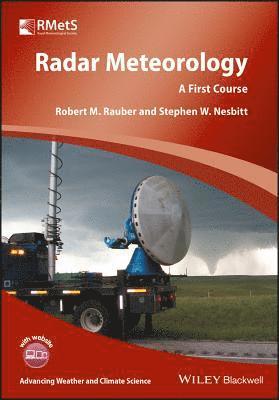
A comprehensive introduction to the current technology and application of radar in meteorology and atmospheric sciencesWritten by leading experts in the field, Radar Meteorology, A first Course offers an introduction to meteorological radar systems and applications, with emphasis on observation and interpretation of physical processes in clouds and weather systems. This comprehensive introduction to the subject offers an overview of the quantities essential to radar meteorology including the radar reflectivity factor, and Doppler, dual-polarization, and multi-wavelength radar variables. The authors highlight wind retrieval from single and multiple Doppler radars, precipitation estimation and hydrometeorological applications, with chapters dedicated to interpretation of radar data from warm season mid-latitude severe weather, winter storms, tropical cyclones and more.In addition, Radar Meteorology highlights research applications of this burgeoning technology, exploring dynamic applications such as space-borne and ground-based vertically pointing radar systems, and cloud, airborne and mobile radars. As meteorological radars are increasingly used professionally for weather observation, forecasting and warning, this much-needed text: Presents an introduction to the technical aspects and current application of radar as used in the meteorology and atmospheric sciencesContains full-colour illustrations that enhance the understanding of the material presentedExamines the wide-range of meteorological applications of radarIncludes problems at the end of each chapter as a helpful review of the contentsProvides full instructor support with all illustrations and answers to problems available via the book’s instructor website.Radar Meteorology offers a much-needed introductory text to the study of radar as applied to meteorology. The text was designed for a one semester course based on the authors' own course in Radar Meteorology at the University of Illinois at Urbana-Champaign.
829 kr
Skickas inom 7-10 vardagar
This book describes the fundamental scientific principles underlying high quality instrumentation used for environmental measurements. It discusses a wide range of in situ sensors employed in practical environmental monitoring and, in particular, those used in surface based measurement systems. It also considers the use of weather balloons to provide a wealth of upper atmosphere data. To illustrate the technologies in use it includes many examples of real atmospheric measurements in typical and unusual circumstances, with a discussion of the electronic signal conditioning, data acquisition considerations and data processing principles necessary for reliable measurements. This also allows the long history of atmospheric measurements to be placed in the context of the requirements of modern climate science, by building the physical science appreciation of the instrumental record and looking forward to new and emerging sensor and recording technologies.