Aesthetics - Böcker
Visar alla böcker i serien Aesthetics. Handla med fri frakt och snabb leverans.
6 produkter
6 produkter
668 kr
Skickas inom 5-8 vardagar
In his Aesthetics Hegel gives full expression to his seminal theory of art. He surveys the history of art from ancient India, Egypt, and Greece through to the Romantic movement of his own time, criticizes major works, and probes their meaning and significance; his rich array of examples gives broad scope for his judgement and makes vivid his exposition of his theory.The substantial Introduction is Hegel's best exposition of his general philosophy of art, and provides the ideal way into his Aesthetics. In Part I he considers the general nature of art: he distinguishes art, as a spiritual experience, from religion and philosophy; he discusses the beauty of art and differentiates it from the beauty of nature; and he examines artistic genius and originality. Part II provides a sort of history of art, divded into three periods called Symbolic (India, Persia, Egypt), Classical (Greece), and Romantic (medieval and post-medieval up to the end of the eighteenth century). Part III deals individually with architecture, scuplture, painting, music, and literature.
572 kr
Skickas inom 5-8 vardagar
In his Aesthetics Hegel gives full expression to his seminal theory of art. He surveys the history of art from ancient India, Egypt, and Greece through to the Romantic movement of his own time, criticizes major works, and probes their meaning and significance; his rich array of examples gives broad scope for his judgement and makes vivid his exposition of his theory.The substantial Introduction is Hegel's best exposition of his general philosophy of art, and provides the ideal way into his Aesthetics. In Part I he considers the general nature of art: he distinguishes art, as a spiritual experience, from religion and philosophy; he discusses the beauty of art and differentiates it from the beauty of nature; and he examines artistic genius and originality. Part II provides a sort of history of art, divded into three periods called Symbolic (India, Persia, Egypt), Classical (Greece), and Romantic (medieval and post-medieval up to the end of the eighteenth century). Part III deals individually with architecture, sculpture, painting, music, and literature.
101 kr
Skickas
The complex relationship between life and the arts has always been a crucial topic in philosophical discourse. The essays in this book discuss fundamental issues of modern and contemporary aesthetics, drawing upon the work of the French philosopher Jean- Pierre Cometti, a key figure in the studies of aesthetics, pragmatism, and Austrian philosophy. The volume covers a wide-range of topics, from the examination of fundamental principles of art and literary criticism to a new understanding of the Modernist notion of art. It proposes an anthropological aesthetics using Musil’s The Man Without Qualities or the analysis of literary characters such as Tolstoj’s Hadji Murat and Cervantes’ Don Quixote as a tool to cast light on themes in Wittgenstein’s philosophy. Editors Carla Carmona and Jerrold Levinson have brought together renowned voices in the field of philosophy to offer a window onto Cometti’s philosophical work, as well as an in-depth analysis of contemporary artistic and aesthetic practices, in an effort to overcome what can sometimes appear as a gulf between art and life.
188 kr
Skickas
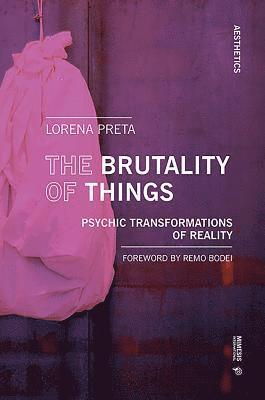
In every psychic experience, even in the production of a work of art, there exists a nucleus that is impossible to transform. It resists any and every action against itself. We are used to dealing with these irreducible and radical othernesses by adapting them to our own way of knowing and our experience. In reality, they make up the ugly material of our living and, hence, of our humanity. We can, however, transform them in some way, without altering their substance, but rather organizing them in different configurations, which generate new forms. Psychoanalysis can aid in this difficult and risky process, providing resilient equipment, much like a sophisticated spacesuit, allowing one to travel the cosmic spaces of psychic life and of human reality without bursting into flames. In the actual world, we find ourselves having to deal with problems never before encountered, which eradicate old certainties – problems which feel uncanny compared to the known experiences of ourselves and others. We meet with disorganized and fragmentary conflict, to which psychoanalysis attempts to answer adopting an open, non-defensive procedure, aiming to widen the field of experience rather than reducing it, in accordance with the basis of its practice and theory.For this reason, the interweaving of various forms of knowledge is necessary in order to link the diverse aspects and levels of psychic and external reality. The author examines this theme through the psychoanalytic approach, as well as through philosophy, science and art, and using stories based on personal life and clinical experiences.
191 kr
Skickas inom 5-8 vardagar
This book collects Adornian contributions on different trends, genres and artists belonging to the broad and complex and in-itself-articulated field of popular music. On the occasion of the 50th anniversary of Adorno’s death, this book aims to represent an important contribution for the international community of Adorno scholars and, additionally, for scholars of both philosophy and musicology in general, in order to assess and celebrate the persistent actuality of Adorno’s contribution to the understanding of popular music in the context of the dynamics and processes of the culture industry. But the book also aims to critically rethink some of the main concepts and themes of Adorno's influential philosophy of music and thus to develop it at a further level, also intersecting it with other philosophical perspectives or adapting it when necessary to the partially changed conditions of popular music in our time in comparison to his epoch.
349 kr
Tillfälligt slut
If 2019 was an "Adornian year" because of the 50th anniversary of the untimely death of Theodor W. Adorno in August 1969, also 2020 has been an "Adornian year" because of the 50th anniversary of the posthumous publication of Adorno’s great but unfinished masterpiece Aesthetic Theory, first published in 1970. Adorno’s intellectual legacy is still alive today and indeed important for the conceptual tools as it still provides to develop a critical, active and negative (instead than acritical, passive and affirmative) relationship with the real. In the vast and complex corpus of Adorno’s entire philosophical oeuvre, his aesthetic theory deserves an especially close and renewed attention today for the variety of intellectual provocations that are still richly offered to us in order to critically understand our age.