Applications of Modern Technology in Business – Serie
Visar alla böcker i serien Applications of Modern Technology in Business. Handla med fri frakt och snabb leverans.
8 produkter
8 produkter
1 637 kr
Skickas inom 10-15 vardagar
876 kr
Skickas inom 10-15 vardagar
Operations Management of Distributed Service Networks
A Practical Quantitative Approach
Häftad, Engelska, 2011
550 kr
Skickas inom 10-15 vardagar
Distributed service networks encompass various facilities with which we have daily contact. In the public sector they include, for instance, ambulance, fire, and police services; in the business sector they include maintenance and repair services, road services, courier services, and the like. Policy making problems in distributed service networks can be clearly classified into a number of hierarchical levels. The levels are distinguished by the time horizon of the problem, by the amount of cost involved in the implementation of a solution, and by the political implications of the solution. This top-down classification is typical of what is known as the "systems approach," advocating that the direction of the analysis of complex systems should be from the whole to the details. The top-down classification consists of the following categories of policies: 1. Zoning: How should a network be partitioned into subzones? 2. Station location: Where should service stations or service units be located? 3. Resource allocation: What amount of resources should be allocated to the stations? vii viii Preface 4. Dispatching, routing, and repositioning: What is the optimal dis patching policy, what are the optimal routes for nonbusy units, and under what circumstances is it worthwhile to reposition a certain idle unit? A top-down approach implies that each of the problems is solved separately; however, the solution of a higher-level problem sets constraints on problems at lower levels.
534 kr
Skickas inom 10-15 vardagar
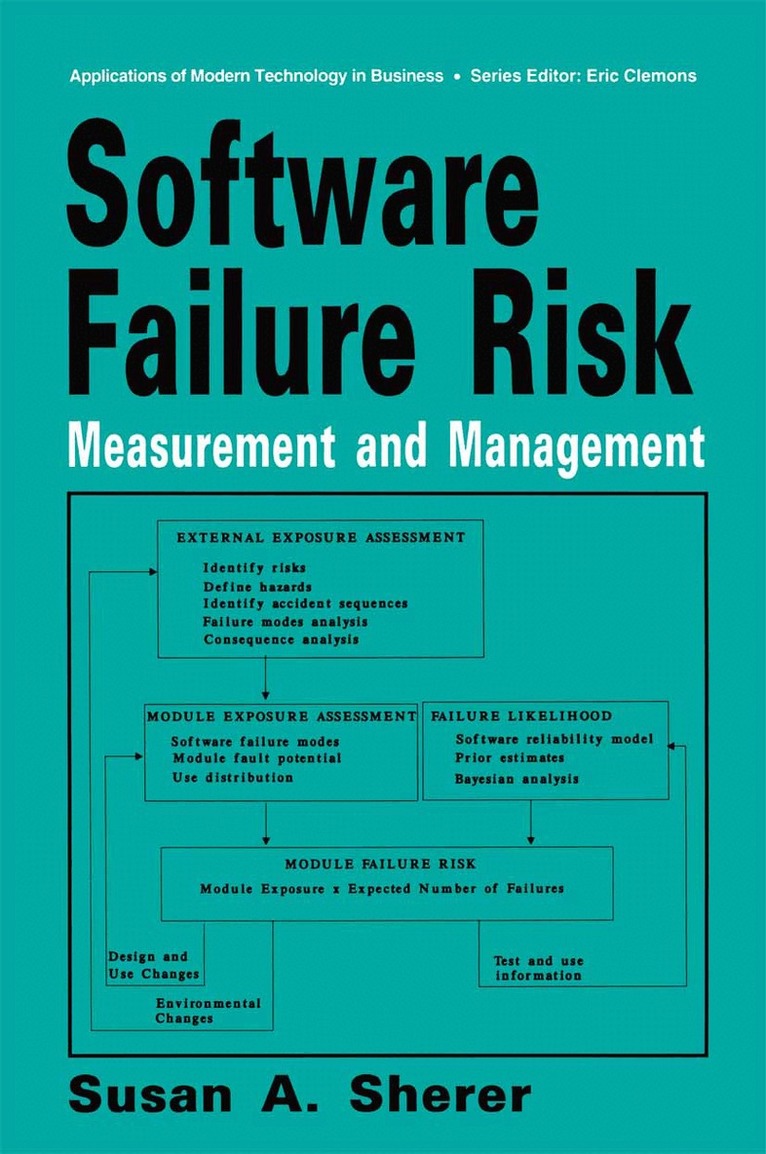
The author here presents a detailed explanation of the methodolgy of software reliablity evaluation, and then demonstrates its applications to a commercial loan system, a funds transfer security system, and a payables processing system. Her well-written, practical text enables users to design original software modules, as well as to critically assess commercial software products.
550 kr
Skickas inom 10-15 vardagar
Every pioneer takes large risks, hoping that the new frontier he seeks will provide the benefits of independence and good fortune. Don Tapscott is such a pioneer in the area of office automation. He has been a true pioneer, having entered the field in its early days and taken the risk of working not in technol ogy, which was fashionable, but in the field of the problems of organizations, which was less fashionable, but in many ways more important. The utilization of computers for data processing, accounting, inventory, and other "bread and butter" applications is now well entrenched in our society and culture. The process of designing such systems tends to focus on the needs of the company and the constraints of the equipment, leading to efficient systems with little tolerance for the variety of people who must use or interface with them. Within the office automation area, these methods do not work nearly as well. The frequency and amount of human interaction in the office environment, and the wide variety of situations and reactions there in, demands a different design methodology.
550 kr
Skickas inom 10-15 vardagar
This book has evolved primarily from lecture notes for data communications courses taught at Georgia State University since 1969. Additional material was derived from seminar presentations that were made during this period as well as from consulting work. Teaching data communications in the College of Business Administration influenced the point of view of this material, giving it a semitechnical orientation. This point of view has been extended to the prepara tion of this book. Only those technical details were included which, it was felt, would lead the student to a better understanding of the subject. References are provided for those who desire further information in particular areas. The reader for whom this book is intended is the nontechnical person who has some knowledge of computer technology and who wishes to extend that knowledge to the field of data communications. The two key points stressed in this book are terminology and concepts. The objectives of this book are to enable the student: 1. To read articles in the field of data communications with an understand ing of their content. 2. To be able to engage in knowledgeable discussions with communica tions engineers on the subject of data communications. 3. To design and implement the hardware aspects of applications using data communications. The software that would be involved is beyond the scope of this book except where protocols are considered. v vi Preface 4. To effectively evaluate proposals for the implementation of data com munications systems.
527 kr
Skickas inom 10-15 vardagar
Electronic funds transfer (EFT) systems include a wide range of computer-based payment systems and sources that substitute electronic and digital transfers for movements of cash and paper checks. A few years ago some people were predict ing that EFT would replace paper money and coins entirely and that we would soon be a "checkless" and' 'cashless" society. Such sweeping changes have not occurred, but a slower evolution is clearly underway. Although checks, cur rency, and coin are likely to be here for many years to come, EFT is becoming an established part of our worldwide payment transfer system, and the implications and consequences of this technology are real. They include: • Alterations in personal finance and in the process of purchasing and paying for consumer goods and services. • Changes in the structure of financial and retail organizations and their mode of interaction in the marketplace. • Modifications in the flow of funds in our society and in the interactions among economic institutions. • Alterations in the prospects for invasion of personal privacy, perpetration of fraud and theft, and violation of antitrust regulations. • Changes in the regulatory and competitive balance among the numerous financial institutions in the United States. Such alterations foretell important impacts on people and society. Benefits are forthcoming, but the costs will also be real.
1 094 kr
Skickas inom 10-15 vardagar
In modem organizations, data has been added to the classical economic assets of land, labor, and capital. Data on company products, finances, and operations are gathered into data bases that are used to support management reporting and decision making. Effective use of these data bases requires control over their design and development and coordination among the various users. The exercise of these management functions is called data base administration (DBA). DBA is an evolutionary area. In many organizations, it was formed as a response to the problems created by the installation of sophisticated systems for data base management. As a result, the practice of DBA has been strongly influ enced by its technological and organizational environment. The size, organiza tional position, staffing, and defined role of DBA vary from firm to firm. How ever, certain fundamental tasks and responsibilities are, or should be, recognized as the province of DBA. To date, literature on the DBA function is sparse. Most texts on data base management systems (Date, 1975; Kroenke, 1977; Martin, 1978; Sprowls, 1976; Tsichritzis and Lochovsky, 1977)* discuss DBA as one aspect of that technology.