Ashgate Studies in Resilience Engineering - Böcker
Visar alla böcker i serien Ashgate Studies in Resilience Engineering. Handla med fri frakt och snabb leverans.
9 produkter
9 produkter
Resilience Engineering Perspectives, Volume 1
Remaining Sensitive to the Possibility of Failure
Inbunden, Engelska, 2008
2 306 kr
Skickas inom 10-15 vardagar
In the resilience engineering approach to safety, failures and successes are seen as two different outcomes of the same underlying process, namely how people and organizations cope with complex, underspecified and therefore partly unpredictable work environments. Therefore safety can no longer be ensured by constraining performance and eliminating risks. Instead, it is necessary to actively manage how people and organizations adjust what they do to meet the current conditions of the workplace, by trading off efficiency and thoroughness and by making sacrificing decisions. The Ashgate Studies in Resilience Engineering series promulgates new methods, principles and experiences that can complement established safety management approaches, providing invaluable insights and guidance for practitioners and researchers alike in all safety-critical domains. While the Studies pertain to all complex systems they are of particular interest to high hazard sectors such as aviation, ground transportation, the military, energy production and distribution, and healthcare. Published periodically within this series will be edited volumes titled Resilience Engineering Perspectives. The first volume, Remaining Sensitive to the Possibility of Failure, presents a collection of 20 chapters from international experts. This collection deals with important issues such as measurements and models, the use of procedures to ensure safety, the relation between resilience and robustness, safety management, and the use of risk analysis. The final six chapters utilise the report from a serious medical accident to illustrate more concretely how resilience engineering can make a difference, both to the understanding of how accidents happen and to what an organisation can do to become more resilient.
Governance and Control of Financial Systems
A Resilience Engineering Perspective
Häftad, Engelska, 2017
805 kr
Skickas inom 10-15 vardagar
The recent financial crisis has made it paramount for the financial services industry to find new perspectives to look at their industry and, most importantly, to gain a better understanding of how the global financial system can be made less vulnerable and more resilient. The primary objective of this book is to illustrate how the safety science of Resilience Engineering can help to gain a better understanding of what the financial services system is and how to improve governance and control of financial services systems by leveraging some of its key concepts. Resilience is the intrinsic ability of a system to adjust its functioning prior to, during, or following changes and disturbances, so that it can sustain required operations under both expected and unexpected conditions. This definition is focused on the ability to function, rather than just to be impervious to failure, and thereby bridges the traditional conflict between productivity and safety. The core concept of the book is that the behaviour of the financial services system is the result of the tight couplings among the humans, organizations and technologies that are necessary to provide complex financial functions such as the transfer of economic resources. It is a consequence of this perspective that the risks associated with these systems cannot be understood without considering the nature of these tight couplings. Adopting this perspective, the book is designed to provide some answers to the following key questions about the financial crisis: - What actually happened? - Why and how did it happen? - Could something similar happen again? How can we see that in time and how can we control it? - How can sustainable recovery of the global financial system be established? How can its resilience be improved?
2 374 kr
Skickas inom 10-15 vardagar
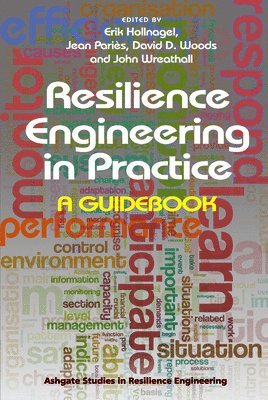
Resilience engineering has since 2004 attracted widespread interest from industry as well as academia. Practitioners from various fields, such as aviation and air traffic management, patient safety, off-shore exploration and production, have quickly realised the potential of resilience engineering and have became early adopters. The continued development of resilience engineering has focused on four abilities that are essential for resilience. These are the ability a) to respond to what happens, b) to monitor critical developments, c) to anticipate future threats and opportunities, and d) to learn from past experience - successes as well as failures. Working with the four abilities provides a structured way of analysing problems and issues, as well as of proposing practical solutions (concepts, tools, and methods). This book is divided into four main sections which describe issues relating to each of the four abilities. The chapters in each section emphasise practical ways of engineering resilience and feature case studies and real applications. The text is written to be easily accessible for readers who are more interested in solutions than in research, but will also be of interest to the latter group.
Governance and Control of Financial Systems
A Resilience Engineering Perspective
Inbunden, Engelska, 2011
2 375 kr
Skickas inom 10-15 vardagar
The recent financial crisis has made it paramount for the financial services industry to find new perspectives to look at their industry and, most importantly, to gain a better understanding of how the global financial system can be made less vulnerable and more resilient. The primary objective of this book is to illustrate how the safety science of Resilience Engineering can help to gain a better understanding of what the financial services system is and how to improve governance and control of financial services systems by leveraging some of its key concepts. Resilience is the intrinsic ability of a system to adjust its functioning prior to, during, or following changes and disturbances, so that it can sustain required operations under both expected and unexpected conditions. This definition is focused on the ability to function, rather than just to be impervious to failure, and thereby bridges the traditional conflict between productivity and safety. The core concept of the book is that the behaviour of the financial services system is the result of the tight couplings among the humans, organizations and technologies that are necessary to provide complex financial functions such as the transfer of economic resources. It is a consequence of this perspective that the risks associated with these systems cannot be understood without considering the nature of these tight couplings. Adopting this perspective, the book is designed to provide some answers to the following key questions about the financial crisis: - What actually happened? - Why and how did it happen? - Could something similar happen again? How can we see that in time and how can we control it? - How can sustainable recovery of the global financial system be established? How can its resilience be improved?
1 748 kr
Skickas inom 10-15 vardagar
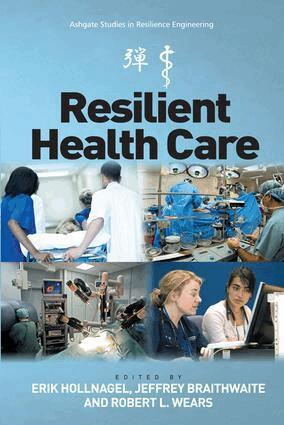
Health care is everywhere under tremendous pressure with regard to efficiency, safety, and economic viability - to say nothing of having to meet various political agendas - and has responded by eagerly adopting techniques that have been useful in other industries, such as quality management, lean production, and high reliability. This has on the whole been met with limited success because health care as a non-trivial and multifaceted system differs significantly from most traditional industries. In order to allow health care systems to perform as expected and required, it is necessary to have concepts and methods that are able to cope with this complexity. Resilience engineering provides that capacity because its focus is on a system’s overall ability to sustain required operations under both expected and unexpected conditions rather than on individual features or qualities. Resilience engineering’s unique approach emphasises the usefulness of performance variability, and that successes and failures have the same aetiology. This book contains contributions from acknowledged international experts in health care, organisational studies and patient safety, as well as resilience engineering. Whereas current safety approaches primarily aim to reduce or eliminate the number of things that go wrong, Resilient Health Care aims to increase and improve the number of things that go right. Just as the WHO argues that health is more than the absence of illness, so does Resilient Health Care argue that safety is more than the absence of risk and accidents. This can be achieved by making use of the concrete experiences of resilience engineering, both conceptually (ways of thinking) and practically (ways of acting).
857 kr
Skickas inom 10-15 vardagar
Resilience engineering depends on four abilities: the ability a) to respond to what happens, b) to monitor critical developments, c) to anticipate future threats and opportunities, and d) to learn from past experience - successes as well as failures. They provide a structured way of analysing problems and proposing practical solutions.
1 470 kr
Skickas inom 10-15 vardagar
This volume describes how safety can change from being protective to being productive, thereby improving the resilience of the system. This is the fifth book published within the Ashgate Studies in Resilience Engineering series. The first introduced resilience engineering broadly.
1 818 kr
Skickas inom 10-15 vardagar
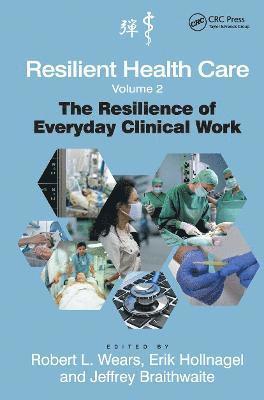
Analysing everyday work situations in primary, secondary, and tertiary care, this title identifies and describes the fundamental strategies that clinicians everywhere have developed and use with a fluency that belies the demands to be resolved and the dilemmas to be balanced.
745 kr
Skickas inom 10-15 vardagar
This book contains contributions from international experts in health care, organisational studies and patient safety, as well as resilience engineering.