Bio-Bibliographies in Art and Architecture - Böcker
Visar alla böcker i serien Bio-Bibliographies in Art and Architecture. Handla med fri frakt och snabb leverans.
5 produkter
5 produkter
901 kr
Skickas inom 10-15 vardagar
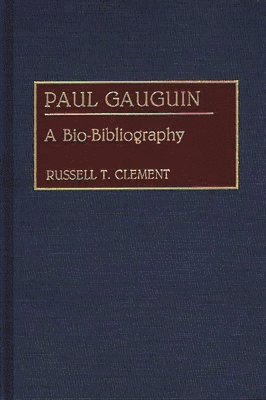
This first comprehensive research guide and annotated bibliography of Paul Gauguin includes information on more than 1500 books and articles on the artist as well as a comprehensive chronology and list of exhibitions. The secondary bibliography is arranged by topics and includes citations on the artist's life and career, his relationships with contemporary artists in France, including Vincent van Gogh, his life and work in Panama, Martinique, Tahiti, and the Marquesas Islands, his oeuvre in general and in various media, self-portraits, iconography, and more.The French artist Paul Gauguin continues to be a larger-than-life figure whose mystique exerts its spell on popular, critical, and scholarly minds. Consequently, the available literature on the artist is copious and marked by diversity of opinion on every aspect of his life and work. From the first book-length biography of Gauguin written by Louis Brouillon in 1906, interest in Gauguin has continued unabated and, since 1959, critical interest in the artist's drawings, prints, sculptures, and art works in other media has dramatically increased. Russell T. Clement has compiled the first comprehensive research guide and annotated bibliography on Gauguin. This volume encompasses primary materials by Gauguin including those published during the artist's lifetime and those published posthumously; contemporary accounts and criticism of Gauguin's life and work published through 1906; descriptions of the artist's oeuvre; a lengthy secondary bibliography; and a section that catalogs exhibitions of Gauguin's work between 1884 and 1989. While concentrating on printed materials, this guide also includes selected manuscripts--in all, more than 1500 books and articles are cited. For entries where titles give incomplete or unclear information about works and their content, the author provides brief annotations.Following a biographical sketch and chronology, the primary bibliography lists articles, essays, letters, manuscripts, and sketch books of Gauguin and then accounts and critiques of Gauguin's life and work published through 1906. The main part of the bibliography and research guide, the secondary bibliography, lists monographs, catalogues, dissertations, theses, periodical literature, films, sound recordings and musical scores, and selected newspaper articles. Substantial book reviews and exhibition reviews are also included. Arranged by topic, the secondary bibliography also includes citations on Gauguin's relationships with contemporary artists in France, his work in Panama and Martinique, his work and life in Tahiti and the Marquesas Islands, and his oeuvre in general. Not just a list of sources but a complete research guide, this volume deserves a place in every research library collection.
929 kr
Skickas inom 10-15 vardagar
The elegant Matisse retrospective at New York's Museum of Modern Art in the fall of 1992 was the first king-sized retrospective of Matisse's work anywhere in the world for more than twenty years. Appropriately labelled the most beautiful show in the world, this giant new look at Matisse and his pursuit of pleasure was a consummate success. Henri Matisse: A Bio-Bibliography provides the scholar, student, artist, and layperson with an extended primary and secondary bibliography with which to study and enjoy this great artist. These works cover his life, career, oeuvre, and influence on other artists. Though many of the entries are annotated, this is not meant to be a critical guide; rather, it is a way to get to know a great artist through the literature surrounding him and his art.
787 kr
Skickas inom 10-15 vardagar
The first comprehensive research guide and bibliography to the large literature surrounding the life and work of one of the 20th century's greatest artists, this volume includes information on more than 1,100 books and articles as well as a chronology, biographical sketch, and list of exhibitions. The secondary bibliography is arranged by topic and includes citations on the artist's life and career, his relationships with contemporary artists (notably Picasso), his influence on subsequent artists, his work in diverse artistic media as well as his oeuvre in general, iconography, and more. While concentrating on printed materials, this guide also includes selected manuscripts and audio-visual materials.Following a biographical sketch and chronology, the primary bibliography lists articles, essays, letters, interviews, manuscripts, and sketchbooks of Braque. The main part of the secondary bibliography lists monographs, catalogues, dissertations, theses, periodical articles, films, and selected newspaper articles. Substantial book reviews and exhibition reviews are also cited. Arranged by topic, this bibliography includes citations on Braque's career and development as an artist, his relationships with contemporary artists, a section on Braque/Picasso, his influence on other artists, his work in various media including paintings, drawings, prints, illustrated books, papiers decoupes, sculpture, jewelry, theatre designs, and other commissions. Georges Braque first came to world attention as Picasso's friend during the formative years of Cubism. Long overshadowed by his more famous contemporary, in the quarter-century after his death Braque is beginning to be evaluated accurately. Major retrospective exhibitions over the past decade, accompanied by a considerable body of new criticism and scholarship, have brought Braque into the spotlight.
929 kr
Skickas inom 10-15 vardagar
This self-taught Dutch architect was among the most widely copied architects of the 1930s and 1940s. His international influence is all the more amazing when one considers that most of his architecture was built in the provincial town of Hilversum. Travel, word-of-mouth, and literature spread the news of his humane, modern approach to building design. The more than 1,200 bibliographic entries in this work are presented alphabetically by decades and further by genres. Each is summarized, described, and evaluated in the context of a critical overview of Dudok's career. Architectural scholars and students will profit from this comprehensive guide to the international literature on one of the most emulated champions of modern architecture.For too long, much was made in the English-language architectural literature of Germany's pioneer role in developing Modernism. That contribution was undeniably valuable, but the Dutch were unfairly overlooked; however, Dudok's work was not. Hilversum became a magnet for young foreign architects in the 1930s. He cast his spell upon much of continental Europe, the United States and Britain, and throughout the 1940s his style was so widely mimicked that a new adjective was coined: dudoky. This volume will reintroduce the importance of Dudok's work to today's scholars and students.
929 kr
Skickas inom 10-15 vardagar
J.J.P. Oud was a famed modern architect; his European contemporaries are Le Corbusier, Walter Gropius, and Ludwig Mies van der Rohe. In Leiden in 1917, Oud, with the Dutch artist Theo van Doesburg and the expatriate Hungarian Vilmos Huszár, and fellow Hollanders Jan Wils and Bart van der Leck formed a collaboration between artists and architects a movement they called De Stijl. The loose knit group slowly disintegrated, but in terms of architectural style the movement sought a unity between art and society that flirted with Constructivism, developed theories of Neoplasticism, and what Oud called Cubism. Although these intellectualized theories seldom resulted in architectural realities, the realized projects were spectacular and they include Oud's director's hut at the Oud-Mathenesse housing development, 1923, and the facade of the Café De Unie, Rotterdam, 1925. This annotated bibliography documents not only the literature on Oud but also Oud's own writings. A biographical essay, this book examines the place afforded Oud in the international literature of architecture and traces his career which spanned fifty-seven years.Architectural students and scholars will benefit from this guide to the major archives, minor collections, and listing of Oud's projects and the books in his own professional library. Bibliographic entries are alphabetically arranged, by books and monographs and by journals, within chronological divisions. Entries are cross-referenced to a works list and index.