Bulletin de Correspondance Hellénique Suppléments – serie
Visar alla böcker i serien Bulletin de Correspondance Hellénique Suppléments. Handla med fri frakt och snabb leverans.
3 produkter
3 produkter
Del 58 - Bulletin de Correspondance Hellénique Suppléments
Entrepôts et circuits de distribution en Méditerranée antique
Häftad, Franska, 2018
655 kr
Skickas inom 3-6 vardagar
Rassemblant à la fois des données du monde grec et du monde romain, cet ouvrage entend contribuer à une meilleure analyse des circuits économiques méditerranéens, locaux et régionaux, en remettant au cœur de la réflexion les questions d'entreposage, des modes de distribution et de la spéculation. En s’intéressant aux lieux et bâtiments de stockage, cette enquête est en même temps une étude des circuits et des flux, qui interroge à nouveaux frais la documentation écrite et archéologique, à travers plusieurs exemples montrant le pragmatisme et la plurifonctionnalité des bâtiments, les articulations entre le rôle de l’État et l’action des particuliers, la complexité des circuits. La connaissance de l’organisation des échanges s’enrichit de nombreuses études de cas qui témoignent de techniques de construction et d’aménagements de l’espace dans les bâtiments de stockage mais aussi de réseaux d’intérêts sociaux et économiques fondés sur des groupements professionnels, qui conduisent à réenvisager les formes de l’intégration économique en Méditerranée, de l’époque classique à l’Empire. Gathering data from the Greek world and the Roman world, this book aims to contribute to a better analysis of local and regional economic circuits in the Mediterranean, and puts therefore the issues of storage, distribution methods and speculation at the heart of the debate. By focusing on storage places and buildings, this survey is also a study of circuits and flows, addressed both in the written and archaeological documentation. Several examples show the pragmatism and multi-functionality of buildings, the links between the role of the State and the action of individuals, the complexity of circuits. Our knowledge of the organization of exchanges is enriched here by numerous case studies that testify to construction techniques and space arrangements in storage buildings but also to social and economic interest networks based on professional groups. This study leads to a re-examination of the forms of economic integration in the Mediterranean, from the classical period to the Empire.
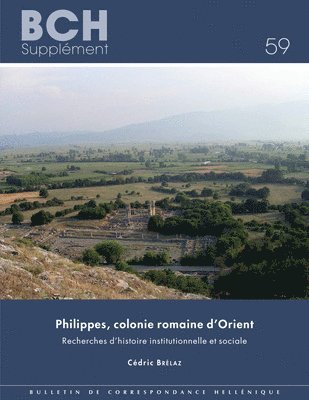
Del 59 - Bulletin de Correspondance Hellénique Suppléments
Philippes, colonie romaine d'Orient
Recherches d'histoire institutionnelle et sociale
Häftad, Franska, 2018
745 kr
Skickas inom 3-6 vardagar
Fondée en terre thrace par le roi Philippe II de Macédoine, la cité grecque de Philippes fut, au cours de l’automne 42 av. J.-C., le théâtre de l’affrontement décisif entre l’armée des républicains Brutus et Cassius et celle des héritiers de César, Antoine et Octave. À l’issue de la bataille, Antoine décida de tirer profit du vaste territoire environnant pour y établir les vétérans des légions qui avaient combattu et pour fonder une colonie romaine. S’appuyant sur une riche documentation épigraphique, ce livre reconstitue la structure et le fonctionnement des institutions de l’entité politique qui fut substituée à la cité grecque à cette occasion, ainsi que la formation des élites dirigeantes de la colonie et les dynamiques démographiques, sociales et culturelles qui animèrent ce groupe durant plus de trois siècles, de la fondation de la colonie à la fin du IIIe s. apr. J.-C. Par le biais de comparaisons avec les autres colonies fondées par Rome dans les provinces orientales de l’Empire, avec les cités grecques et avec les municipes et colonies d’Occident, l’étude s’efforce de replacer Philippes dans le cadre général des communautés locales de l’Empire romain, aussi bien que dans son contexte régional immédiat. À travers l’exemple de Philippes, ce livre montre que, bien loin d’avoir été des images statiques de Rome comme le prétend la formule célèbre d’Aulu-Gelle, les colonies, quoique dotées d’institutions calquées sur un archétype élaboré à Rome, en étaient plutôt des ramifications vivantes et autonomes, sensibles à leur environnement provincial et disposant chacune d’une coloration particulière. Founded on Thracian soil by Macedonian king Philip II, Philippi witnessed the final battle between the Republican army of Brutus and Cassius and the army of Antony and Octavian, the heirs to Caesar. In the aftermath of the battle, which took place in the fall of 42 BCE, Antony decided to take advantage of the large surrounding territory, settling the veterans of the legions who had fought there and founding a Roman colony. Relying on extensive epigraphic evidence, this book explores how the political community that was founded in place of that Greek city was structured and how it functioned, as well as traces the rise of the colony’s ruling elite and the demographic, social, and cultural dynamics of this group over the course of more than three centuries, from the establishment of the colony until the end of the third century CE. Through the systematic comparison of this colony with others that were settled by Rome in the Eastern provinces of the Empire, along with other Greek cities and the Western municipia and colonies, this book places Philippi within the general framework of both the local communities of the Roman Empire and its regional context. Through the example of Philippi, this book argues that, though colonies were provided with set institutions patterned after the Roman model, far from being static copies of Rome as assumed by Gellius, they were living and autonomous offshoots influenced in turn by their provincial environment, and ultimately each colony developed its own specific and unique identity.
Del 61 - Bulletin de Correspondance Hellénique Suppléments
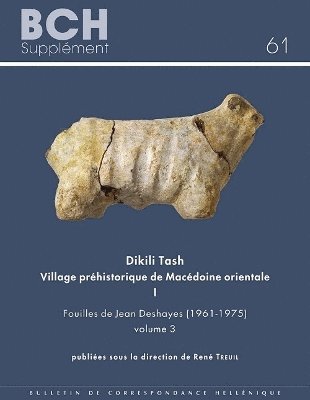
Dikili Tash, village préhistorique de Macédoine orientale I. Fouilles de Jean Deshayes (1961-1975). Volume 3
Häftad, Franska, 2019
941 kr
Skickas inom 3-6 vardagar
Ce volume complète et achève la publication des fouilles de Jean Deshayes (1961-1975) à Dikili Tash. Il fait suite aux deux volumes déjà disponibles. Le premier, paru en 1992, décrivait le site et les fouilles, la stratigraphie et la chronologie, la construction, l'outillage, les moyens de subsistance et les éléments de parure. Le second, paru en 2004, traitait la céramique néolithique (techniques, formes et décors), y compris les récipients zoomorphes et anthropomorphes. Ce troisième volume contient d'abord l'étude des formes et des décors de la céramique du Bronze Ancien et du Bronze Récent. L'âge du Bronze, mal connu en Macédoine orientale, se voit enrichi d'une nouvelle étude précise et fondée sur une stratigraphie bien documentée. Également nouvelle est la publication exhaustive des figurines et des maquettes du Néolithique Moyen au Bronze Récent: il s'agit d'un catalogue complet et raisonné, suivi d'une étude systématique organisée selon les catégories d'objets; l'ensemble est le plus important publié à ce jour. Ces contributions augmentent significativement nos connaissances sur les périodes concernées et proposent des interprétations argumentées. La conclusion générale, qui clôt le volume et la publication des fouilles de J. Deshayes, retrace l'évolution des méthodes de travail et des modes de pensée au fil des différents programmes mis en œuvre à Dikili Tash: elle souligne la réflexion de plus en plus consciente qui, ici comme ailleurs en Macédoine, commande toute la recherche archéologique. This volume completes and rounds off the publication of the excavations of Jean Deshayes (1961-1975) at Dikili Tash. It follows on from the two volumes already available. The first volume, published in 1992, described the site and the excavations, the stratigraphy and the chronology, the construction, the tools, the means of subsistence and the trappings of finery. The second volume, published in 2004, dealt with Neolithic pottery (techniques, forms and decorations), including zoomorphic and anthropomorphic containers. This third volume contains, firstly, the study of the forms and decorations of the ceramics of the Early Bronze and the Late Bronze Ages. The Bronze Age, little known in eastern Macedonia, is thus enriched by a new detailed study based on well-documented stratigraphy. Also new is the comprehensive publication of figurines and models from the Middle Neolithic to the Late Bronze Age: this is a complete and well-reserached catalogue, followed by a systematic study organized according to the catagories of objects; this assemblage is the largest published to date. These contributions significantly add to our knowledge of the periods concerned and propose well-argued interpretations. The general conclusion, which completes the volume and the publication of the excavations of J. Deshayes, traces the evolution of working methods and thought processes involved in the different programmes at Dikili Tash, underlining the increasingly conscious intellectual interrogations that here, as well as elsewhere in Macedonia, pervade all archaeological research.