Complex Networks and Dynamic Systems - Böcker
Visar alla böcker i serien Complex Networks and Dynamic Systems. Handla med fri frakt och snabb leverans.
8 produkter
8 produkter
1 749 kr
Skickas inom 10-15 vardagar
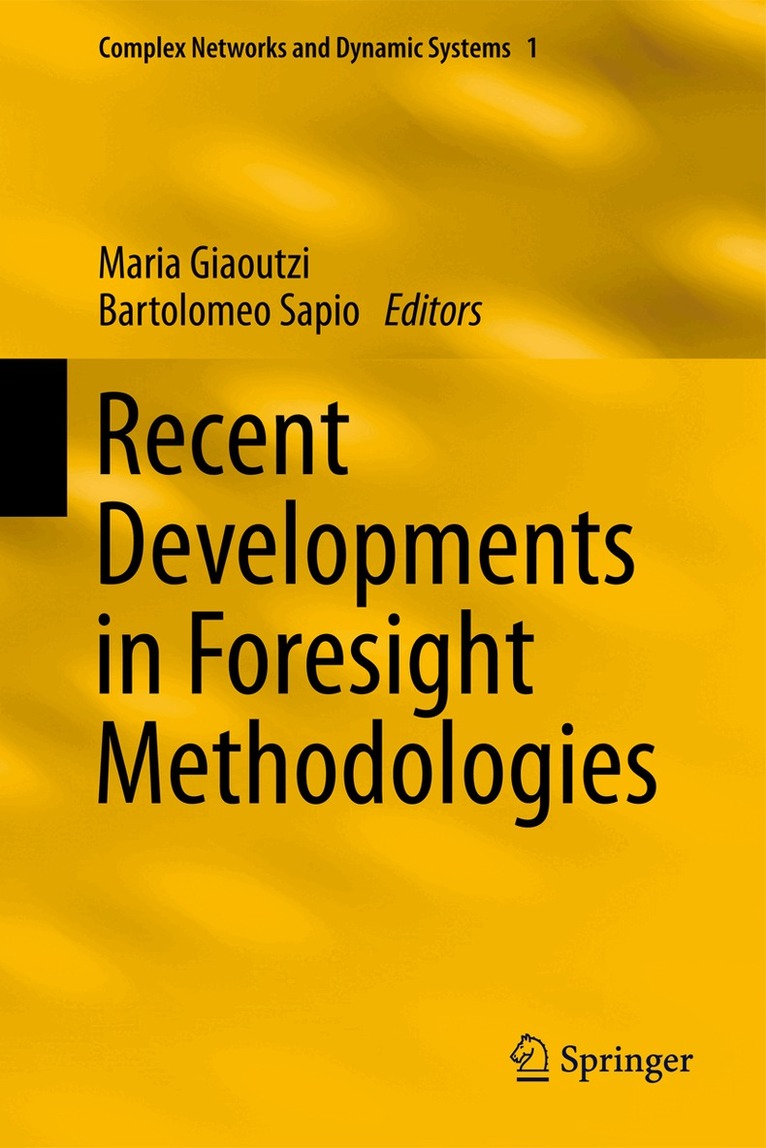
Foresight is an area within Futures Studies that focuses on critical thinking concerning long term developments, whether within the public sector or in industry and management, and is something of a sub-section of complexity and network science. This book examines developments in foresight methodologies and relates in its greater part to the work done in the context of the COSTA22 network of the EU on Foresight Methodologies. Foresight is a professional practice that supports significant decisions, and as such it needs to be more assured of its claims to knowledge (methodology). Foresight is practiced across many domains and is not the preserve of specialized ‘futurists’, or indeed of foresight specialists. However, the disciplines of foresight are not well articulated or disseminated across domains, leading to re-inventions and practice that does not make best use of experience in other domains. The methodological development of foresight is an important task that aims at strengthening the pool of the tools available for application, thereby empowering the actors involved in foresight practice. Elaborating further on methodological issues, such as those presented in the present book, enables the actors involved in foresight to begin to critique current practice from this perspective and, thirdly, to begin to design foresight practice. The present trends towards methodological concerns indicates a move from ‘given’ expert-predicted futures to one in which futures are nurtured through a dialogue among “stakeholders.” The book has four parts, each elaborating on a set of aspects of foresight methodologies. After an introductory section, Part II considers theorizing about foresight methodologies. Part III covers system content issues, and Part IV presents foresight tools and approaches.
1 640 kr
Skickas inom 10-15 vardagar
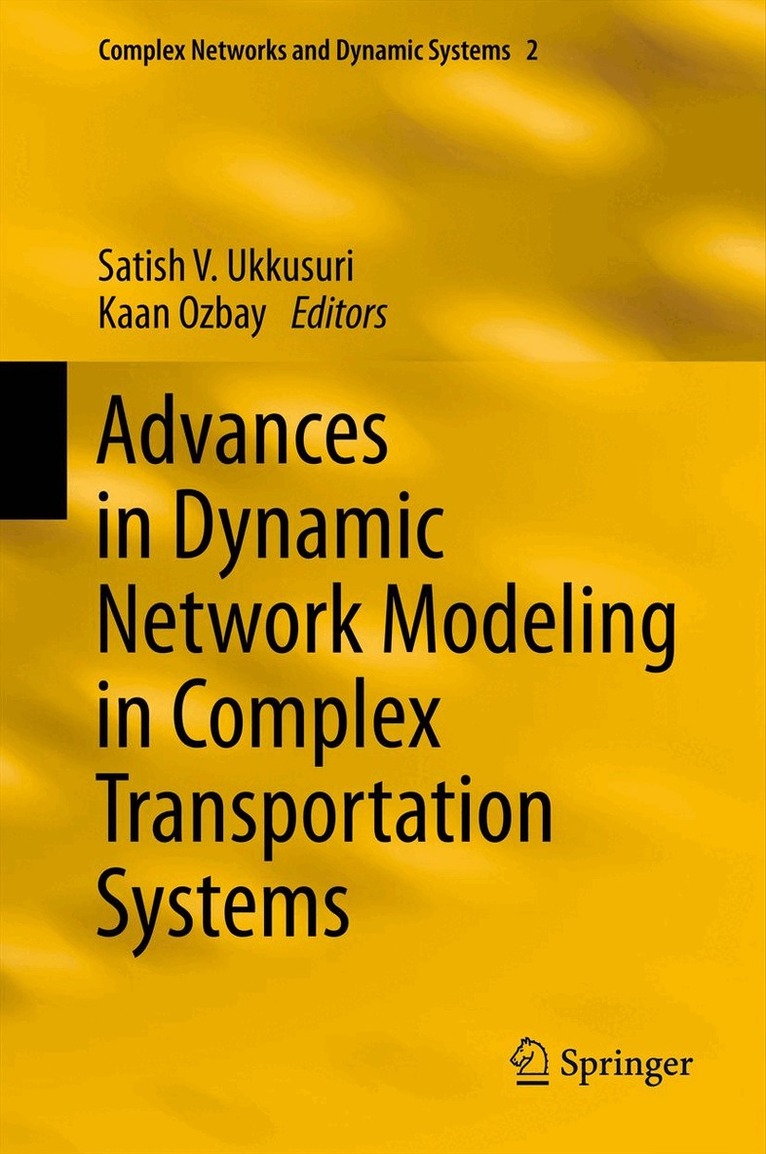
This edited book focuses on recent developments in Dynamic Network Modeling, including aspects of route guidance and traffic control as they relate to transportation systems and other complex infrastructure networks. Dynamic Network Modeling is generally understood to be the mathematical modeling of time-varying vehicular flows on networks in a fashion that is consistent with established traffic flow theory and travel demand theory. Dynamic Network Modeling as a field has grown over the last thirty years, with contributions from various scholars all over the field. The basic problem which many scholars in this area have focused on is related to the analysis and prediction of traffic flows satisfying notions of equilibrium when flows are changing over time. In addition, recent research has also focused on integrating dynamic equilibrium with traffic control and other mechanism designs such as congestion pricing and network design. Recently, advances in sensor deployment, availability of GPS-enabled vehicular data and social media data have rapidly contributed to better understanding and estimating the traffic network states and have contributed to new research problems which advance previous models in dynamic modeling. A recent National Science Foundation workshop on “Dynamic Route Guidance and Traffic Control” was organized in June 2010 at Rutgers University by Prof. Kaan Ozbay, Prof. Satish Ukkusuri , Prof. Hani Nassif, and Professor Pushkin Kachroo. This workshop brought together experts in this area from universities, industry and federal/state agencies to present recent findings in this area. Various topics were presented at the workshop including dynamic traffic assignment, traffic flow modeling, network control, complex systems, mobile sensor deployment, intelligent traffic systems and data collection issues. This book is motivated by the research presented at this workshop and the discussions that followed.
1 749 kr
Skickas inom 10-15 vardagar
Foresight is an area within Futures Studies that focuses on critical thinking concerning long term developments, whether within the public sector or in industry and management, and is something of a sub-section of complexity and network science. This book examines developments in foresight methodologies and relates in its greater part to the work done in the context of the COSTA22 network of the EU on Foresight Methodologies. Foresight is a professional practice that supports significant decisions, and as such it needs to be more assured of its claims to knowledge (methodology). Foresight is practiced across many domains and is not the preserve of specialized ‘futurists’, or indeed of foresight specialists. However, the disciplines of foresight are not well articulated or disseminated across domains, leading to re-inventions and practice that does not make best use of experience in other domains. The methodological development of foresight is an important task that aims at strengthening the pool of the tools available for application, thereby empowering the actors involved in foresight practice. Elaborating further on methodological issues, such as those presented in the present book, enables the actors involved in foresight to begin to critique current practice from this perspective and, thirdly, to begin to design foresight practice. The present trends towards methodological concerns indicates a move from ‘given’ expert-predicted futures to one in which futures are nurtured through a dialogue among “stakeholders.” The book has four parts, each elaborating on a set of aspects of foresight methodologies. After an introductory section, Part II considers theorizing about foresight methodologies. Part III covers system content issues, and Part IV presents foresight tools and approaches.
1 593 kr
Skickas inom 10-15 vardagar
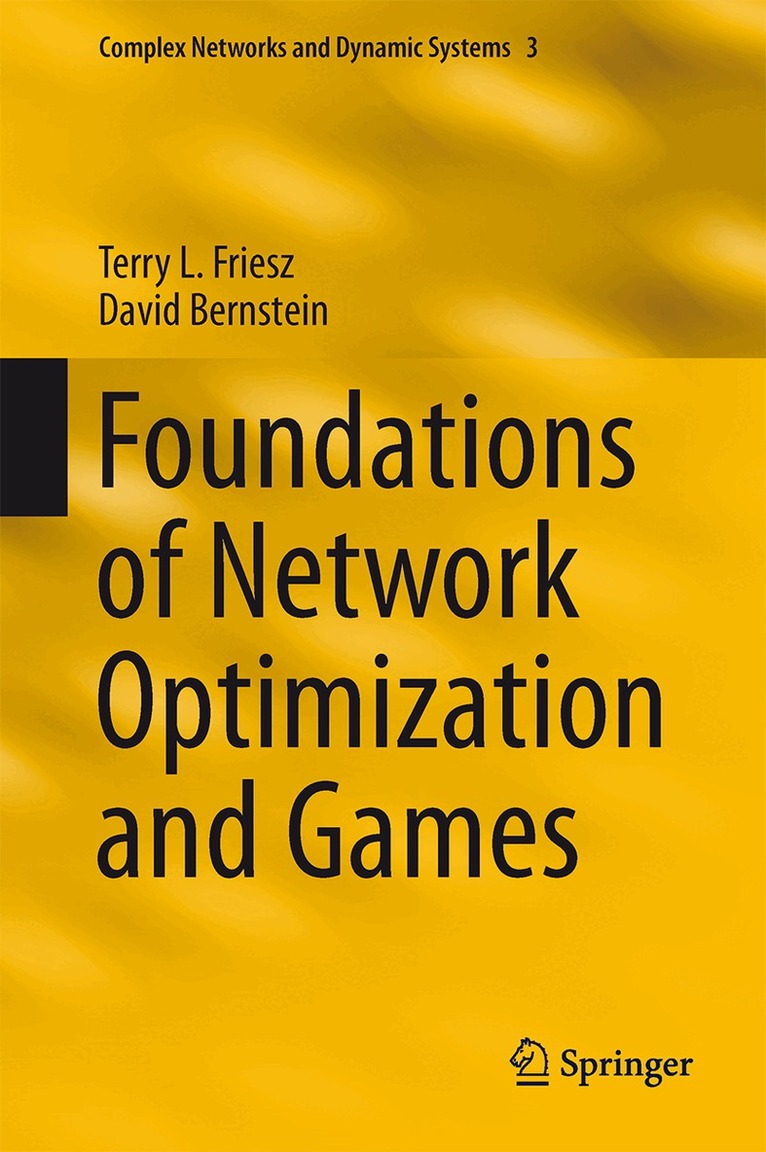
This is a book about infrastructure networks that are intrinsically nonlinear. The networks considered range from vehicular networks to electric power networks to data networks. The main point of view taken is that of mathematical programming in concert with finite-dimensional variational inequality theory. The principle modeling perspectives are network optimization, the theory of Nash games, and mathematical programming with equilibrium constraints. Computational methods and novel mathematical formulations are emphasized. Among the numerical methods explored are network simplex, gradient projection, fixed-point, gap function, Lagrangian relaxation, Dantzig-Wolfe decomposition, simplicial decomposition, and computational intelligence algorithms.Many solved example problems are included that range from simple to quite challenging. Theoretical analyses of several models and algorithms, to uncover existence, uniqueness and convergence properties, are undertaken. The bookis meant for use in advanced undergraduate as well as doctoral courses taught in civil engineering, industrial engineering, systems engineering, and operations research degree programs. At the same time, the book should be a useful resource for industrial and university researchers engaged in the mathematical modeling and numerical analyses of infrastructure networks.
1 640 kr
Skickas inom 10-15 vardagar
This edited book focuses on recent developments in Dynamic Network Modeling, including aspects of route guidance and traffic control as they relate to transportation systems and other complex infrastructure networks. Dynamic Network Modeling is generally understood to be the mathematical modeling of time-varying vehicular flows on networks in a fashion that is consistent with established traffic flow theory and travel demand theory. Dynamic Network Modeling as a field has grown over the last thirty years, with contributions from various scholars all over the field. The basic problem which many scholars in this area have focused on is related to the analysis and prediction of traffic flows satisfying notions of equilibrium when flows are changing over time. In addition, recent research has also focused on integrating dynamic equilibrium with traffic control and other mechanism designs such as congestion pricing and network design. Recently, advances in sensor deployment, availability of GPS-enabled vehicular data and social media data have rapidly contributed to better understanding and estimating the traffic network states and have contributed to new research problems which advance previous models in dynamic modeling. A recent National Science Foundation workshop on “Dynamic Route Guidance and Traffic Control” was organized in June 2010 at Rutgers University by Prof. Kaan Ozbay, Prof. Satish Ukkusuri , Prof. Hani Nassif, and Professor Pushkin Kachroo. This workshop brought together experts in this area from universities, industry and federal/state agencies to present recent findings in this area. Various topics were presented at the workshop including dynamic traffic assignment, traffic flow modeling, network control, complex systems, mobile sensor deployment, intelligent traffic systems and data collection issues. This book is motivated by the research presented at this workshop and the discussions that followed.
Del 4 - Complex Networks and Dynamic Systems
Transportation Analytics in the Era of Big Data
Häftad, Engelska, 2019
1 064 kr
Skickas inom 10-15 vardagar
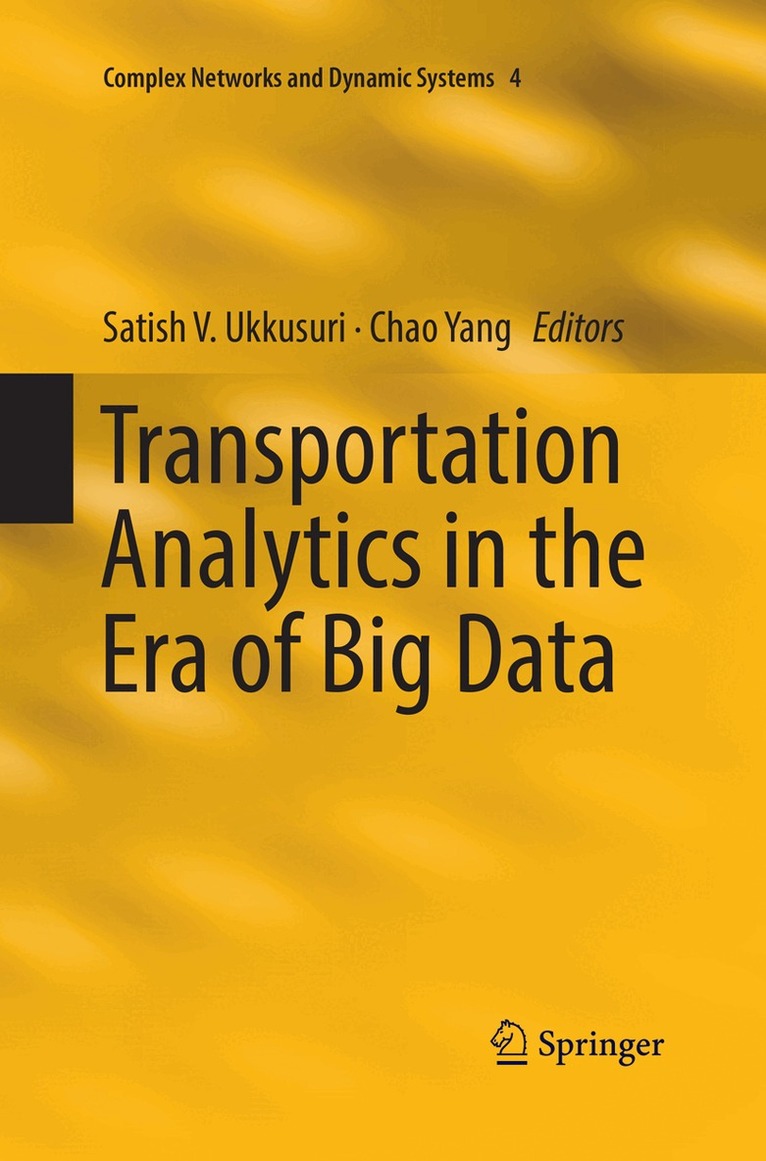
This book presents papers based on the presentations and discussions at the international workshop on Big Data Smart Transportation Analytics held July 16 and 17, 2016 at Tongji University in Shanghai and chaired by Professors Ukkusuri and Yang. The book is intended to explore a multidisciplinary perspective to big data science in urban transportation, motivated by three critical observations:The rapid advances in the observability of assets, platforms for matching supply and demand, thereby allowing sharing networks previously unimaginable.The nearly universal agreement that data from multiple sources, such as cell phones, social media, taxis and transit systems can allow an understanding of infrastructure systems that is critically important to both quality of life and successful economic competition at the global, national, regional, and local levels.There is presently a lack of unifying principles and methodologies that approach big dataurban systems.The workshop brought together varied perspectives from engineering, computational scientists, state and central government, social scientists, physicists, and network science experts to develop a unifying set of research challenges and methodologies that are likely to impact infrastructure systems with a particular focus on transportation issues. The book deals with the emerging topic of data science for cities, a central topic in the last five years that is expected to become critical in academia, industry, and the government in the future. There is currently limited literature for researchers to know the opportunities and state of the art in this emerging area, so this book fills a gap by synthesizing the state of the art from various scholars and help identify new research directions for further study.
Del 5 - Complex Networks and Dynamic Systems
Dynamic Network User Equilibrium
Inbunden, Engelska, 2023
1 422 kr
Skickas inom 10-15 vardagar
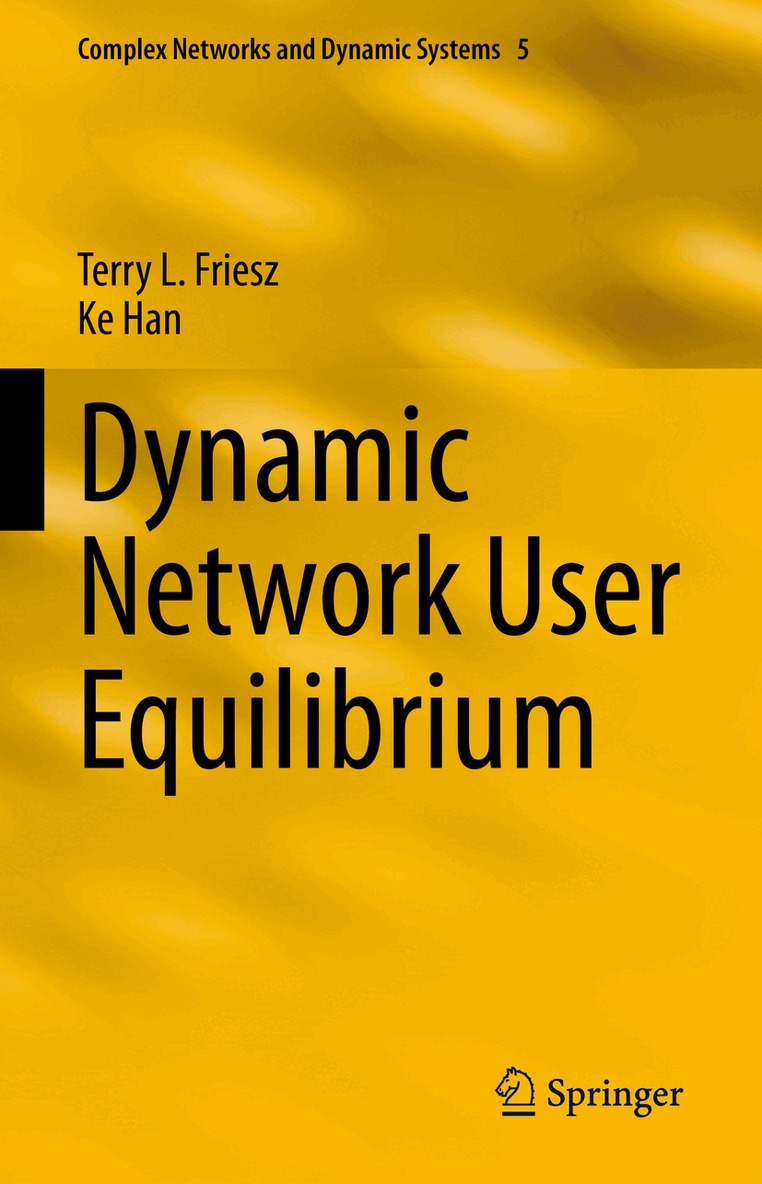
This book presents advanced research in a relatively new field of scholarly inquiry that is usually referred to as dynamic network user equilibrium, now almost universally abbreviated as DUE. It provides the first synthesis of results obtained over the last decade from applying the differential variational inequality (DVI) formalism to study the DUE problem. In particular, it explores the intimately related problem of dynamic network loading, which determines the arc flows and effective travel delays (or generalized travel costs) arising from the expression of departure rates at the origins of commuter trips between the workplace and home.In particular, the authors show that dynamic network loading with spillback of queues into upstream arcs may be formulated as a differential algebraic equation system. They demonstrate how the dynamic network loading problem and the dynamic traffic user equilibrium problem may be solved simultaneously rather than sequentially, as well as how the first-in-first-out queue discipline may be maintained for each when Lighthill-Whitham-Richardson traffic flow theory is used. A number of recent and new extensions of the DVI-based theory of DUE and corresponding examples are presented and discussed. Relevant mathematical background material is provided to make the book as accessible as possible.
Del 4 - Complex Networks and Dynamic Systems
Transportation Analytics in the Era of Big Data
Inbunden, Engelska, 2018
1 487 kr
Skickas inom 10-15 vardagar
This book presents papers based on the presentations and discussions at the international workshop on Big Data Smart Transportation Analytics held July 16 and 17, 2016 at Tongji University in Shanghai and chaired by Professors Ukkusuri and Yang. The book is intended to explore a multidisciplinary perspective to big data science in urban transportation, motivated by three critical observations:The rapid advances in the observability of assets, platforms for matching supply and demand, thereby allowing sharing networks previously unimaginable.The nearly universal agreement that data from multiple sources, such as cell phones, social media, taxis and transit systems can allow an understanding of infrastructure systems that is critically important to both quality of life and successful economic competition at the global, national, regional, and local levels.There is presently a lack of unifying principles and methodologies that approach big dataurban systems.The workshop brought together varied perspectives from engineering, computational scientists, state and central government, social scientists, physicists, and network science experts to develop a unifying set of research challenges and methodologies that are likely to impact infrastructure systems with a particular focus on transportation issues. The book deals with the emerging topic of data science for cities, a central topic in the last five years that is expected to become critical in academia, industry, and the government in the future. There is currently limited literature for researchers to know the opportunities and state of the art in this emerging area, so this book fills a gap by synthesizing the state of the art from various scholars and help identify new research directions for further study.