Computational Geophysics - Böcker
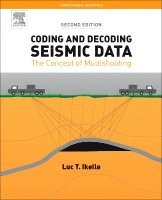
Coding and Decoding: Seismic Data
The Concept of Multishooting
1 690 kr
Skickas inom 7-10 vardagar
Coding and Decoding Seismic Data: The Concept of Multishooting, Volume One, Second Edition, offers a thorough investigation of modern techniques for collecting, simulating, and processing multishooting data. Currently, the acquisition of seismic surveys is performed as a sequential operation in which shots are computed separately, one after the other. The cost of performing various shots simultaneously is almost identical to that of one shot; thus, the benefits of using the multishooting approach for computing seismic surveys are enormous.
By using this approach, the longstanding problem of simulating a three-dimensional seismic survey can be reduced to a matter of weeks. Providing both theoretical and practical explanations of the multishooting approach, including case histories, this book is an essential resource for exploration geophysicists and practicing seismologists.
Investigates how to collect, stimulate, and process multishooting data Addresses the improvements in seismic characterization and resolution that can be expected from multishooting data Provides information for the oil and gas exploration and production business that will influence day-to-day surveying techniques Covers robust decoding methods of undetermined mixtures, nonlinear decoding, the use of constraints in decoding processes, and nonlinear imaging of undecoded data Includes access to a companion site with answers to questions posed in the bookAdvantages and Pitfalls of Pattern Recognition
Selected Cases in Geophysics
1 410 kr
Skickas inom 7-10 vardagar
Advantages and Pitfalls of Pattern Recognition presents various methods of pattern recognition and classification, useful to geophysicists, geochemists, geologists, geographers, data analysts, and educators and students of geosciences. Scientific and technological progress has dramatically improved the knowledge of our planet with huge amounts of digital data available in various fields of Earth Sciences, such as geology, geophysics, and geography. This has led to a new perspective of data analysis, requiring specific techniques that take several features into consideration rather than single parameters. Pattern recognition techniques offer a suitable key for processing and extracting useful information from the data of multivariate analysis. This book explores both supervised and unsupervised pattern recognition techniques, while providing insight into their application.
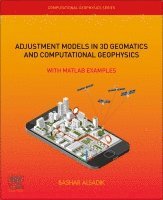
Offers real-world examples of techniques for pattern recognition and handling multivariate data Includes examples, applications, and diagrams to enhance understanding Provides an introduction and access to relevant software packagesAdjustment Models in 3D Geomatics and Computational Geophysics
With MATLAB Examples
1 446 kr
Skickas inom 7-10 vardagar
Adjustment Models in 3D Geomatics and Computational Geophysics: With MATLAB Examples, Volume Four introduces a complete package of theoretical and practical subjects in adjustment computations relating to Geomatics and geophysical applications, particularly photogrammetry, surveying, remote sensing, GIS, cartography, and�geodesy. Supported by illustrating figures and solved examples with MATLAB codes, the book provides clear methods for processing 3D data for accurate and reliable results. Problems cover free net adjustment, adjustment with constraints, blunder detection, RANSAC, robust estimation, error propagation, 3D co-registration, image pose determination, and more.
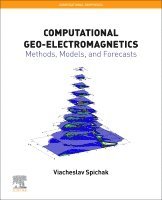
Covers both the theory and practice of using adjustment techniques in a wide variety of modern applications in Geomatics Presents topics on the Kalman filter, Robust estimation, Levenberg Marquardt technique, and many other vital applications in the context of Geomatics and photogrammetry Provides 75 solved problems in detail, especially related to 3-dimensional applications of Geomatics Offers MATLAB codes to strengthen understanding and give readers up-to-date knowledge on information scienceComputational Geo-Electromagnetics
Methods, Models, and Forecasts
1 446 kr
Skickas inom 7-10 vardagar
Computational Geo-Electromagnetics: Methods, Models, and Forecasts, Volume Five in the Computational Geophysics series, is devoted to techniques for building of geoelectrical models from electromagnetic data, featuring Bayesian statistical analysis and neural network algorithms. These models are applied to studying the geoelectrical structure of famous volcanoes (i.e., Vesuvio, Kilauea, Elbrus, Komagatake, Hengill) and geothermal zones (i.e., Travale, Italy; Soultz-sous-Forets, Elsace). Methodological recommendations are given on electromagnetic sounding of faults as well as geothermal and hydrocarbon reservoirs. Techniques for forecasting of petrophysical properties from the electrical resistivity as proxy parameter are also considered.
Computational Geo-Electromagnetics: Methods, Models, and Forecasts offers techniques and algorithms for building geoelectrical models under conditions of rare or irregularly distributed EM data and/or lack of prior geological and geophysical information. This volume also includes methodological guidelines on interpretation of electromagnetic sounding data depending on goals of the study. Finally, it details computational algorithms for using electrical resistivity for properties beyond boreholes.
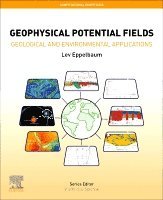
Provides algorithms for inversion of incomplete, rare or irregularly distributed EM data Features methodological issues of building geoelectrical models Offers techniques for retrieving petrophysical properties from EM sounding data and well logsGeophysical Potential Fields
Geological and Environmental Applications
1 446 kr
Skickas inom 7-10 vardagar
Geophysical Potential Fields: Geological and Environmental Applications, Volume Two, investigates the similarities and differences of potential geophysical fields, including gravity, magnetics, temperature, resistivity and self-potential, along with the influence of noise on these fields. As part of the Computational Geophysics series, this volume provides computational examples and methods for effectively solving geophysical problems in a full cycle manner. Including both quantitative and qualitative analysis, the book offers different filtering and transformation procedures, integrated analysis, and special interpretation methodologies, also presenting a developed 3D algorithm for combined modeling of gravity and magnetic fields in complex environments.
The book also includes applications of the unified potential field system, such as studying deep structure, searching hydrocarbon and ore deposits, localizing buried water horizons and rockslide areas, tectono-structural mapping of water basins, and classifying archaeological targets. It is an ideal and unique resource for geophysicists, exploration geologists, archaeologists and environmental scientists.
Clearly demonstrates the successive stages of geophysical field analysis for different geological and environmental targets Provides a unified system for potential geophysical field analysis that is demonstrated by numerous examples of system application Demonstrates the possibilities for rapidly and effectively interpreting anomalies, receiving some knowledge of modern wavelet, diffusion maps and informational approach applications in geophysics, and combined gravity-magnetic methodology of 3D modeling Includes text of the Geological Space Field Calculation (GSFC) software intended for 3D combined modeling of gravity and magnetic fields in complex environments