Critical Perspectives in the History of Environmental Design – serie
Visar alla böcker i serien Critical Perspectives in the History of Environmental Design. Handla med fri frakt och snabb leverans.
3 produkter
3 produkter
678 kr
Skickas inom 3-6 vardagar
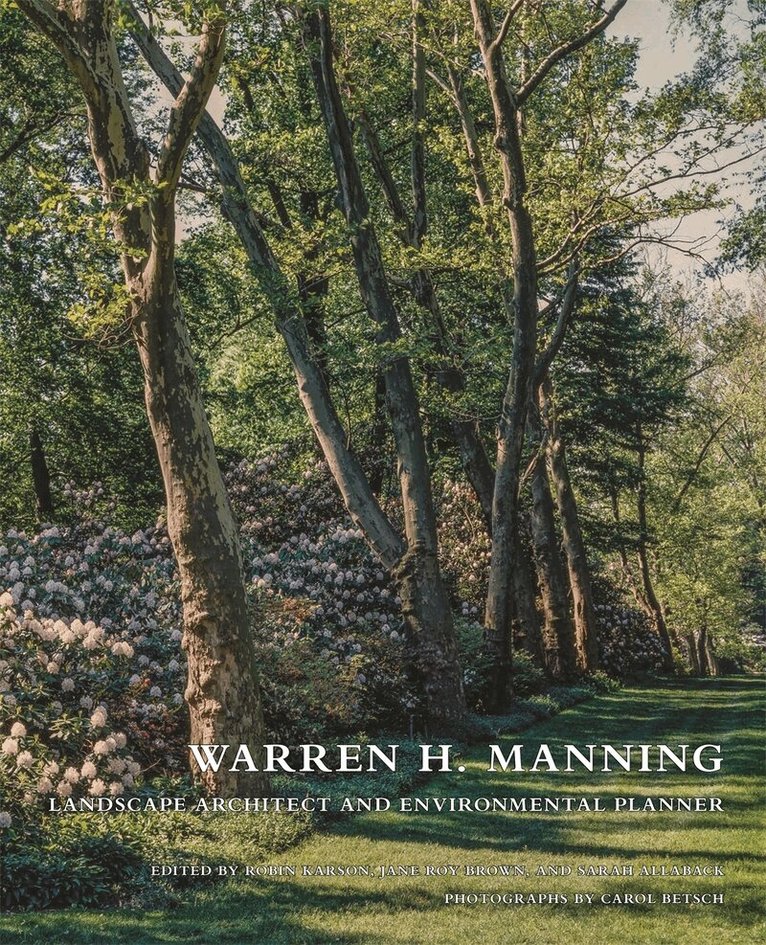
Warren H. Manning’s (1860–1938) national practice comprised more than sixteen hundred landscape design and planning projects throughout North America, from small home grounds to estates, cemeteries, college campuses, parks and park systems, and new industrial towns. Manning approached his design and planning projects from an environmental perspective, conceptualizing projects as components of larger regional (in some cases, national) systems, a method that contrasted sharply with those of his stylistically oriented colleagues. In this regard, as in many others, Manning had been influenced by his years with the Olmsted firm, where the foundations of his resource-based approach to design were forged. Manning’s overlay map methods, later adopted by the renowned landscape architect Ian McHarg, providedthe basis for computer mapping software in widespread use today.One of the eleven founders of the American Society of Landscape Architects, Manning also ran one of the nation’s largest offices, where he trained several influential designers, including Fletcher Steele, A. D. Taylor, Charles Gillette, and Dan Kiley. After Manning’s death, his reputation slipped into obscurity. Contributors to the Warren H. Manning Research Project have worked more than a decade to assess current conditions of his built projects and to compile a richly illustrated compendium of site essays that illuminate the range, scope, and significance of Manning’s notable career with specially commissioned photographs by Carol Betsch.
775 kr
Skickas inom 3-6 vardagar
When Sidney J. Hare (1860–1938) and S. Herbert Hare (1888–1960) launched their Kansas City firm in 1910, they founded what would become the most influential landscape architecture and planning practice in the Midwest. Over time, their work became increasingly far-ranging, in both its geographical scope and its project types. Between 1924 and 1955, Hare & Hare commissions included fifty-four cemeteries in fifteen states; numerous city and state parks (seventeen in Missouri alone); more than fifteen subdivisions in Salt Lake City; the Denver neighborhood of Belcaro Park; the picturesque grounds of the Christian Science Sanatorium in Chestnut Hill, Massachusetts; and the University of Texas at Austin among fifty-one college and university campuses.In Hare & Hare: Landscape Architects and City Planners Carol Grove and Cydney Millstein document the extraordinary achievements of this little-known firm and weave them into a narrative that spans from the birth of the late nineteenth-century “modern cemetery movement” to midcentury modernism. Through the figures of Sidney, a “homespun” amateur geologist who built a rustic family retreat called Harecliff, and his son Herbert, an urbane Harvard-trained landscape architect who traveled Europe and lived in a modern apartment building, Grove and Millstein chronicle the growth of the field from its amorphous Victorian beginnings to its coalescence as a profession during the first half of the twentieth century. Hare & Hare provides a unique and valuable parallel to studies of prominent East and West Coast landscape architecture firms—one that expands the reader’s understanding of the history of American landscape architecture practice.
275 kr
Skickas inom 5-8 vardagar